In today’s digital world, children spend more time than ever on tablets, smartphones, computers, and televisions. While technology certainly has educational benefits, many parents are looking for ways to develop strong reading habits without increasing screen time.
One of the most effective ways to build literacy skills is through engaging in phonics games. Children learn best when they are actively involved, moving, exploring, speaking, and playing. The good news is that many powerful reading activities require nothing more than simple household materials and a little creativity.
Whether you’re a parent, homeschool educator, tutor, or teacher, these screen-free games can help children develop phonics sounds, improve reading confidence, strengthen vocabulary, and support long-term literacy success.
Many families who use Jolly Phonics, Hooked on Phonics Kindergarten, homeschooling programs, and structured literacy approaches regularly incorporate games because children remember concepts more effectively when learning feels like play.
Parents interested in professional phonics instruction can learn more at:
Easy Teach Academy:
https://easyteachacademy.com/
Online Phonics Program:
https://easyteachacademy.com/best-online-phonics-classes-for-kids-and-adults/
Why Screen-Free Phonics Activities Matter
Children develop important skills when learning away from screens:
- Active listening
- Concentration
- Memory
- Communication
- Problem-solving
- Social interaction
- Creativity
Screen-free phonics activities also encourage children to move, touch, sort, speak, and interact with learning materials.
Research consistently shows that hands-on learning supports stronger literacy development during the early years.
How Phonics Games Support Reading Development
Good phonics games help children:
- Recognize letter patterns
- Learn phonics sounds
- Build vocabulary
- Improve spelling
- Increase fluency
- Develop decoding skills
- Strengthen reading confidence
Most importantly, games help children associate reading with enjoyment rather than frustration.
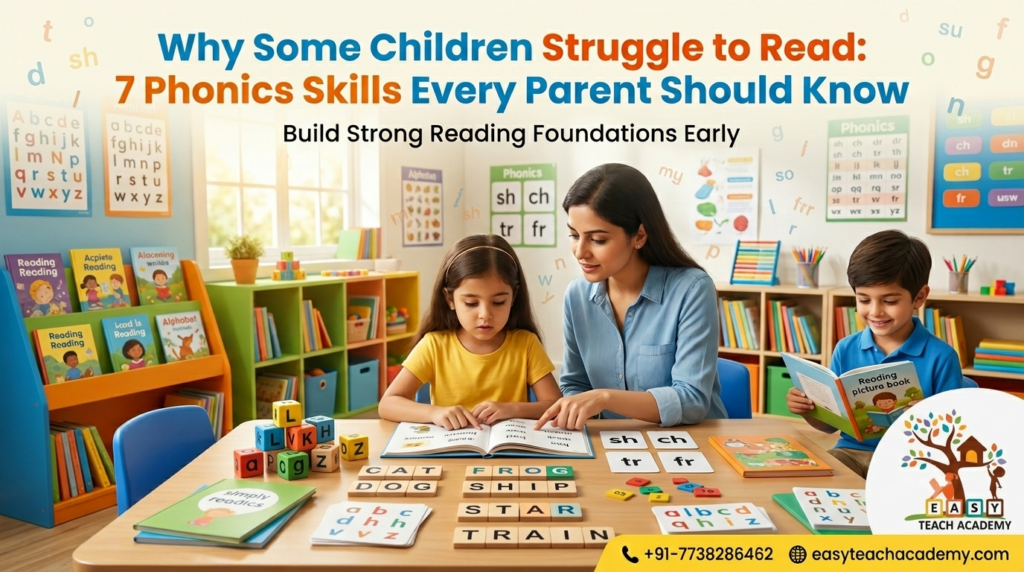
IMAGE IDEA FOR THE BLOG
Place an image here showing children playing word-building games with letter cards, alphabet blocks, picture cards, and phonics matching activities.
Suggested Alt Text:
“Children enjoying screen-free phonics games and literacy activities”
Game 1: Sound Treasure Hunt
Choose a target sound.
Example:
/b/
Children search the house for objects beginning with that sound.
Examples:
- basket
- book
- bottle
- brush
This develops sound awareness and observation skills.
Game 2: Alphabet Hop
Write letters on paper and place them on the floor.
Call out a sound.
Children jump onto the correct letter.
Example:
Teacher says:
“/m/”
Child jumps onto M.
This activity combines movement with learning.
Game 3: Mystery Bag
Place objects inside a cloth bag.
Examples:
- toy car
- spoon
- pencil
- key
Children pull out an object and identify its beginning sound.
Game 4: Build-A-Word Race
Provide magnetic letters.
Say a simple word.
Example:
dog
Children build:
d-o-g
This strengthens spelling and decoding skills.
Game 5: Rhyming Basket Challenge
Place picture cards in a basket.
Children sort cards according to rhyming patterns.
Example:
cat, hat, bat
tree, bee, key
Rhyming develops phonological awareness.
Game 6: Phonics Bowling
Write letters on plastic cups.
Roll a soft ball.
When a cup falls, the child says the letter sound.
This activity is especially popular with energetic learners.
Game 7: Sound Detective
Give children a magnifying glass.
Ask them to find items beginning with a specific sound.
Example:
Find three objects that start with /s/.
This turns learning into an adventure.
Game 8: Word Family House
Create paper houses labeled:
- at
- an
- ip
- og
Children place words inside the correct house.
Example:
cat → at house
dog → og house
This teaches word families effectively.
Game 9: Letter Fishing
Attach paper clips to letter cards.
Use a toy fishing rod with a magnet.
Children “catch” letters and say the sounds.
A wonderful activity for younger learners.
Game 10: Sound Sorting Boxes
Prepare boxes labeled:
B
M
T
Children sort picture cards into the correct box.
This reinforces beginning sound recognition.
Game 11: Hidden Word Hunt
Hide word cards around a room.
Children search and read each word they find.
Examples:
- sun
- map
- pig
- red
This combines movement with reading practice.
Game 12: Syllable Clap Challenge
Say a word.
Children clap the number of syllables.
Examples:
Apple = 2 claps
Elephant = 3 claps
Butterfly = 3 claps
This strengthens phonological awareness.
Game 13: Phonics Bingo
Create bingo boards with letters, sounds, or simple words.
Call out:
“/ch/”
Children cover the matching sound.
A highly effective classroom and homeschool activity.
Game 14: Word Building With Blocks
Write letters on building blocks.
Children use blocks to create words.
Examples:
- ship
- frog
- train
- clock
This helps children visualize word structures.
Game 15: Sentence Builder Cards
Prepare word cards.
Example:
The
dog
runs
fast
Children arrange cards into complete sentences.
This develops reading fluency and grammar awareness.
Game 16: Sound Relay Race
Place letter cards at one end of the room.
Call out a sound.
Children run and collect the matching letter.
Excellent for group learning.
Game 17: Picture Match Challenge
Prepare:
- picture cards
- word cards
Children match each picture to the correct word.
Example:
Picture: apple
Word: apple
This builds vocabulary and word recognition.
Game 18: Secret Sound Spy
Choose a target sound.
Example:
/p/
Throughout the day, children identify words containing that sound.
Examples:
- pencil
- paper
- pizza
- paint
This activity encourages continuous learning.
Game 19: Story Sequence Cards
Read a short story.
Provide picture cards representing story events.
Children arrange events in the correct order.
This supports important reading comprehension strategies and story understanding.
Game 20: Create Your Own Mini Book
Children fold paper to create a small book.
They write simple words and draw matching pictures.
Examples:
Page 1: cat
Page 2: dog
Page 3: sun
Page 4: fish
Creating books increases ownership and enthusiasm for reading.
How Jolly Phonics Makes Learning Fun
Many parents choose Jolly Phonics because it combines:
- Songs
- Stories
- Actions
- Visual learning
- Multi-sensory activities
Children often remember sounds more easily when physical actions are linked to each letter sound.
This approach transforms phonics practice into an enjoyable experience.
Using Phonics Worksheets Alongside Games
While games are valuable, phonics worksheets can reinforce learning.
Examples include:
- Letter tracing
- Sound matching
- Word family practice
- Missing letter activities
- Picture-word matching
A balanced combination of games and worksheets often produces excellent results.
Homeschooling Phonics: Why Games Are Essential
Families using homeschooling phonics programs frequently rely on games because they:
- Maintain motivation
- Reduce boredom
- Encourage participation
- Adapt to different learning styles
Games help transform lessons into meaningful experiences rather than repetitive drills.
Supporting Summer Learning
Many children experience learning loss during long school breaks.
Participating in summer reading skills programs can help maintain progress.
Parents can:
- Read daily
- Play phonics games
- Use phonics worksheets
- Visit libraries
- Encourage storytelling
Even 15–20 minutes of daily literacy practice can make a significant difference.
Hooked on Phonics Kindergarten and Game-Based Learning
Many parents explore Hooked on Phonics Kindergarten programs because they combine structured instruction with engaging activities.
Successful reading programs typically include:
- Sound practice
- Word building
- Reading games
- Story reading
- Fluency development
The most effective programs make learning enjoyable while maintaining educational goals.
Building Reading Comprehension Through Play
Strong readers do more than decode words.
They understand what they read.
Useful reading comprehension strategies include:
Prediction
Ask:
“What do you think will happen next?”
Character Discussion
Ask:
“Why did the character make that choice?”
Summarization
Ask:
“Can you tell the story in your own words?”
Visualisation
Ask:
“What picture do you imagine while reading?”
These strategies help children become thoughtful readers.
When to Seek Reading Support
Some children benefit from additional guidance.
Consider professional help if your child:
- Struggles to learn letter sounds
- Avoids reading
- Frequently guesses words
- Has difficulty blending sounds
- Shows limited progress despite practice
Professional reading comprehension tutoring and phonics instruction can provide targeted support.
Frequently Asked Questions
At what age should children start phonics games?
Most children can begin simple phonics games between ages 3 and 5.
Are phonics games effective?
Yes. Games improve engagement, memory, and skill retention.
Can games replace formal phonics lessons?
Games work best when combined with structured phonics instruction.
Are phonics worksheets still useful?
Yes. Worksheets provide valuable reinforcement when used appropriately.
How often should children practice?
Daily practice of 10–20 minutes is often enough to build consistent progress.
Final Thoughts
Children do not need screens to become successful readers. Simple, engaging phonics games, hands-on phonics activities, and meaningful literacy experiences can dramatically improve reading development. Whether you are teaching at home, supporting a homeschool program, or supplementing school learning, these activities help children strengthen phonics sounds, vocabulary, fluency, and comprehension.
By combining games, reading practice, phonics worksheets, and effective reading comprehension strategies, parents can create enjoyable learning experiences that support lifelong reading success.
For expert-led online phonics instruction, visit:
Website: https://easyteachacademy.com/
Program Details:
https://easyteachacademy.com/best-online-phonics-classes-for-kids-and-adults/
Phone/WhatsApp: +91-7738286462