Imagine a child reading a simple story:
“The dog ran to the park and played with his friend.”
Some children read this sentence smoothly and confidently.
Others stop frequently:
“The… dog… ran… to… the…”
The difference often comes down to sight words.
Sight words are among the most frequently used words in the English language. They appear repeatedly in books, worksheets, classroom materials, websites, and everyday reading experiences. When children can recognize these words instantly, reading becomes faster, smoother, and far less frustrating.
Many beginning readers spend so much energy trying to decode common words that they lose track of the meaning of the sentence. Learning sight words reduces this burden and allows children to focus on understanding what they read.
In this comprehensive guide, we’ll explore:
- What sight words are
- Why they matter
- The 100 most common sight words every child should know
- Effective teaching methods
- Creative practice activities
- Common mistakes parents make
- Ways sight words help children improve reading comprehension
Parents seeking professional literacy support can learn more at:
🌐 https://easyteachacademy.com/
📚 https://easyteachacademy.com/best-online-phonics-classes-for-kids-and-adults/
What Are Sight Words?
Sight words are high-frequency words that children learn to recognize instantly without needing to sound them out every time.
Examples include:
- the
- and
- was
- said
- come
- where
- here
These words appear so frequently in written English that automatic recognition significantly improves reading fluency.
Think about driving a car.
When you see a STOP sign, you don’t sound out:
S-T-O-P
You recognize the word immediately.
The same principle applies to sight words.
Readers who instantly recognize common words can focus more attention on understanding the meaning of a text.
Why Sight Words Matter More Than Many Parents Realize
A surprising percentage of children’s books contain the same small group of words repeatedly.
For example:
“The”
appears thousands of times in children’s reading materials.
If a child must decode “the” every time it appears, reading becomes slow and exhausting.
However, when the word is recognized automatically, reading becomes more natural.
Strong sight word recognition helps children:
- read more fluently
- read with confidence
- understand stories better
- develop stronger vocabulary
- enjoy reading more
Most importantly, it helps children improve reading comprehension because their brains can focus on meaning instead of decoding every word.
Sight Words vs Phonics: Do Children Need Both?
Some parents mistakenly believe sight words and phonics compete with each other.
In reality, they work together.
Phonics teaches children how sounds and letters combine to form words.
Sight word instruction helps children recognize frequently occurring words quickly.
Consider these examples:
Word Easily Decoded Through Phonics
- jump
- flag
- swim
- plant
Common Sight Words
- the
- was
- said
- could
Strong readers develop both skills.
A good phonics tutor understands how to balance phonics instruction with sight word practice.
The 100 Most Common Sight Words Every Child Should Know
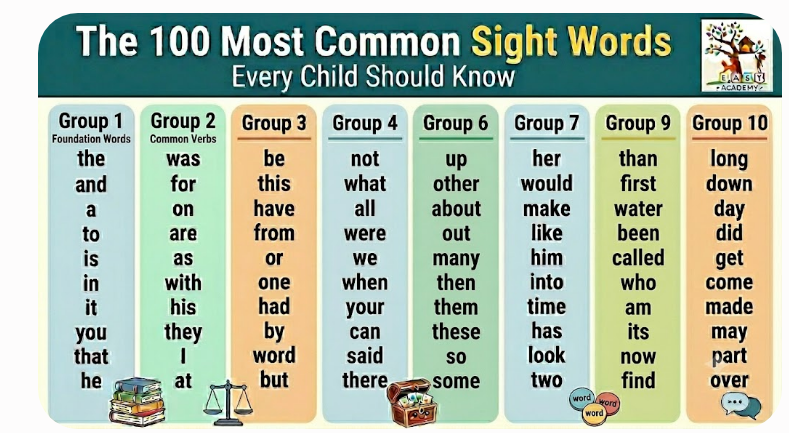
Group 1: Foundation Words
- the
- and
- a
- to
- is
- in
- it
- you
- that
- he
Group 2
- was
- for
- on
- are
- as
- with
- his
- they
- I
- at
Group 3
- be
- this
- have
- from
- or
- one
- had
- by
- word
- but
Group 4
- not
- what
- all
- were
- we
- when
- your
- can
- said
- there
Group 5
- use
- an
- each
- which
- she
- do
- how
- their
- if
- will
Group 6
- up
- other
- about
- out
- many
- then
- them
- these
- so
- some
Group 7
- her
- would
- make
- like
- him
- into
- time
- has
- look
- two
Group 8
- more
- write
- go
- see
- number
- no
- way
- could
- people
- my
Group 9
- than
- first
- water
- been
- called
- who
- am
- its
- now
- find
Group 10
- long
- down
- day
- did
- get
- come
- made
- may
- part
- over
How Sight Words Improve Reading Speed
Imagine reading this sentence:
“The children were playing near the river when they found a small turtle.”
A child who instantly recognizes:
- the
- were
- they
- a
- when
can focus on:
- children
- playing
- river
- found
- turtle
This makes reading smoother and more enjoyable.
A Real-Life Reading Example
Consider two students.
Student A
Recognizes only a few sight words.
Reading speed:
Slow
Confidence:
Low
Comprehension:
Limited
Student B
Recognizes most common sight words automatically.
Reading speed:
Faster
Confidence:
Higher
Comprehension:
Stronger
This demonstrates why sight word mastery matters.
Common Mistakes Parents Make When Teaching Sight Words
Teaching Too Many Words at Once
Introducing 30 new words in one week often overwhelms children.
A better approach:
- 3 words per week
- 5 words per week
- gradual review
Ignoring Context
Some parents teach sight words only through flashcards.
Children also need to see words inside sentences.
Example:
Word:
“where”
Sentence:
“Where is my backpack?”
Meaning becomes clearer.
10 Creative Ways to Practice Sight Words
1. Sight Word Detective
Hide sight words around the house.
Children search and read each one.
2. Sight Word Chef
Create pretend recipes using sight words.
Example:
Mix:
- the
- and
- come
to complete funny instructions.
3. Word Building Wall
Create a wall displaying newly learned words.
Children review them daily.
4. Story Completion Challenge
Leave blanks in a story.
Children insert correct sight words.
5. Word Treasure Chest
Collect mastered words in a special box.
Each new word becomes a “treasure.”
6. Reading Race
Read sight words against a timer.
Focus on accuracy rather than speed.
7. Sidewalk Word Path
Write words with chalk outdoors.
Children read while moving from word to word.
8. Family Reading Challenge
Choose five sight words for everyone to use during conversations.
9. Word Art Activity
Decorate sight words with colors and illustrations.
10. Story Creation Game
Use random sight words to create imaginative stories.
How Sight Words Support Reading Comprehension
Many parents focus only on reading accuracy.
However, understanding text is equally important.
Strong sight word recognition helps children:
- process information faster
- follow story events
- remember details
- answer questions accurately
Children who instantly recognize common words can devote more mental energy to understanding meaning.
This directly helps improve reading comprehension.
When Children Need Extra Help With Reading Comprehension
Some children can read words correctly but struggle to explain what they have read.
Signs include:
- forgetting story details
- difficulty answering questions
- misunderstanding instructions
- limited recall
Parents seeking help with reading comprehension should focus on both word recognition and discussion.
Questions such as:
- Why did the character make that choice?
- What happened first?
- What might happen next?
encourage deeper thinking.
Sight Words and Older Learners
Sight word practice is not only for young children.
Many older learners benefit from reviewing common high-frequency vocabulary.
Even adults improving literacy may use programs such as Hooked on Phonics for Adults to strengthen reading skills.
Building automatic word recognition supports readers at every age.
Sight Words and Academic Success
Strong sight word knowledge benefits children far beyond primary school.
Students preparing for challenging assessments often need excellent reading skills.
For example, learners working through a TEAS Reading Practice Test must quickly process written information and identify key details.
Automatic word recognition helps students read more efficiently.
The Role of Online Reading Programs
Many families now use online reading comprehension programs alongside traditional reading instruction.
These programs can provide:
- guided reading practice
- comprehension exercises
- vocabulary development
- progress tracking
However, nothing replaces daily reading and meaningful conversations about books.
When Should Parents Consider a Phonics Tutor?
A qualified phonics tutor may be helpful when a child:
- struggles to recognize common words
- avoids reading
- reads very slowly
- lacks confidence
- falls behind classmates
Early support often prevents future difficulties.
Frequently Asked Questions
How many sight words should children learn first?
Start with 20–25 high-frequency words before gradually expanding.
Are sight words more important than phonics?
No. Both skills are essential and work together.
How often should children practice sight words?
Short daily practice sessions usually produce the best results.
Can older children benefit from sight word review?
Yes. Automatic recognition continues to support fluency and comprehension.
Do sight words help reading comprehension?
Absolutely. Faster word recognition allows children to focus on understanding meaning.
Final Thoughts
Sight words form an important part of every child’s reading journey. By recognizing common words instantly, children read more smoothly, understand stories more easily, and gain confidence as readers.
While phonics teaches children how words work, sight words help make reading efficient and enjoyable. Together, these skills create strong, capable readers who are prepared for academic success.
Whether your child is just beginning to read or needs additional support, consistent sight word practice can make a remarkable difference.
Help Your Child Become a Stronger Reader
Easy Teach Academy offers engaging online reading and phonics instruction designed to strengthen fluency, comprehension, vocabulary, and confidence.
🌐 Website:
https://easyteachacademy.com/
📚 Learn More:
https://easyteachacademy.com/best-online-phonics-classes-for-kids-and-adults/
📞 Phone/WhatsApp:
+91-7738286462
Book a trial lesson today and help your child build the reading skills needed for lifelong success.