How Singapore Math Builds Confidence in Children
Many children do not dislike mathematics because it is difficult.
They dislike mathematics because they have lost confidence.
A child who once enjoyed counting and solving simple puzzles may suddenly begin saying:
- “Math is too hard.”
- “I’m not good at numbers.”
- “Everyone else is smarter than me.”
- “I always get the wrong answer.”
For parents, hearing these words can be worrying.
The good news is that mathematical confidence can be rebuilt.
Confidence is not something children are born with. It develops through positive learning experiences, clear explanations, patient guidance, and opportunities to succeed.
This is one of the greatest strengths of Singapore Math.
Instead of encouraging children to memorise formulas without understanding them, Singapore Math helps children think, explore, and solve problems with confidence.
In this guide, you’ll discover why confidence is one of the most important ingredients for mathematical success, how the Singapore Math approach develops confident learners, and what parents can do to support their children both at home and in school.
Why Confidence Matters More Than Marks
Many parents focus on examination scores.
While good marks are important, confidence often comes first.
A confident child is more likely to:
- Attempt difficult questions.
- Ask thoughtful questions.
- Learn from mistakes.
- Complete homework independently.
- Enjoy learning.
- Continue improving over time.
A child who lacks confidence may avoid mathematics altogether, even if they have the ability to succeed.
Building confidence early creates a strong foundation for future learning.
Why Children Lose Confidence in Mathematics
Understanding the causes helps parents provide better support.
Some common reasons include:
Learning Too Quickly
When concepts move faster than a child can understand them, small misunderstandings gradually become larger learning gaps.
Memorising Without Understanding
Children may remember procedures for a test but struggle when questions are presented differently.
This often leads them to believe they are “bad at maths.”
Fear of Making Mistakes
Some children become afraid to answer questions because they worry about being wrong.
Over time, they stop participating and become less confident.
Comparing Themselves with Others
Children naturally compare themselves with classmates or siblings.
Every learner develops at a different pace, and comparisons can reduce motivation.
Negative Past Experiences
One difficult examination or repeated frustration can affect a child’s attitude toward mathematics for years.
The encouraging news is that confidence can be rebuilt with the right teaching approach.
The Singapore Math Difference
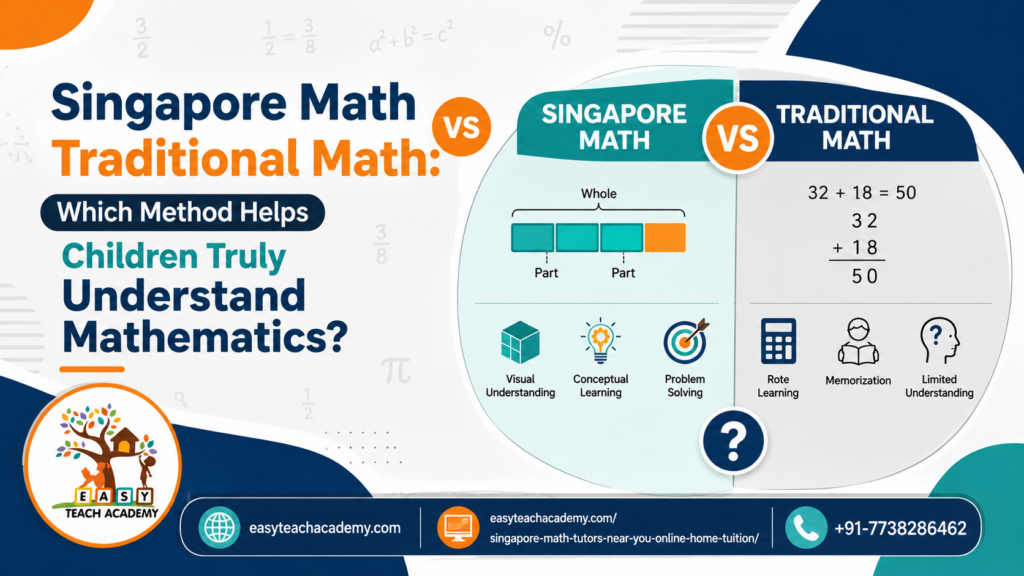
The Singapore Math approach recognises that children learn best when they understand concepts before memorising methods.
Instead of asking children to repeat procedures without explanation, lessons encourage them to:
- Explore mathematical ideas.
- Use visual models.
- Discuss different strategies.
- Explain their thinking.
- Solve problems step by step.
When children understand why mathematics works, they become more willing to tackle challenging questions.
Learning Without Fear
A confident classroom is one where children feel comfortable thinking aloud.
Rather than asking only for correct answers, teachers encourage students to explain:
- Why they chose a particular method.
- How they reached their answer.
- Whether another strategy could also work.
This creates an environment where mistakes become learning opportunities instead of reasons for embarrassment.
Children begin viewing challenges as part of the learning process.
Building Success One Step at a Time
One of the biggest reasons children gain confidence through Singapore Math is that concepts are introduced gradually.
Each lesson builds on previous understanding.
Children first master simple ideas before moving to more challenging topics.
This structured progression allows them to experience regular success.
Small achievements build self-belief, and self-belief encourages greater effort.
Confidence Through Understanding
Imagine two children solving the same problem.
The first child memorised a formula yesterday.
The second child understands why the formula works.
A week later, both children see a new type of question.
Which child feels more confident?
Usually, it is the child who understands the concept.
Understanding creates confidence because children know they can adapt their knowledge to unfamiliar situations.
A Global Choice for Parents
Families around the world increasingly choose concept-based mathematics because they want their children to become confident learners.
Parents in places such as Singapore, Queensland, Western Australia, New Jersey, Illinois, and British Columbia are increasingly looking for programmes that emphasise understanding, reasoning, and confidence rather than rote memorisation alone.
Many students attending international schools also benefit from learning approaches inspired by Singapore Math, particularly when families want additional support outside regular school hours.
Confidence Today, Success Tomorrow
Strong mathematical confidence helps children throughout their education.
Students who believe in their ability to solve problems are more likely to participate actively in lessons and continue studying mathematics with a positive attitude.
Those habits can support future study at respected institutions such as Singapore Management University, University of Queensland, University of British Columbia, and Princeton University. While admission depends on many factors, strong mathematical confidence and reasoning skills provide an excellent academic foundation.
Confidence Begins with Understanding
Imagine asking a child to solve a difficult puzzle without explaining the rules.
Most children would quickly become frustrated.
Unfortunately, this sometimes happens in mathematics.
Children are expected to remember procedures before they truly understand the ideas behind them.
The Singapore Math approach changes this completely.
Instead of asking children to memorise first, it helps them discover how mathematics works.
Understanding creates confidence because children know why an answer is correct.
The CPA Learning Journey
One of the greatest strengths of the Singapore Math approach is the CPA Learning Journey.
CPA stands for:
- Concrete
- Pictorial
- Abstract
This simple sequence allows children to build confidence gradually.
Step 1 – Concrete Learning
Children begin with real objects.
For example:
- Building blocks
- Coins
- Buttons
- Cubes
- Fruit
- Counters
Instead of imagining numbers, they can actually see and touch mathematical ideas.
This makes learning enjoyable and reduces anxiety.
Step 2 – Pictorial Learning
Once children understand a concept with objects, they begin drawing pictures.
These include:
- Number bonds
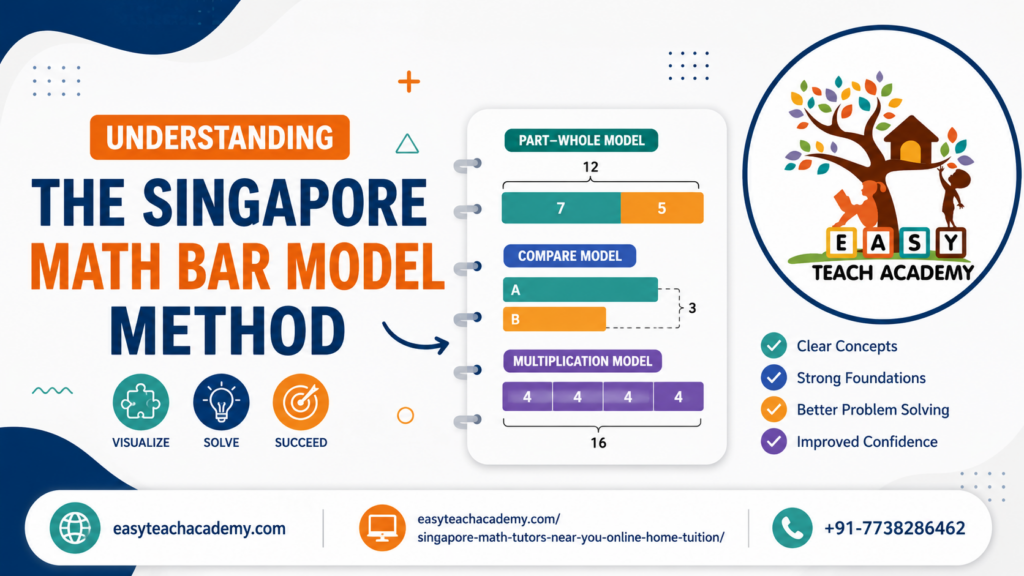
- Part-whole models
- Bar models
- Number lines
- Arrays
Pictures help children organise information and recognise patterns.
Children often say,
“Now I understand!”
That moment of understanding is where confidence begins.
Step 3 – Abstract Learning
Only after children understand the concept do they move to equations.
For example:
Concrete:
🍎🍎🍎🍎🍎
Remove two apples.
Pictorial:
○ ○ ○ ○ ○
Cross out two circles.
Abstract:
5 − 2 = 3
Children no longer memorise the equation.
They understand it.
Why Visual Learning Reduces Maths Anxiety
Many children feel nervous when they see pages full of numbers.
Visual learning changes that experience.
Instead of feeling overwhelmed, children use diagrams that help them organise their thinking.
The Singapore Math Bar Model is one of the most effective visual tools.
Rather than guessing which operation to use, children draw simple bars to represent the information.
This makes word problems much easier to understand.
As success increases, confidence grows.
Every Child Learns at a Different Pace
Parents sometimes worry because another child seems to learn more quickly.
However, every learner develops differently.
Some children:
- Learn best by seeing.
- Learn best by doing.
- Learn best through discussion.
- Learn best with repeated practice.
A good learning programme recognises these differences.
The Singapore Math approach uses multiple teaching methods so children can build confidence in ways that suit their learning style.
Mistakes Become Opportunities
Many children stop participating because they fear making mistakes.
In a confidence-building classroom, mistakes are treated differently.
Instead of hearing,
“That’s wrong.”
Children are encouraged to ask:
- What happened?
- Which step was confusing?
- Can I solve it another way?
- What have I learned?
This mindset helps children become resilient learners.
Encouraging Independent Thinking
One of the greatest gifts parents and teachers can give children is independence.
Instead of immediately giving answers, encourage children to think.
Ask questions such as:
- What do you already know?
- What information is important?
- Which strategy might work?
- Can you explain your thinking?
When children discover answers themselves, they develop genuine confidence.
Real-Life Mathematics Builds Confidence
Children learn best when mathematics feels meaningful.
Parents can strengthen confidence through everyday activities.
Shopping
Ask children to:
- Compare prices.
- Estimate totals.
- Calculate change.
Cooking
Encourage children to:
- Measure ingredients.
- Compare quantities.
- Double recipes.
Travel
Discuss:
- Distance.
- Time.
- Speed.
- Maps.
Games
Play:
- Card games.
- Number puzzles.
- Strategy games.
- Building activities.
These experiences help children see mathematics as part of daily life rather than only a school subject.
Why Parents Around the World Value Confidence-Based Learning
Parents from places such as Singapore, Queensland, Western Australia, British Columbia, New Jersey, and Illinois increasingly recognise that confident learners are more likely to enjoy mathematics and continue progressing through school.
Many international schools in these regions emphasise reasoning, communication, and conceptual understanding—qualities that align well with the principles of Singapore Math.
Confidence Creates Better Learners
Imagine two children facing the same challenging maths question.
The first child immediately says,
“I can’t do this.”
The second child says,
“Let me try another way.”
The difference is not always mathematical ability.
It is confidence.
Children who believe they can solve problems are more likely to continue thinking until they find a solution.
This positive attitude gradually improves both understanding and achievement.
Children Stop Fearing Difficult Questions
Many students panic when they see long word problems or unfamiliar questions.
The Singapore Math approach changes this mindset.
Instead of rushing to find an answer, children learn to:
- Read carefully.
- Understand the situation.
- Break the problem into smaller parts.
- Use visual representations.
- Check whether their answer makes sense.
Because they have a clear strategy, difficult questions become manageable rather than frightening.
Better Confidence Leads to Better School Performance
Teachers often notice that confident students:
- Participate more actively.
- Complete homework independently.
- Ask thoughtful questions.
- Explain their reasoning.
- Support classmates during group activities.
These learning habits improve performance across many subjects, not only mathematics.
Children begin believing they are capable learners.
That belief influences future success.
Confidence Helps Beyond the Classroom
The benefits of confidence extend well beyond school.
Children who become confident mathematical thinkers often develop:
Better Decision-Making
Learning to analyse information before making choices.
Improved Communication
Explaining ideas clearly and listening carefully to others.
Greater Resilience
Continuing to work through challenges instead of giving up.
Stronger Concentration
Remaining focused while solving complex problems.
Independent Thinking
Finding solutions without relying on constant help.
These life skills remain valuable throughout secondary school, university, and future careers.
Preparing Children for Future Education
Parents naturally hope their children will have opportunities to study at excellent schools and universities.
Strong mathematical confidence provides an excellent academic foundation for future learning.
Students with well-developed reasoning skills are better prepared for advanced study at respected institutions such as:
- National University of Singapore
- Nanyang Technological University
- University of Sydney
- University of Queensland
- University of British Columbia
- Princeton University
While admission depends on many factors, confidence in mathematics supports success in many academic pathways.
Why Families Across the World Choose Singapore Math
Parents from different countries share similar goals.
Whether a family lives in:
- Singapore
- Perth
- Brisbane
- Vancouver
- Chicago
- Princeton
they want children who enjoy learning, think independently, and approach challenges with confidence.
That is why concept-based mathematics continues gaining popularity among parents and international schools.
Meet Your Teacher – Niral Devnath
Hello, I’m Niral Devnath, founder of Easy Teach Academy.
For more than 15 years, I have helped children from different countries improve their mathematical understanding, confidence, and academic performance.
During my teaching career, I have worked with students from:
- Singapore
- Australia
- United States
- United Kingdom
- Norway
- India
- Other international communities
Every child teaches me something new.
Some learners need more encouragement.
Others need more challenging questions.
Some simply need mathematics explained in a way that finally makes sense.
That is why every lesson I teach is personalised to match the child’s learning style and pace.
My Teaching Philosophy
I believe every child can become confident in mathematics when teaching focuses on understanding rather than memorisation.
My lessons are built on four important principles.
Understand First
Children should know why mathematical ideas work before learning shortcuts.
Think Independently
Students should develop the confidence to solve unfamiliar problems on their own.
Learn Through Encouragement
Positive reinforcement helps children become motivated learners.
Confidence grows through consistent success.
Enjoy Mathematics
Children who enjoy learning are more likely to continue improving throughout their education.
Why Parents Choose Easy Teach Academy
At Easy Teach Academy, we focus on building confident learners—not just improving test scores.
Our Online Singapore Math Classes help children:
- Develop conceptual understanding.
- Strengthen logical reasoning.
- Improve problem-solving abilities.
- Build lasting confidence.
- Enjoy mathematics.
Parents appreciate our programme because we provide:
- Live interactive online classes.
- Small class sizes.
- Personalised guidance.
- Structured learning plans.
- Regular assessments.
- Parent progress updates.
- Flexible schedules for international students.
Our mission is to help every child become a confident mathematical thinker who is prepared for lifelong learning.
Learn More About Our Singapore Math Programme
If you would like your child to become a confident learner through Singapore Math, we would be delighted to support your family.
Explore our Singapore Math programme:
Visit Easy Teach Academy:
Practical Ways Parents Can Build Math Confidence at Home
Children spend only part of their day at school.
The encouragement they receive at home plays an equally important role.
Here are some simple strategies that parents can use.
Celebrate Progress, Not Perfection
Instead of praising only correct answers, recognise your child’s effort.
For example, praise them for:
- Trying a new strategy.
- Explaining their thinking.
- Completing a difficult problem.
- Learning from mistakes.
- Showing patience.
Children who feel appreciated are more willing to keep learning.
Avoid Comparing Your Child with Others
Every child develops at a different pace.
Comparing your child with classmates, siblings, or relatives can reduce motivation and confidence.
Instead, compare today’s progress with last month’s progress.
Small improvements create lasting confidence.
Ask Questions Instead of Giving Answers
When your child asks for help, avoid solving the question immediately.
Instead ask:
- What information do you already know?
- Which method could you try first?
- Can you draw a picture?
- Does your answer make sense?
These questions encourage independent thinking.
Create a Positive Learning Routine
A short daily routine is often more effective than long study sessions once a week.
Even 20–30 minutes of focused learning can help children develop:
- Better concentration.
- Stronger reasoning.
- Greater confidence.
- Better study habits.
Consistency is more important than study duration.
Signs That Your Child Is Becoming More Confident
Confidence does not appear overnight.
Parents often notice gradual improvements such as:
- Your child starts maths homework without being reminded.
- They ask more questions during lessons.
- They are willing to attempt difficult problems.
- They explain their thinking more clearly.
- They become less afraid of making mistakes.
- They enjoy mathematics more than before.
These are strong indicators that genuine learning is taking place.
Common Myths About Confidence in Mathematics
Myth 1: Some Children Are Naturally Good at Maths
While children have different strengths, confidence and mathematical ability grow through good teaching, practice, and encouragement.
Most successful learners build their skills over time.
Myth 2: Fast Learners Are Always Better
Speed is not the same as understanding.
Children who carefully think through problems often develop stronger long-term mathematical skills.
Myth 3: Mistakes Mean Failure
Mistakes are part of learning.
Each mistake helps children understand concepts more deeply and improve their problem-solving strategies.
Myth 4: Confidence Comes Only After High Marks
In reality, confidence often comes first.
When children believe they can succeed, they participate more, practise more, and gradually improve their academic performance.
Why Families Around the World Trust Concept-Based Learning
Parents from many parts of the world are looking for mathematics programmes that develop confident learners.
Families living in places such as Singapore, Perth, Brisbane, Vancouver, Chicago, Princeton, and many other international cities increasingly value learning approaches that encourage reasoning, confidence, and independent thinking.
Children who build these skills during primary school are often better prepared for future learning in secondary school and higher education.
Strong mathematical confidence can support future study at respected universities such as Singapore Management University, University of Queensland, University of British Columbia, and Princeton University, where analytical thinking and strong academic foundations are valuable.
About Me – Niral Devnath
Hello, I’m Niral Devnath, founder of Easy Teach Academy.
For more than 15 years, I have helped children from different countries become confident mathematics learners through personalised, concept-based teaching.
Over the years, I have worked with students from Singapore, Australia, the United States, the United Kingdom, Norway, India, and many other countries.
I have seen children who once believed mathematics was impossible become confident learners simply because they were taught in a way that matched their learning style.
My teaching philosophy is based on four principles:
- Build understanding before memorisation.
- Encourage logical and independent thinking.
- Develop confidence through steady progress.
- Make mathematics enjoyable, practical, and meaningful.
Every child deserves the opportunity to experience success in mathematics.
Why Parents Choose Easy Teach Academy
At Easy Teach Academy, our goal is not only to improve mathematics results but also to help children enjoy learning.
Our Online Singapore Math Classes help students:
- Build strong conceptual understanding.
- Strengthen mathematical reasoning.
- Improve analytical thinking.
- Develop lasting confidence.
- Solve problems independently.
Parents appreciate our programme because we offer:
- Live interactive online lessons.
- Small class sizes.
- Individual attention.
- Structured learning pathways.
- Regular assessments.
- Parent progress updates.
- Flexible schedules for families across different countries.
Whether your child needs additional support or greater academic challenge, we are committed to helping them succeed.
Learn more about our Singapore Math programme:
Visit Easy Teach Academy:
Frequently Asked Questions
How does Singapore Math improve confidence?
By helping children understand concepts before memorising methods. Success through understanding naturally builds confidence.
Can children who struggle with maths benefit from Singapore Math?
Yes. The visual, step-by-step teaching approach helps many children rebuild confidence and strengthen their mathematical understanding.
Is Singapore Math suitable for confident learners as well?
Absolutely. Advanced learners are encouraged to solve challenging problems, explain their reasoning, and explore multiple strategies.
How can parents support confidence at home?
Parents can encourage effort, ask thoughtful questions, celebrate progress, and create a positive learning routine rather than focusing only on marks.
Are online Singapore Math classes effective?
Yes. Well-structured live online classes provide expert guidance, interactive learning, personalised feedback, and regular progress monitoring that support both confidence and academic growth.
Final Thoughts
Every child has the ability to become confident in mathematics.
Confidence is not created by memorising formulas or completing hundreds of worksheets.
It grows when children understand ideas, experience success, ask questions, and discover that they are capable of solving challenging problems.
That is why so many parents are choosing Singapore Math.
It develops not only stronger mathematical skills but also curiosity, resilience, logical reasoning, and independent thinking—qualities that support children throughout school and beyond.
Help Your Child Build Lasting Mathematical Confidence
If you would like your child to enjoy mathematics, think independently, and develop lasting confidence, Easy Teach Academy is here to help.
Our Online Singapore Math Classes combine proven teaching strategies with personalised guidance to help every learner reach their full potential.
Why Families Trust Easy Teach Academy
✔ 15+ years of teaching experience
✔ Live interactive Online Singapore Math Classes
✔ Small groups with personalised attention
✔ Concept-based teaching that develops confidence
✔ Strong focus on reasoning and problem-solving
✔ Flexible schedules for students across Singapore, Australia, the United States, Canada, the United Kingdom, India, and other countries
✔ Regular parent communication and progress tracking
Begin Your Child’s Journey Today
Explore our Singapore Math programme:
Visit Easy Teach Academy to discover all our educational programmes: