Introduction
“My child can memorize multiplication tables and formulas, but struggles when faced with a new problem.”
This is one of the most common concerns parents share.
Many children perform well on routine exercises but become confused when solving word problems, multi-step questions, or real-life applications of mathematics.
The reason is often simple:
They have learned procedures without truly understanding mathematical concepts.
This is where the debate between Singapore Math vs Traditional Math becomes important.
Both approaches teach mathematics, but they teach it in very different ways.
Traditional methods often emphasize repetition and memorization. Singapore Math focuses on conceptual understanding, visual learning, logical reasoning, and problem-solving.
In this guide, we will compare both approaches in detail, examine real examples, discuss long-term benefits, and help parents determine which method may be best for their child.
Why Are Parents Comparing Math Curriculums?
Parents today have more educational options than ever before.
Questions commonly asked include:
- Which curriculum develops stronger problem-solving skills?
- Why does my child forget formulas so quickly?
- Why does my child struggle with word problems?
- Should I switch to Singapore Math?
- Which curriculum prepares children for higher mathematics?
Understanding these differences can help parents make informed decisions about their child’s education.
What Is Traditional Math?
Traditional mathematics instruction has been used in schools worldwide for decades.
The typical structure includes:
- Teacher explains a procedure.
- Students memorize the procedure.
- Students complete repetitive exercises.
- Tests assess whether procedures were remembered correctly.
For example:
Multiplication
Students memorize:
7 × 8 = 56
without necessarily understanding why.
The emphasis is often on:
- Speed
- Correct answers
- Repetition
- Formula memorization
This approach can be effective for some learners but often creates difficulties when students encounter unfamiliar problems.
What Is Singapore Math?
Singapore Math is a teaching approach developed by Singapore’s Ministry of Education.
The goal is not simply to get the correct answer.
The goal is to understand mathematical relationships deeply.
Students learn through:
- Visual models
- Number sense
- Logical reasoning
- Mental mathematics
- Problem-solving strategies
The foundation of the Singapore Math Program is understanding before memorization.
Students learn:
- Why methods work
- How numbers relate to each other
- How to solve unfamiliar problems
This is one reason Singapore consistently ranks among the world’s strongest mathematics-performing nations.
Traditional Math vs Singapore Math: Side-by-Side Comparison
| Traditional Math | Singapore Math |
|---|---|
| Memorization | Understanding |
| Procedures First | Concepts First |
| Formula Driven | Reasoning Driven |
| Repetition Based | Problem Solving Based |
| Limited Visualization | Strong Visual Learning |
| Focus on Answer | Focus on Thinking |
| Teacher-Centered | Student-Centered |
| Calculator Dependence | Mental Math Focus |
Understanding vs Memorization
One of the biggest differences in the Math Curriculum Comparison is how students learn.
Traditional Approach
Students often memorize:
8 × 7 = 56
But if asked:
Why?
Many cannot explain.
Singapore Math Approach
Students might first see:
8 groups of 7
7 + 7 + 7 + 7 + 7 + 7 + 7 + 7
= 56
They understand multiplication as repeated addition.
Later, memorization becomes easier because understanding already exists.
The CPA Approach
A key feature of Singapore Math Lessons is the CPA approach.
CPA stands for:
Concrete
Students use physical objects.
Examples:
- Counters
- Blocks
- Beads
Pictorial
Students draw visual models.
Examples:
- Bar models
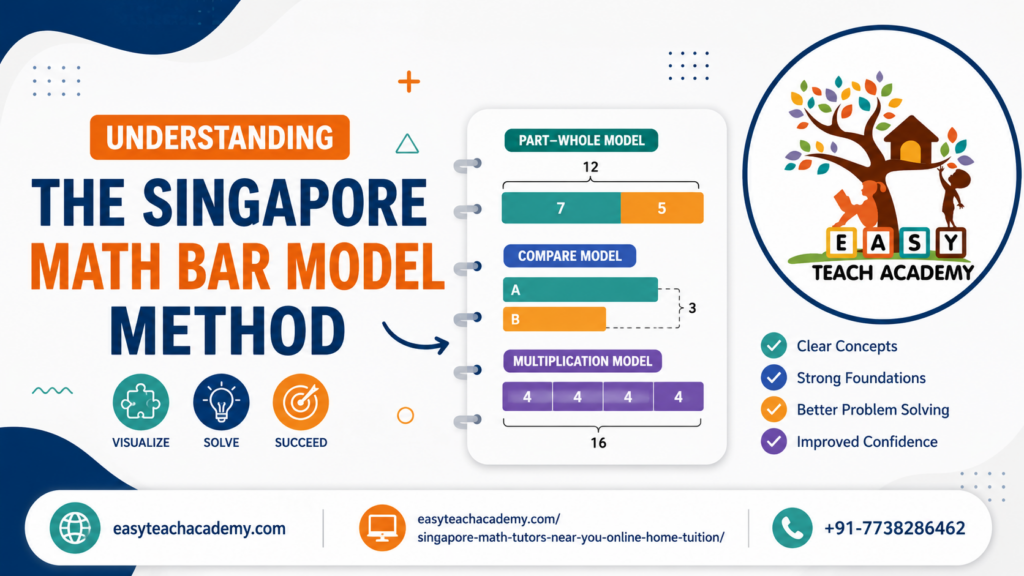
- Number bonds
- Diagrams
Abstract
Students use mathematical symbols.
Example:
8 × 7 = 56
This progression helps children understand mathematics naturally.
Why Children Memorize but Still Struggle
Many parents notice:
“My child gets homework correct but struggles in tests.”
This happens because memorization alone is fragile.
When questions change slightly, students become uncertain.
For example:
Memorized Question
12 × 5 = 60
Easy.
New Question
A factory packs 12 boxes each containing 5 toys.
How many toys are packed?
Many students hesitate because they do not recognize it as multiplication.
Conceptual learners immediately identify the relationship.
Real Example 1: Fraction Understanding
Traditional Method
Teacher says:
To add fractions:
1/4 + 1/4 = 2/4
Simplify to 1/2
Students memorize.
Singapore Math Method
Students first see a picture.
Pizza divided into four pieces.
One slice plus one slice.
Visual model shows two out of four parts.
Students understand the meaning before learning the rule.
Real Example 2: Word Problems
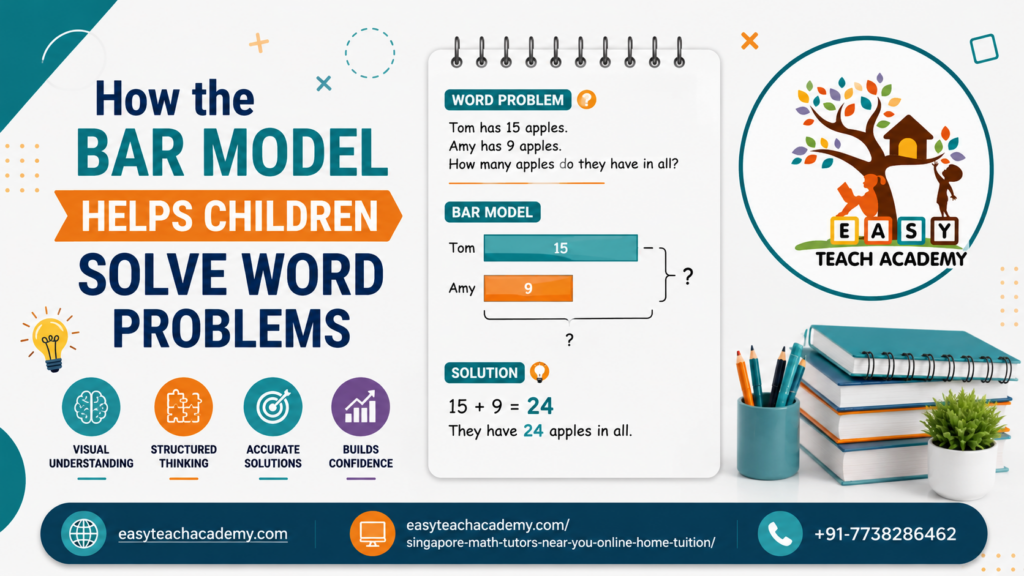
A bookstore sold 245 books on Monday and 378 books on Tuesday.
How many books were sold altogether?
Traditional Method
Students search for keywords.
“Altogether means add.”
Sometimes this works.
Sometimes it doesn’t.
Singapore Math Method
Students visualize.
Monday = 245
Tuesday = 378
Total = ?
245 + 378 = 623
Students understand the relationship between quantities.
Difficult Example 3: Advanced Bar Model Problem
Sarah has three times as much money as Emma.
Together they have $320.
How much money does each child have?
Step 1
Emma = 1 unit
Sarah = 3 units
Total = 4 units
Step 2
320 ÷ 4 = 80
Step 3
Emma = 80
Sarah = 240
Answer
Emma has $80.
Sarah has $240.
This type of visual reasoning is central to Singapore Math Training.
Difficult Example 4: Multi-Step Ratio Problem
The ratio of boys to girls in a school club is 5:7.
There are 84 students altogether.
How many girls are there?
Step 1
Total ratio units
5 + 7 = 12
Step 2
Each unit
84 ÷ 12 = 7
Step 3
Girls
7 × 7 = 49
Answer
49 girls
This develops algebraic thinking years before formal algebra.
Difficult Example 5: Higher-Level Problem Solving
A train travels 180 km in 3 hours.
At the same speed, how far will it travel in 7.5 hours?
Step 1
Find speed
180 ÷ 3 = 60 km/h
Step 2
Distance
60 × 7.5
= 450 km
Answer
450 km
Singapore Math encourages students to think logically rather than simply applying formulas.
More Advanced Singapore Math Examples
One of the biggest advantages of Singapore Math is that children learn to tackle complex problems systematically. These examples demonstrate how Singapore Math Lessons develop deep understanding and strong problem-solving skills.
Example 6: Multi-Step Word Problem
A library had 2,450 books.
It purchased 375 new books and later donated 218 books to another school.
How many books does the library have now?
Solution
Step 1: Add new books
2450 + 375 = 2825
Step 2: Subtract donated books
2825 − 218 = 2607
Answer
The library now has 2,607 books.
Example 7: Advanced Bar Model Problem
David has four times as much money as Ryan.
Together they have $750.
How much money does each child have?
Step 1
Ryan = 1 unit
David = 4 units
Total = 5 units
Step 2
750 ÷ 5 = 150
Step 3
Ryan = $150
David = $600
Answer
Ryan has $150 and David has $600.
Example 8: Fraction of a Quantity
A basket contains 72 oranges.
3/8 of the oranges are sold.
How many oranges are sold?
Step 1
Find 1/8
72 ÷ 8 = 9
Step 2
Find 3/8
9 × 3 = 27
Answer
27 oranges were sold.
Example 9: Fraction Word Problem
A water tank is 5/6 full.
The tank holds 900 litres when full.
How much water is currently in the tank?
Step 1
Find 1/6
900 ÷ 6 = 150
Step 2
Find 5/6
150 × 5 = 750
Answer
The tank contains 750 litres.
Example 10: Percentage Increase
A school had 480 students.
Enrollment increased by 25%.
How many students are there now?
Step 1
Find 25%
480 × 25 ÷ 100 = 120
Step 2
Add increase
480 + 120 = 600
Answer
There are now 600 students.
Example 11: Percentage Decrease
A jacket costs $120.
It is discounted by 35%.
What is the sale price?
Step 1
Find discount
120 × 35 ÷ 100
= 42
Step 2
Subtract discount
120 − 42 = 78
Answer
Sale price = $78
Example 12: Ratio Problem
The ratio of red marbles to blue marbles is 7 : 5.
There are 84 red marbles.
How many blue marbles are there?
Step 1
7 parts = 84
1 part = 84 ÷ 7 = 12
Step 2
Blue marbles
5 × 12 = 60
Answer
There are 60 blue marbles.
Example 13: Challenging Ratio Problem
The ratio of boys to girls is 4 : 7.
There are 132 students altogether.
How many girls are there?
Step 1
Total ratio parts
4 + 7 = 11
Step 2
Value of one part
132 ÷ 11 = 12
Step 3
Girls
12 × 7 = 84
Answer
There are 84 girls.
Example 14: Consecutive Numbers Problem
The sum of three consecutive numbers is 99.
Find the numbers.
Step 1
Middle number
99 ÷ 3 = 33
Step 2
Numbers
32, 33, 34
Check
32 + 33 + 34 = 99
Answer
The numbers are 32, 33, and 34.
Example 15: Advanced Consecutive Number Problem
The sum of five consecutive even numbers is 240.
Find the numbers.
Step 1
Middle number
240 ÷ 5 = 48
Step 2
Even numbers
44, 46, 48, 50, 52
Check
44 + 46 + 48 + 50 + 52 = 240
Answer
The numbers are 44, 46, 48, 50, and 52.
Example 16: Algebra Preparation
A number is multiplied by 6 and then 18 is added.
The result is 90.
Find the number.
Step 1
90 − 18 = 72
Step 2
72 ÷ 6 = 12
Answer
The number is 12.
Example 17: Work Backwards Problem
After spending $45, Emma has one-third of her original money left.
How much money did she have originally?
Step 1
If one-third remains, two-thirds was spent.
Two-thirds = $45
Step 2
One-third
45 ÷ 2 = 22.50
Step 3
Original amount
22.50 × 3 = 67.50
Answer
Emma originally had $67.50.
Example 18: Advanced Bar Model Challenge
A father is 4 times as old as his son.
In 8 years, the father will be twice as old as the son.
How old are they now?
Solution
Let son’s age = x
Father’s age = 4x
In 8 years:
4x + 8 = 2(x + 8)
4x + 8 = 2x + 16
2x = 8
x = 4
Father = 16
Answer
Son = 4 years
Father = 16 years
Example 19: Singapore Olympiad Style Question
A box contains red, blue, and green balls.
There are twice as many blue balls as red balls.
There are three times as many green balls as red balls.
There are 72 balls altogether.
How many red balls are there?
Step 1
Red = 1 unit
Blue = 2 units
Green = 3 units
Total = 6 units
Step 2
72 ÷ 6 = 12
Answer
Red balls = 12
Blue balls = 24
Green balls = 36
Example 20: High-Level Problem Solving
A train travels 360 km in 4.5 hours.
At the same speed, how far will it travel in 8 hours?
Step 1
Find speed
360 ÷ 4.5 = 80 km/h
Step 2
Distance in 8 hours
80 × 8 = 640 km
Answer
The train will travel 640 km.
These challenging examples demonstrate why Singapore Math Tutoring, Singapore Math Training, and structured Singapore Math Classes help children develop strong reasoning skills, confidence, and the ability to solve unfamiliar problems independently. Parents often notice that children become less reliant on memorization and more capable of explaining their mathematical thinking clearly.
Long-Term Benefits of Singapore Math
Stronger Problem-Solving Skills
Children learn to approach unfamiliar questions confidently.
Better Mathematical Understanding
Students understand concepts deeply.
Improved Confidence
Understanding reduces anxiety.
Strong Preparation for Algebra
Bar models naturally prepare children for algebraic thinking.
Better Exam Performance
Students perform better on reasoning-based assessments.
Real-Life Application
Mathematics becomes useful rather than abstract.
Singapore Math vs Traditional Math in Higher Grades
As mathematics becomes more advanced, conceptual understanding becomes increasingly important.
Topics such as:
- Algebra
- Ratios
- Percentages
- Geometry
- Probability
require reasoning.
Students who rely solely on memorization often struggle.
Students trained through Singapore Math Courses generally transition more smoothly.
Common Mistakes Parents Make
Focusing Only on Answers
Understanding matters more than speed.
Encouraging Memorization Too Early
Concepts should come first.
Overusing Worksheets
Children need problem-solving experiences.
Relying on Calculators
Mental math develops stronger number sense.
Ignoring Visual Models
Visual thinking improves understanding.
Home Activities That Build Conceptual Understanding
Shopping Activities
Calculate discounts and totals.
Cooking Activities
Practice fractions and measurements.
Mental Math Challenges
Develop numerical fluency.
Board Games
Strengthen logical thinking.
Daily Estimation Games
Estimate distances, quantities, and costs.
Is Singapore Math Suitable for Struggling Learners?
Absolutely.
Many struggling learners improve because:
- Visual methods reduce confusion.
- Concepts become easier to understand.
- Learning becomes less intimidating.
- Confidence increases.
Is Singapore Math Suitable for Advanced Students?
Yes.
Gifted learners benefit because:
- Problems require deeper thinking.
- Multiple solution methods are encouraged.
- Higher-order reasoning is developed.
Frequently Asked Questions
Is Singapore Math harder than traditional math?
Initially, it may feel more challenging because students must think deeply rather than memorize.
Does Singapore Math improve problem-solving skills?
Yes. Problem-solving is at the heart of the curriculum.
Can my child switch from traditional math to Singapore Math?
Yes. Many students transition successfully.
Is Singapore Math suitable for international students?
Absolutely.
Children from the USA, UK, Australia, Canada, Singapore, and other countries benefit from this approach.
How often should children practice?
15–30 minutes daily is generally effective.
Does Singapore Math help with school exams?
Yes. Strong conceptual understanding supports exam success.
Why Choose Online Singapore Math Classes?
Today’s families increasingly choose Singapore Math Online learning because it provides:
- Flexible schedules
- Live interactive instruction
- Individual attention
- Personalized learning plans
- Progress tracking
- Global accessibility
Whether your child needs enrichment or additional support, quality Singapore Math Tutoring can make a significant difference.
Why Parents Choose Easy Teach Academy
At Easy Teach Academy, we help students build confidence, logical thinking, and strong mathematical foundations through structured online instruction.
Our programs include:
Singapore Math Classes
Singapore Math Tutoring
Singapore Math Training
Singapore Math Lessons
Singapore Math Courses
One-to-One Coaching
Small Group Learning
International Student Support
Free Trial Classes
Visit:
Easy Teach Academy
Singapore Math Program
Our goal is simple:
Help children understand mathematics deeply and develop skills that last a lifetime.
Conclusion
When comparing Singapore Math vs Traditional Math, the biggest difference is clear:
Traditional methods often focus on memorization.
Singapore Math focuses on understanding.
Children learn how mathematics works, why solutions make sense, and how to solve unfamiliar problems confidently.
For parents looking for the best math curriculum, conceptual learning provides long-term benefits that extend far beyond school exams.
By developing reasoning, visualization, mental math, and problem-solving skills, Singapore Math helps children become confident and capable learners prepared for future academic success.