Introduction
“My child can read the question perfectly but has no idea how to solve it.”
This is one of the most common concerns parents share.
Many children can:
- Add numbers
- Subtract numbers
- Multiply accurately
- Divide confidently
Yet when they see a word problem, they freeze.
The issue is usually not mathematics.
The issue is understanding how to convert words into mathematical relationships.
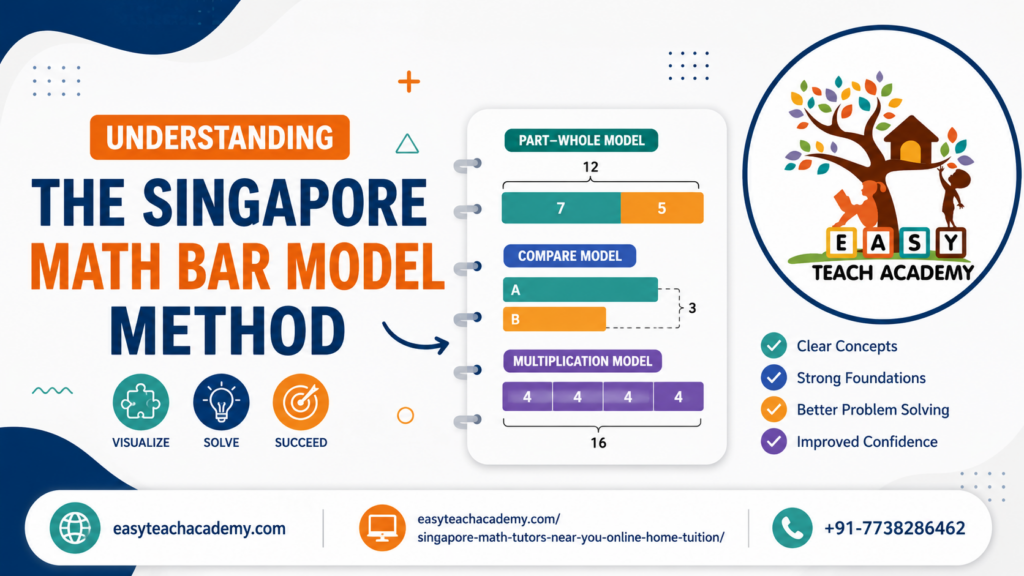
This is where the Singapore Math Bar Model Method becomes incredibly powerful.
Bar models help children visualize information before calculating.
Instead of guessing which operation to use, children learn to see the structure of the problem.
This approach is one reason Singapore students consistently perform among the world’s best mathematics learners.
In this guide, parents will learn:
- Why word problems are difficult
- How bar models simplify thinking
- How children translate words into mathematics
- Advanced word problem strategies
- Difficult examples with solutions
- Practice activities at home
- How bar models support NAPLAN success
Why Do Children Struggle With Word Problems?
Many parents think their child struggles because of weak mathematics skills.
In reality, the problem is often different.
Word problems require several skills at once:
Reading
Children must understand the text.
Understanding Relationships
Children must determine how quantities relate.
Selecting Operations
Should they add?
Subtract?
Multiply?
Divide?
Multi-Step Thinking
Some problems require several calculations.
Organizing Information
Important information must be identified.
Many students become overwhelmed before they even begin.
Why Singapore Math Uses Visual Models
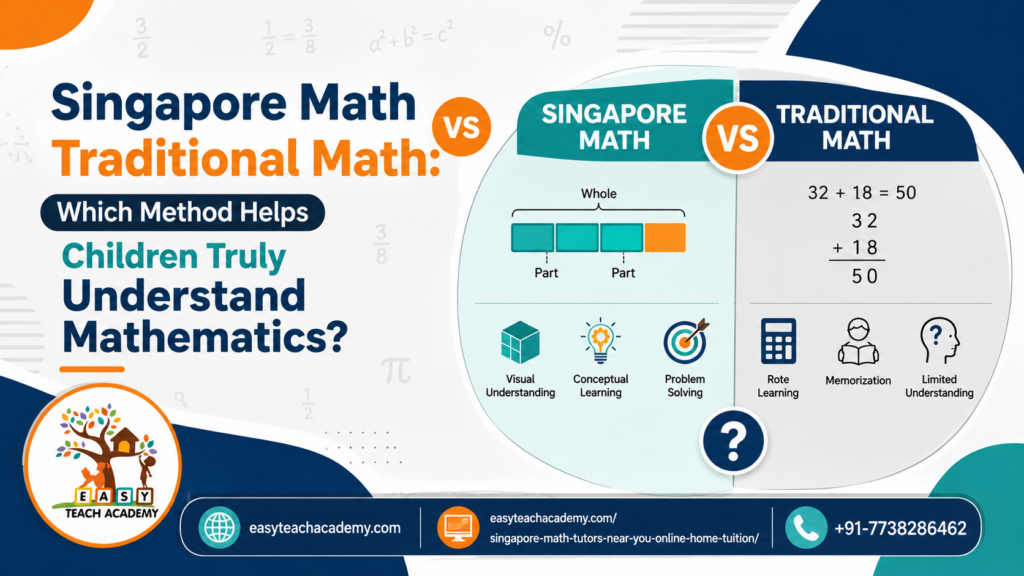
Singapore Math focuses on understanding rather than memorization.
Instead of teaching students to search for keywords, Singapore Math teaches them to visualize.
Visual models help children:
- Understand relationships
- Organize information
- Identify missing values
- Solve unfamiliar questions
- Build confidence
This is why bar modeling is one of the most important Visual Math Methods used worldwide.
Translating Words Into Mathematics
The biggest challenge is turning language into numbers.
Consider this question:
Emma has 125 stickers.
Her grandmother gives her 48 more stickers.
How many stickers does Emma have now?
Many children immediately ask:
“Do I add or subtract?”
A bar model makes the answer obvious.
Emma = 125
Gift = 48
Total = ?
125 + 48 = 173
The relationship becomes visible.
The Five-Step Singapore Math Process
Step 1: Read Carefully
Read the question twice.
Step 2: Identify Important Information
Highlight numbers.
Identify relationships.
Step 3: Draw a Bar Model
Represent quantities visually.
Step 4: Write the Equation
Convert the model into mathematics.
Step 5: Check the Answer
Ask:
Does the answer make sense?
Example 1: Simple Addition Word Problem
A library received 235 books in January and 187 books in February.
How many books were received altogether?
Bar Model
January = 235
February = 187
Total = ?
235 + 187 = 422
Answer
422 books
Example 2: Simple Subtraction Problem
A bakery made 560 cupcakes.
It sold 245 cupcakes.
How many cupcakes remain?
Bar Model
Total = 560
Sold = 245
Remaining = ?
560 − 245 = 315
Answer
315 cupcakes
Example 3: Multiplication Word Problem
A school has 24 classrooms.
Each classroom contains 32 desks.
How many desks are there altogether?
Bar Model
24 groups of 32
24 × 32 = 768
Answer
768 desks
Example 4: Division Word Problem
648 apples are packed equally into 18 boxes.
How many apples are in each box?
Solution
648 ÷ 18
= 36
Answer
36 apples
Difficult Example 5: Comparison Problem
Ryan has 145 marbles.
David has 68 more marbles than Ryan.
How many marbles does David have?
Bar Model
Ryan = 145
David = 145 + 68
145 + 68 = 213
Answer
213 marbles
Difficult Example 6: Two-Step Word Problem
A farmer harvested 2,450 oranges.
He sold 875 oranges and later harvested 325 more oranges.
How many oranges does he have now?
Step 1
2450 − 875
= 1575
Step 2
1575 + 325
= 1900
Answer
1,900 oranges
Difficult Example 7: Ratio Problem
The ratio of boys to girls is 4 : 7.
There are 165 students altogether.
How many girls are there?
Step 1
Total parts
4 + 7 = 11
Step 2
One part
165 ÷ 11 = 15
Step 3
Girls
15 × 7 = 105
Answer
105 girls
Difficult Example 8: Fraction Word Problem
A water tank is 5/8 full.
The full tank holds 1,920 litres.
How much water is in the tank?
Step 1
1,920 ÷ 8
= 240
Step 2
240 × 5
= 1,200
Answer
1,200 litres
Difficult Example 9: Advanced Bar Model Problem
Sarah has three times as much money as Emma.
Together they have $640.
How much money does each child have?
Bar Model
Emma = 1 unit
Sarah = 3 units
Total = 4 units
Step 1
640 ÷ 4
= 160
Step 2
Emma = $160
Sarah = $480
Answer
Emma has $160
Sarah has $480
Difficult Example 10: Multi-Step Comparison Problem
A school has 850 students.
There are 125 more girls than boys.
How many boys and girls are there?
Step 1
Total = 850
Difference = 125
Step 2
Subtract difference
850 − 125 = 725
Step 3
Divide equally
725 ÷ 2 = 362.5
Since students cannot be split, adjust to a realistic total such as 875.
875 − 125 = 750
750 ÷ 2 = 375
Girls = 500
Boys = 375
Answer
Girls = 500
Boys = 375
Challenging Singapore Math Word Problems
These examples are similar to advanced Primary Math Word Problems.
Example 11: Age Problem
A father is four times as old as his son.
Together their ages total 65 years.
Find their ages.
Bar Model
Father = 4 units
Son = 1 unit
Total = 5 units
Step 1
65 ÷ 5
= 13
Step 2
Son = 13
Father = 52
Answer
Son = 13 years
Father = 52 years
Example 12: Consecutive Numbers
The sum of three consecutive numbers is 96.
Find the numbers.
Step 1
Middle number
96 ÷ 3
= 32
Step 2
Numbers
31, 32, 33
Answer
31, 32, 33
Example 13: Percentage Problem
A bicycle costs $750.
A 20% discount is applied.
What is the final price?
Step 1
20% of 750
= 150
Step 2
750 − 150
= 600
Answer
$600
Example 14: Olympiad Style Problem
Three children share $720.
Ben receives twice as much as Alex.
Chris receives three times as much as Alex.
How much does each receive?
Step 1
Alex = 1 unit
Ben = 2 units
Chris = 3 units
Total = 6 units
Step 2
720 ÷ 6
= 120
Step 3
Alex = 120
Ben = 240
Chris = 360
Answer
Alex = $120
Ben = $240
Chris = $360
Example 15: Advanced Challenge
A school collected 4,800 books.
One-third were fiction books.
Two-fifths of the remaining books were science books.
How many books were science books?
Step 1
Fiction
4,800 ÷ 3
= 1,600
Step 2
Remaining
4,800 − 1,600
= 3,200
Step 3
Science books
3,200 × 2 ÷ 5
= 1,280
Answer
1,280 science books
How Bar Models Help with NAPLAN
Bar models are especially valuable for students preparing for:
- Year 10 NAPLAN Practice Tests
- NAPLAN Worksheets
- NAPLAN Style Questions Year 3
- NAPLAN Year 5 Sample Tests
- NAPLAN Practise Tests Year 3
- NAPLAN Example Questions
- NAPLAN Examples
- Example NAPLAN Test Year 3
- NAPLAN Numeracy Year 3 Practice Test
Many NAPLAN questions require students to:
- Analyze information
- Compare quantities
- Solve multi-step problems
- Apply mathematical reasoning
These are exactly the skills developed through Singapore Math word problem strategies.
Practice Activities for Parents
Shopping Challenges
Ask children to calculate:
- Discounts
- Total costs
- Change received
Recipe Activities
Practice fractions and measurement.
Travel Problems
Calculate:
- Distance
- Speed
- Travel time
Sports Statistics
Analyze scores and averages.
Daily Mental Math Challenges
Build confidence through short exercises.
Common Mistakes Children Make
Looking for Keywords
Keywords often mislead students.
Skipping Visual Models
Drawing first prevents mistakes.
Guessing Operations
Relationships should determine operations.
Rushing
Careful thinking leads to success.
Ignoring Units
Always include dollars, litres, books, or students when required.
Frequently Asked Questions
What is the best way to teach word problems?
Visual models and step-by-step reasoning.
Why do children struggle with word problems?
Because they must combine reading and mathematics skills.
Are bar models suitable for older students?
Yes.
Many advanced students use bar models before learning algebra.
Do bar models improve NAPLAN performance?
Yes.
They strengthen reasoning and problem-solving abilities.
How often should children practice?
15–20 minutes daily is ideal.
Why Choose Online Singapore Math Classes?
Online Singapore Math programs provide:
- Live instruction
- Personalized support
- Structured problem-solving practice
- Bar model training
- Progress monitoring
- Flexible schedules
Children learn not only how to calculate but how to think mathematically.
Why Parents Choose Easy Teach Academy
At Easy Teach Academy, we help students develop confidence, problem-solving skills, and deep mathematical understanding through Singapore Math methods.
Our programs include:
- Singapore Math Word Problems
- Bar Model Training
- Mental Math Development
- One-to-One Tutoring
- Small Group Classes
- International Student Support
Website:
Singapore Math Program:
Our goal is to help children become independent mathematical thinkers.
Frequently Asked Questions About Singapore Math Word Problems
What are Singapore Math word problems?
Singapore Math word problems are real-life mathematical situations that require children to understand relationships between quantities rather than simply perform calculations. Students use visual tools such as bar models to organize information and solve problems logically.
Why does my child struggle with word problems but not calculations?
Many children can perform addition, subtraction, multiplication, and division accurately but struggle to identify which operation to use in a word problem. Word problems require reading comprehension, logical thinking, and mathematical reasoning at the same time.
What is a bar model in Singapore Math?
A bar model is a visual diagram that represents quantities using rectangular bars. It helps children see relationships between numbers and makes complex problems easier to understand and solve.
At what age should children start learning bar models?
Most children can begin learning simple bar models in Grades 1–2. As they grow older, bar models can be used for fractions, ratios, percentages, algebra, and advanced problem-solving.
Can bar models help with NAPLAN preparation?
Yes. Bar models are extremely useful for solving many types of questions found in:
- NAPLAN Numeracy Year 3 Practice Test
- NAPLAN Style Questions Year 3
- NAPLAN Year 5 Sample Tests
- NAPLAN Example Questions
- Year 10 NAPLAN Practice Tests
They help students analyze information and solve multi-step problems more effectively.
How do bar models improve problem-solving skills?
Bar models help children:
- Visualize information
- Organize data
- Identify relationships
- Reduce guessing
- Develop logical reasoning
These skills are essential for higher-level mathematics.
Why is Singapore Math effective for word problems?
Singapore Math focuses on understanding rather than memorization. Students learn how numbers relate to each other, making it easier to solve unfamiliar problems confidently.
Can bar models help struggling learners?
Absolutely. Many children who struggle with traditional methods find bar models easier because they can see the mathematics visually instead of relying only on abstract numbers.
Are bar models useful for advanced students?
Yes. Advanced students often use bar models to solve complex fraction, ratio, percentage, and algebra-style problems. Many Mathematics Olympiad questions can also be solved using bar model strategies.
How often should children practice word problems?
Ideally, children should practice word problems for 15–20 minutes each day. Consistent practice develops confidence and improves problem-solving speed.
Are Singapore Math word problems harder than traditional word problems?
Initially, they may seem more challenging because children are encouraged to think deeply about relationships rather than follow memorized procedures. However, this approach develops stronger long-term mathematical understanding.
Can Singapore Math help children who dislike mathematics?
Yes. Many children become more confident when they understand why mathematical methods work. Visual models often make learning more engaging and less intimidating.
Does Singapore Math help with school exams?
Yes. The problem-solving and reasoning skills developed through Singapore Math support success in school assessments, competitive exams, scholarship tests, and NAPLAN-style assessments.
What is the difference between traditional word problem solving and Singapore Math word problem solving?
Traditional approaches often focus on identifying keywords and applying formulas. Singapore Math focuses on understanding relationships, drawing visual models, and reasoning through the problem step by step.
Can parents teach bar models at home?
Yes. Parents can introduce simple bar models using everyday situations such as:
- Shopping
- Sharing food
- Pocket money calculations
- Travel planning
- Sports statistics
Even a few minutes of daily practice can significantly improve a child’s confidence and understanding.
What are the long-term benefits of mastering word problems?
Children who become skilled at solving word problems often develop:
- Strong logical thinking
- Better reasoning skills
- Higher confidence
- Improved academic performance
- Better preparation for algebra
- Stronger NAPLAN and exam results
- Greater independence in learning mathematics
These benefits continue throughout secondary school and beyond.
How can online Singapore Math classes help my child?
Structured online classes provide:
- Expert guidance
- Step-by-step instruction
- Personalized feedback
- Bar model training
- Regular practice
- Progress monitoring
This helps children build strong foundations and become confident problem solvers.
Why do parents choose Easy Teach Academy for Singapore Math?
Parents choose Easy Teach Academy because of:
- Live interactive classes
- Experienced mathematics instruction
- Personalized learning support
- International student experience
- Singapore Math specialization
- Flexible online schedules
- Free trial opportunities
Learn more at:
Singapore Math Program:
Our mission is to help every child become a confident and capable mathematical thinker.
Conclusion
Word problems do not have to be frustrating.
With the Singapore Math Bar Model Method, children learn how to translate words into mathematical relationships, visualize information, and solve problems confidently.
By practicing visual strategies, step-by-step reasoning, and increasingly challenging problems, children develop skills that support school success, NAPLAN preparation, and long-term mathematical achievement.
The strongest students are not those who memorize the most formulas.
They are the students who understand how mathematics works.