Is Your Child Afraid of Mathematics?
Does your child become nervous before a maths test?
Do they avoid homework, become frustrated with word problems, or quickly say, “I’m not good at maths”?
If so, your child may be experiencing math anxiety.
Math anxiety is more than simply disliking mathematics.
It is a feeling of stress, worry, or fear that can make it difficult for children to think clearly and solve even familiar problems.
The encouraging news is that math anxiety can be reduced.
With the right teaching approach, patient guidance, and consistent support, many children learn to approach mathematics with greater confidence.
One approach that has helped families around the world is the Singapore Math Method.
What Is Math Anxiety?
Math anxiety is the emotional discomfort some children experience when working with numbers or solving mathematical problems.
It can appear during:
- Classroom lessons
- Homework
- Timed tests
- Mental calculations
- Word problems
- Everyday situations involving numbers
Children experiencing math anxiety are not necessarily weak in mathematics.
In many cases, they understand more than they realise but struggle because stress affects their concentration and confidence.
Common Signs of Math Anxiety
Every child responds differently.
Some signs parents often notice include:
- Avoiding maths homework.
- Saying “I hate maths.”
- Becoming upset before tests.
- Giving up quickly when questions seem difficult.
- Feeling nervous when asked to answer in class.
- Rushing through problems without thinking.
- Complaining of headaches or stomach aches before maths lessons.
- Believing everyone else is better at mathematics.
Recognising these signs early allows parents to provide appropriate support.
Why Do Children Develop Math Anxiety?
There is rarely a single reason.
Instead, several experiences may contribute.
1. Memorising Without Understanding
Children who memorise formulas without understanding the concepts may become confused when questions look different from those they have practised.
This uncertainty often increases anxiety.
2. Fear of Making Mistakes
Some children worry that giving a wrong answer will lead to embarrassment or criticism.
As a result, they avoid attempting challenging questions.
3. Moving Too Quickly
If children move to new topics before mastering earlier ones, learning gaps can grow over time.
Eventually, mathematics begins to feel overwhelming.
4. Comparing with Others
Hearing statements such as:
- “Your friend finished already.”
- “Your brother never struggled with maths.”
can reduce confidence and increase stress.
Every child learns at a different pace.
5. Negative Learning Experiences
A poor test result, repeated frustration, or difficulty understanding classroom lessons can affect a child’s attitude toward mathematics for months or even years.
Why the Singapore Math Method Helps
The Singapore Math Method takes a different approach to learning.
Instead of asking children to memorise procedures immediately, it helps them understand ideas step by step.
Children first learn:
- What the concept means.
- Why it works.
- How numbers are connected.
- How mathematics applies to everyday situations.
This approach reduces confusion because children understand the reasoning behind each step.
Understanding often replaces fear with curiosity.
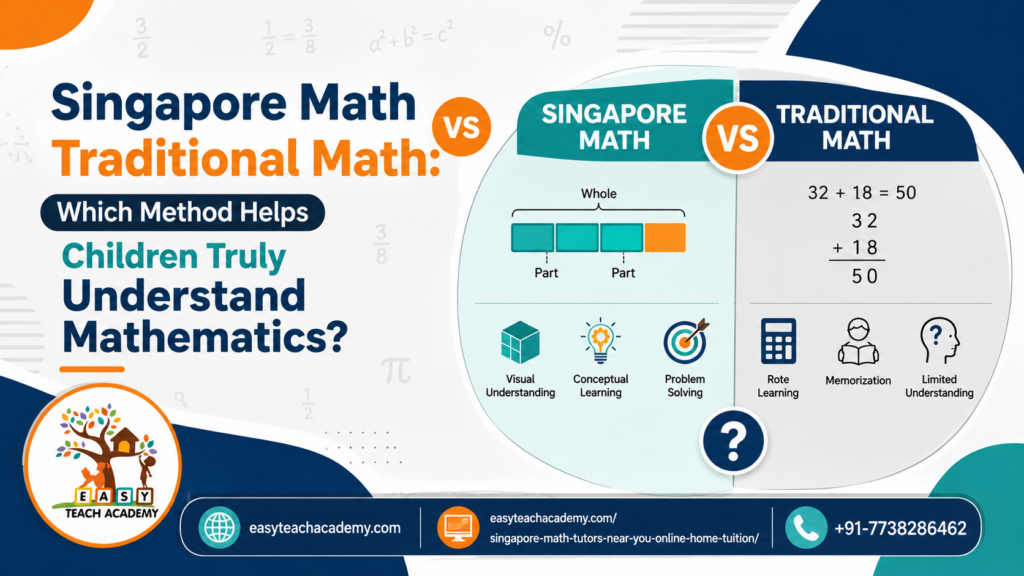
Learning Through Visual Models
Many children feel less anxious when they can see mathematical ideas.
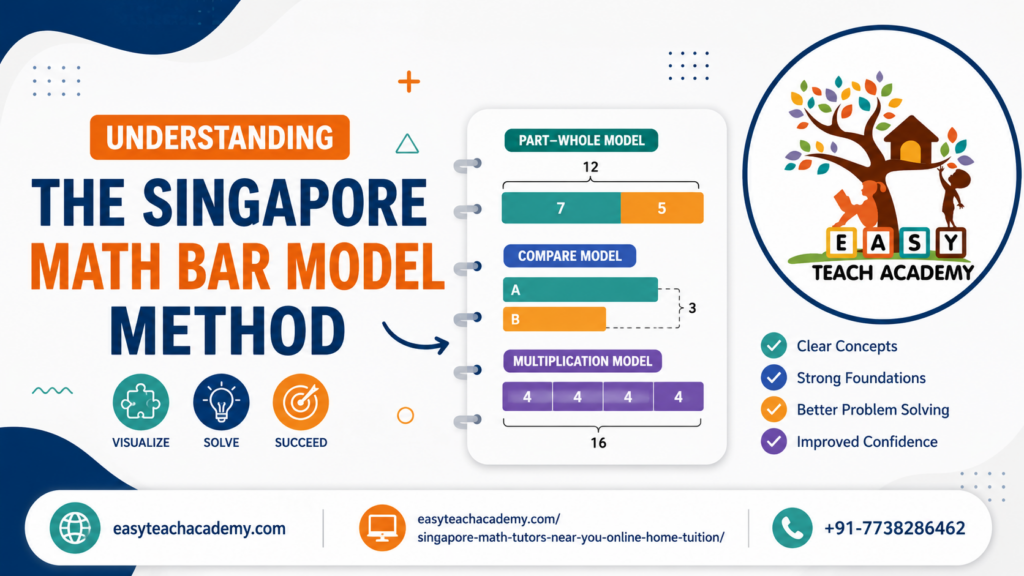
Singapore Math makes extensive use of visual strategies such as:
- Bar models
- Number bonds
- Number lines
- Part-whole diagrams
- Place value charts
- Arrays
These visual tools make abstract ideas easier to understand.
Instead of guessing which operation to use, children can organise information clearly and solve problems with greater confidence.
Small Successes Build Confidence
Children do not overcome math anxiety overnight.
Confidence grows through many small achievements.
The Singapore Primary Math curriculum introduces concepts gradually.
Each lesson builds on previous understanding.
As children experience success with one topic, they become more willing to attempt the next.
This steady progress helps reduce fear and encourages a positive attitude toward learning.
A Calm Learning Environment Matters
Children learn best when they feel safe to ask questions and make mistakes.
Singapore Math encourages teachers to guide students through the learning process rather than simply correcting wrong answers.
Instead of asking,
“Why did you get it wrong?”
teachers encourage questions such as:
- What were you thinking?
- Which step felt difficult?
- Can we solve it another way?
- What did you learn from this attempt?
This supportive environment helps children develop resilience and confidence.
Why Parents Around the World Choose Singapore Math
Families living in Singapore, Sydney, Brisbane, San Francisco, New York City, Toronto, and London are increasingly enrolling their children in Online Singapore Math Classes because they want a learning approach that builds understanding before speed.
Many parents also explore resources and enrichment programmes such as Matrix Math Singapore, Singapore Math Intensive Practice, Mental Arithmetic Singapore, and Singapore Math Challenge to strengthen their children’s skills.
Some families compare programmes such as Kumon Tampines or search for Singapore Math Lexington before deciding which teaching approach best matches their child’s learning needs.
Looking Beyond Marks
Reducing math anxiety is not only about improving examination scores.
It is about helping children:
- Enjoy learning.
- Develop confidence.
- Think independently.
- Solve problems calmly.
- Believe in their own abilities.
When children stop fearing mathematics, they become more willing to learn—and that often leads to stronger academic progress over time.
1. Learning at the Child’s Pace
One reason children become anxious is that lessons sometimes move faster than they can understand.
Singapore Math encourages teachers to build strong foundations before introducing more advanced topics.
For example, a child first learns:
- Number sense
- Place value
- Addition
- Subtraction
Only after mastering these ideas do they move to:
- Multiplication
- Division
- Fractions
- Decimals
- Percentages
This gradual progression helps children feel prepared instead of overwhelmed.
2. Visual Models Reduce Confusion
Many children feel anxious because mathematical ideas seem abstract.
Singapore Math makes learning more concrete by using visual models such as:
- Bar models
- Number bonds
- Number lines
- Arrays
- Place value charts
- Part-whole diagrams
Instead of trying to imagine the problem, children can see the relationships between numbers.
Visual learning reduces confusion and helps children solve problems more confidently.
3. Understanding Before Memorising
Children often become anxious when they memorise formulas without knowing why they work.
Singapore Math changes this approach.
Teachers explain:
- What the concept means.
- Why the method works.
- How ideas connect.
- When different strategies can be used.
Once children understand the concept, practice becomes much easier.
Understanding creates confidence.
4. Mistakes Become Opportunities to Learn
Children with math anxiety often fear making mistakes.
Singapore Math encourages a healthier mindset.
Instead of treating mistakes as failures, teachers use them as learning opportunities.
Questions such as these help children reflect:
- Which step was difficult?
- Why did this answer seem reasonable?
- Can we solve it differently?
- What have we learned?
This approach helps children realise that mistakes are a normal part of learning mathematics.
5. Small Successes Build Lasting Confidence
Confidence develops one lesson at a time.
Singapore Math is structured so children experience regular success.
Each new topic builds on previous understanding.
As children complete one concept successfully, they become more willing to tackle the next challenge.
Over time, this steady progress reduces anxiety and increases motivation.
6. Purposeful Practice Instead of Endless Repetition
Practice is important—but quality matters more than quantity.
Singapore Math Intensive Practice focuses on helping children apply ideas in different ways rather than simply repeating the same question many times.
Students learn to:
- Think flexibly.
- Apply concepts.
- Solve unfamiliar problems.
- Explain their reasoning.
This kind of meaningful practice helps children build genuine understanding instead of relying only on memory.
7. Strengthening Mental Calculation
Many parents also include Mental Arithmetic Singapore activities to improve:
- Number sense.
- Calculation speed.
- Accuracy.
- Concentration.
When mental arithmetic is combined with the conceptual understanding developed through Singapore Math, children become both faster and more confident.
8. Encouraging Healthy Challenges
Once children become more comfortable with mathematics, they often enjoy taking on new challenges.
Activities such as the Singapore Math Challenge introduce interesting problems that encourage:
- Logical thinking.
- Creative strategies.
- Careful reasoning.
- Independent problem-solving.
Children learn that challenging questions are opportunities to grow rather than situations to fear.
How Parents Can Reduce Math Anxiety at Home
Parents play an important role in shaping a child’s attitude toward mathematics.
Here are some simple ways to help.
Stay Positive
Avoid saying:
- “Math was always hard for me.”
- “I’m not good at maths either.”
Instead, remind your child that mathematical skills improve with practice and understanding.
Praise the Process
Celebrate:
- Careful thinking.
- Persistence.
- Improvement.
- Good strategies.
Rather than focusing only on correct answers.
Keep Practice Short and Consistent
Ten to twenty minutes of focused practice several times a week is often more effective than one long study session.
Consistency helps children build confidence gradually.
Encourage Questions
Invite your child to explain:
- Why they chose a method.
- How they solved the problem.
- Whether another solution is possible.
These conversations deepen understanding and reduce fear.
Why Families Around the World Appreciate This Approach
Parents living in Singapore, Sydney, Brisbane, San Francisco, New York City, Toronto, and London increasingly choose Online Singapore Math Classes because they provide personalised guidance and structured learning.
Some families also compare enrichment programmes such as Matrix Math Singapore, Kumon Tampines, and Singapore Math Lexington before selecting the option that best suits their child’s needs.
Regardless of the programme, many parents find that supportive teaching, concept-based learning, and regular encouragement help children feel more relaxed about mathematics.
What happens when a child finally overcomes math anxiety?
The transformation is often much bigger than simply improving mathematics marks.
Children begin to change the way they approach learning itself.
Children Become More Confident Learners
When children are no longer afraid of mathematics, they become more willing to participate.
Instead of saying,
“I can’t do this.”
they begin saying,
“Let me try.”
This small change in attitude often leads to significant improvements.
Children become more likely to:
- Attempt difficult questions.
- Complete homework independently.
- Ask thoughtful questions.
- Explain their reasoning.
- Learn from mistakes.
- Stay calm during tests.
Confidence grows through understanding, not pressure.
Better Problem-Solving Skills
Singapore Math encourages children to think before they calculate.
Instead of immediately searching for a formula, they learn to:
- Understand the question.
- Organise information.
- Choose a suitable strategy.
- Check whether the answer makes sense.
These habits help children solve unfamiliar problems both inside and outside the classroom.
Stronger Performance Across Subjects
The thinking skills developed through Singapore Primary Math are valuable beyond mathematics.
Parents often notice improvements in:
Science
Children become more confident when interpreting information, identifying patterns, and solving scientific problems.
Technology
Logical thinking supports coding, robotics, and computational thinking.
Reading and Comprehension
Word problems encourage children to read carefully, understand meaning, and identify important details before solving.
Everyday Life
Mathematics becomes useful for:
- Shopping.
- Budgeting.
- Measuring.
- Planning.
- Time management.
Children begin seeing mathematics as a practical life skill rather than just another school subject.
Preparing Children for Future Opportunities
The world is changing rapidly.
Many future careers require:
- Logical reasoning.
- Data analysis.
- Creative problem-solving.
- Decision-making.
- Independent learning.
Children who build these habits early are well prepared for future academic and professional challenges.
Singapore Math helps develop these essential skills from the primary years onward.
Learning That Supports International Education
Families living in Singapore, Sydney, Brisbane, San Francisco, New York City, Toronto, and London increasingly choose Online Singapore Math Classes because they complement a wide variety of school curricula.
Many parents also encourage participation in enrichment opportunities such as Kangaroo Math Singapore, where students apply logical reasoning and creative problem-solving. Success in these competitions depends on preparation, but a strong conceptual foundation is an excellent starting point.
Some families also use Singapore Math Intensive Practice, Matrix Math Singapore, and Mental Arithmetic Singapore as additional resources to reinforce classroom learning without losing sight of conceptual understanding.
Strong Foundations for Higher Education
Parents naturally hope their children will one day have opportunities to study at respected schools and universities.
Strong mathematical reasoning supports success throughout secondary school and higher education.
Many well-known institutions value analytical thinking and quantitative reasoning, including:
- National University of Singapore
- Nanyang Technological University
- University of Sydney
- Stanford University
- University of Toronto
- University of Oxford
Admission to these universities depends on many factors, but developing strong mathematical understanding early provides an excellent academic foundation.
About Me – Niral Devnath
Hello, I’m Niral Devnath, founder of Easy Teach Academy.
For more than 15 years, I have been teaching mathematics to children from around the world through live online classes.
I have had the privilege of working with students from:
- Singapore
- Australia
- United States
- United Kingdom
- Norway
- India
- Other international communities
Many of the children who joined my classes were not struggling because they lacked ability.
They were struggling because they lacked confidence.
Once they understood mathematical concepts clearly, their fear gradually disappeared.
They became more willing to ask questions, solve problems independently, and enjoy learning.
My teaching philosophy is simple:
- Build understanding before memorisation.
- Teach every child at their own pace.
- Encourage curiosity.
- Celebrate progress.
- Help children enjoy mathematics.
Every child deserves the opportunity to feel successful in maths.
Why Parents Choose Easy Teach Academy
At Easy Teach Academy, our goal is not only to improve marks but also to help children develop a positive relationship with mathematics.
Our Online Singapore Math Classes provide:
- Live interactive lessons.
- Small class sizes.
- Personalised teaching.
- Step-by-step concept-based learning.
- Regular assessments.
- Progress updates for parents.
- Flexible class timings for families across different countries.
Whether your child is experiencing math anxiety, needs extra support with Singapore Primary Math, or is looking for enrichment through the Singapore Math Method, we provide personalised guidance that helps children build confidence and long-term success.
Learn More About Our Singapore Math Programme
If you would like your child to enjoy mathematics instead of fearing it, we would be delighted to help.
Singapore Math Programme
Visit Easy Teach Academy
Frequently Asked Questions, Parent Action Plan, and Final Thoughts
Helping a child overcome math anxiety is not about finding a shortcut.
It is about creating positive learning experiences where children feel safe to ask questions, understand concepts, and gradually build confidence.
The Singapore Math Method supports this journey by replacing fear with understanding and confusion with clear, structured learning.
Let’s answer some of the most common questions parents ask.
Frequently Asked Questions
Can Singapore Math Really Help Reduce Math Anxiety?
Yes, many children benefit from Singapore Math because it focuses on understanding concepts before memorising formulas.
When children know why a method works, they often feel more confident when solving new types of questions.
A calm, supportive learning environment combined with concept-based teaching can significantly reduce stress around mathematics.
My Child Is Already Struggling. Is It Too Late to Start?
No.
Children can begin learning Singapore Math at different ages.
The key is to identify any learning gaps and rebuild their understanding step by step.
With patience and consistent support, many students regain confidence over time.
Are Online Singapore Math Classes Effective?
Yes.
Live Online Singapore Math Classes allow children to:
- Ask questions in real time.
- Receive immediate feedback.
- Learn through interactive activities.
- Progress at an appropriate pace.
- Study from the comfort of home.
For many families, online learning provides access to experienced teachers regardless of location.
Will Singapore Math Help with School Mathematics?
In many cases, yes.
The Singapore Primary Math approach strengthens number sense, reasoning, and problem-solving, which can support children studying a variety of school curricula.
Rather than replacing school learning, Singapore Math often complements it.
Does Every Child Need Intensive Practice?
Not necessarily.
Some children benefit from additional resources such as Singapore Math Intensive Practice, while others make excellent progress through regular lessons and guided practice.
The amount of practice should match the child’s learning needs rather than simply increasing workload.
Common Myths About Math Anxiety
Myth 1: My Child Is Just “Not a Maths Person”
Most children can improve their mathematical ability with effective teaching, regular practice, and encouragement.
Confidence grows through understanding and experience.
Myth 2: More Homework Will Solve the Problem
Completing large amounts of repetitive homework does not always reduce anxiety.
Children often make greater progress through meaningful practice that develops understanding and problem-solving skills.
Myth 3: Mental Arithmetic Alone Builds Mathematical Understanding
Programmes focused on Mental Arithmetic Singapore can strengthen speed and calculation skills.
However, conceptual understanding remains essential.
Children need both calculation fluency and reasoning skills to become confident mathematical thinkers.
Myth 4: Every Child Learns the Same Way
Every learner is different.
Some children understand quickly through visual models.
Others benefit from additional explanation, discussion, or guided practice.
A flexible teaching approach helps children progress according to their individual needs.
A Parent’s Action Plan
Supporting a child with math anxiety does not require complicated strategies.
Small, consistent actions often have the greatest impact.
Create a Positive Learning Environment
Encourage questions without criticising mistakes.
Children learn more effectively when they feel safe to explore ideas.
Focus on Understanding
Instead of asking,
“Did you get the answer right?”
try asking,
- How did you solve it?
- Why does that method work?
- Can you think of another way?
These conversations strengthen reasoning.
Keep Practice Short and Consistent
Regular practice for 15–20 minutes is often more productive than long study sessions that leave children feeling tired or frustrated.
Celebrate Progress
Recognise effort, improvement, and persistence.
Confidence grows when children notice their own progress.
Choose the Right Learning Support
An experienced teacher can identify misunderstandings, explain concepts clearly, and adapt lessons to suit your child’s pace.
This personalised guidance often makes a significant difference.
Why Families Around the World Choose Singapore Math
Parents in Singapore, Sydney, Brisbane, San Francisco, New York City, Toronto, and London continue choosing Singapore Math because it develops understanding alongside confidence.
Many families also explore enrichment opportunities such as Kangaroo Math Singapore, Matrix Math Singapore, Singapore Math Challenge, and Singapore Math Intensive Practice to extend learning beyond the classroom.
Some parents compare different learning centres, including Kumon Tampines, before deciding on the programme that best suits their child’s learning style. Regardless of the programme chosen, a concept-based approach and supportive teaching environment are key factors in helping children overcome math anxiety.
Children who build strong reasoning skills during the primary years are well prepared for future learning at respected institutions such as National University of Singapore, University of Sydney, Stanford University, University of Toronto, and University of Oxford. While admission depends on many factors, strong mathematical reasoning provides an excellent foundation for future academic success.
About Me – Niral Devnath
Hello, I’m Niral Devnath, founder of Easy Teach Academy.
For more than 15 years, I have helped children from Singapore, Australia, the United States, the United Kingdom, Norway, India, and many other countries improve their mathematical understanding through live online teaching.
One thing I have learned throughout my teaching journey is that most children are capable of succeeding in mathematics when they are taught with patience, clarity, and encouragement.
My lessons focus on:
- Building concepts before memorisation.
- Encouraging logical thinking.
- Reducing fear through understanding.
- Developing independent problem-solving skills.
- Helping every child enjoy mathematics.
Watching students transform from anxious learners into confident problem-solvers continues to be the most rewarding part of my work.
Why Parents Choose Easy Teach Academy
At Easy Teach Academy, we believe every child deserves to enjoy mathematics.
Our Online Singapore Math Classes are designed to help students:
- Build strong conceptual understanding.
- Reduce math anxiety.
- Develop logical reasoning.
- Improve problem-solving skills.
- Gain confidence through personalised learning.
Parents choose us because we provide:
- Live interactive online classes.
- Small batches for individual attention.
- Structured lesson plans.
- Regular assessments.
- Parent progress updates.
- Flexible schedules for international students.
- Personal guidance from an experienced mathematics educator.
Whether your child needs help with Singapore Primary Math, wants additional enrichment, or simply needs a more supportive way to learn mathematics, we are committed to helping every learner succeed.
Start Your Child’s Journey Toward Confident Mathematics
If your child feels anxious about mathematics today, remember that confidence can be built one concept at a time.
With the right guidance, a supportive learning environment, and a structured approach like Singapore Math, children can develop the skills they need to enjoy learning and solve problems with confidence.
Learn More About Our Singapore Math Programme
Visit Easy Teach Academy
We proudly teach students from Singapore, Australia, United States, Canada, United Kingdom, India, and many other countries through live, interactive online classes.
Final Thoughts
Math anxiety does not define a child’s potential.
With patient teaching, meaningful practice, and concept-based learning, children can replace fear with understanding and uncertainty with confidence.
The Singapore Math Method offers a structured pathway that helps children develop strong mathematical foundations while encouraging curiosity, resilience, and independent thinking.
Every confident mathematician begins with a single step—and for many children, that step starts with understanding.
Part 4: Frequently Asked Questions, Parent Action Plan, and Final Thoughts
Helping a child overcome math anxiety is not about finding a shortcut.
It is about creating positive learning experiences where children feel safe to ask questions, understand concepts, and gradually build confidence.
The Singapore Math Method supports this journey by replacing fear with understanding and confusion with clear, structured learning.
Let’s answer some of the most common questions parents ask.
Frequently Asked Questions
Can Singapore Math Really Help Reduce Math Anxiety?
Yes, many children benefit from Singapore Math because it focuses on understanding concepts before memorising formulas.
When children know why a method works, they often feel more confident when solving new types of questions.
A calm, supportive learning environment combined with concept-based teaching can significantly reduce stress around mathematics.
My Child Is Already Struggling. Is It Too Late to Start?
No.
Children can begin learning Singapore Math at different ages.
The key is to identify any learning gaps and rebuild their understanding step by step.
With patience and consistent support, many students regain confidence over time.
Are Online Singapore Math Classes Effective?
Yes.
Live Online Singapore Math Classes allow children to:
- Ask questions in real time.
- Receive immediate feedback.
- Learn through interactive activities.
- Progress at an appropriate pace.
- Study from the comfort of home.
For many families, online learning provides access to experienced teachers regardless of location.
Will Singapore Math Help with School Mathematics?
In many cases, yes.
The Singapore Primary Math approach strengthens number sense, reasoning, and problem-solving, which can support children studying a variety of school curricula.
Rather than replacing school learning, Singapore Math often complements it.
Does Every Child Need Intensive Practice?
Not necessarily.
Some children benefit from additional resources such as Singapore Math Intensive Practice, while others make excellent progress through regular lessons and guided practice.
The amount of practice should match the child’s learning needs rather than simply increasing workload.
Common Myths About Math Anxiety
Myth 1: My Child Is Just “Not a Maths Person”
Most children can improve their mathematical ability with effective teaching, regular practice, and encouragement.
Confidence grows through understanding and experience.
Myth 2: More Homework Will Solve the Problem
Completing large amounts of repetitive homework does not always reduce anxiety.
Children often make greater progress through meaningful practice that develops understanding and problem-solving skills.
Myth 3: Mental Arithmetic Alone Builds Mathematical Understanding
Programmes focused on Mental Arithmetic Singapore can strengthen speed and calculation skills.
However, conceptual understanding remains essential.
Children need both calculation fluency and reasoning skills to become confident mathematical thinkers.
Myth 4: Every Child Learns the Same Way
Every learner is different.
Some children understand quickly through visual models.
Others benefit from additional explanation, discussion, or guided practice.
A flexible teaching approach helps children progress according to their individual needs.
A Parent’s Action Plan
Supporting a child with math anxiety does not require complicated strategies.
Small, consistent actions often have the greatest impact.
Create a Positive Learning Environment
Encourage questions without criticising mistakes.
Children learn more effectively when they feel safe to explore ideas.
Focus on Understanding
Instead of asking,
“Did you get the answer right?”
try asking,
- How did you solve it?
- Why does that method work?
- Can you think of another way?
These conversations strengthen reasoning.
Keep Practice Short and Consistent
Regular practice for 15–20 minutes is often more productive than long study sessions that leave children feeling tired or frustrated.
Celebrate Progress
Recognise effort, improvement, and persistence.
Confidence grows when children notice their own progress.
Choose the Right Learning Support
An experienced teacher can identify misunderstandings, explain concepts clearly, and adapt lessons to suit your child’s pace.
This personalised guidance often makes a significant difference.
Why Families Around the World Choose Singapore Math
Parents in Singapore, Sydney, Brisbane, San Francisco, New York City, Toronto, and London continue choosing Singapore Math because it develops understanding alongside confidence.
Many families also explore enrichment opportunities such as Kangaroo Math Singapore, Matrix Math Singapore, Singapore Math Challenge, and Singapore Math Intensive Practice to extend learning beyond the classroom.
Some parents compare different learning centres, including Kumon Tampines, before deciding on the programme that best suits their child’s learning style. Regardless of the programme chosen, a concept-based approach and supportive teaching environment are key factors in helping children overcome math anxiety.
Children who build strong reasoning skills during the primary years are well prepared for future learning at respected institutions such as National University of Singapore, University of Sydney, Stanford University, University of Toronto, and University of Oxford. While admission depends on many factors, strong mathematical reasoning provides an excellent foundation for future academic success.
About Me – Niral Devnath
Hello, I’m Niral Devnath, founder of Easy Teach Academy.
For more than 15 years, I have helped children from Singapore, Australia, the United States, the United Kingdom, Norway, India, and many other countries improve their mathematical understanding through live online teaching.
One thing I have learned throughout my teaching journey is that most children are capable of succeeding in mathematics when they are taught with patience, clarity, and encouragement.
My lessons focus on:
- Building concepts before memorisation.
- Encouraging logical thinking.
- Reducing fear through understanding.
- Developing independent problem-solving skills.
- Helping every child enjoy mathematics.
Watching students transform from anxious learners into confident problem-solvers continues to be the most rewarding part of my work.
Why Parents Choose Easy Teach Academy
At Easy Teach Academy, we believe every child deserves to enjoy mathematics.
Our Online Singapore Math Classes are designed to help students:
- Build strong conceptual understanding.
- Reduce math anxiety.
- Develop logical reasoning.
- Improve problem-solving skills.
- Gain confidence through personalised learning.
Parents choose us because we provide:
- Live interactive online classes.
- Small batches for individual attention.
- Structured lesson plans.
- Regular assessments.
- Parent progress updates.
- Flexible schedules for international students.
- Personal guidance from an experienced mathematics educator.
Whether your child needs help with Singapore Primary Math, wants additional enrichment, or simply needs a more supportive way to learn mathematics, we are committed to helping every learner succeed.
Start Your Child’s Journey Toward Confident Mathematics
If your child feels anxious about mathematics today, remember that confidence can be built one concept at a time.
With the right guidance, a supportive learning environment, and a structured approach like Singapore Math, children can develop the skills they need to enjoy learning and solve problems with confidence.
Learn More About Our Singapore Math Programme
Visit Easy Teach Academy
We proudly teach students from Singapore, Australia, United States, Canada, United Kingdom, India, and many other countries through live, interactive online classes.
Final Thoughts
Math anxiety does not define a child’s potential.
With patient teaching, meaningful practice, and concept-based learning, children can replace fear with understanding and uncertainty with confidence.
The Singapore Math Method offers a structured pathway that helps children develop strong mathematical foundations while encouraging curiosity, resilience, and independent thinking.
Every confident mathematician begins with a single step—and for many children, that step starts with understanding.