
Mathematics is one of the most important subjects children learn during their school years. Strong maths skills help students solve problems, think logically, and succeed in many academic and professional fields. However, many parents notice that their children struggle with calculations, lack confidence in maths, or find traditional teaching methods difficult to follow.
As a result, parents often search for effective maths learning methods that can make learning easier and more enjoyable. One approach that has gained worldwide popularity is Abacus Maths Training.
But how does Abacus compare with Traditional Maths? Which method helps children learn faster? Is Abacus a replacement for school maths, or does it work alongside traditional learning?
In this comprehensive guide, we will compare Abacus and Traditional Maths in detail so that parents can make an informed decision about the best maths program for kids.
Understanding Traditional Maths Learning
Traditional maths is the method taught in schools worldwide.
Students typically learn through:
- Textbooks
- Worksheets
- Written calculations
- Classroom instruction
- Homework assignments
- Formula memorization
The primary goal is to help children understand mathematical concepts and apply them to various problems.
Traditional maths covers:
- Number systems
- Addition and subtraction
- Multiplication and division
- Fractions and decimals
- Geometry
- Algebra
- Statistics
- Problem-solving
It provides the academic foundation required for school examinations and higher education.
What Is Abacus Maths?
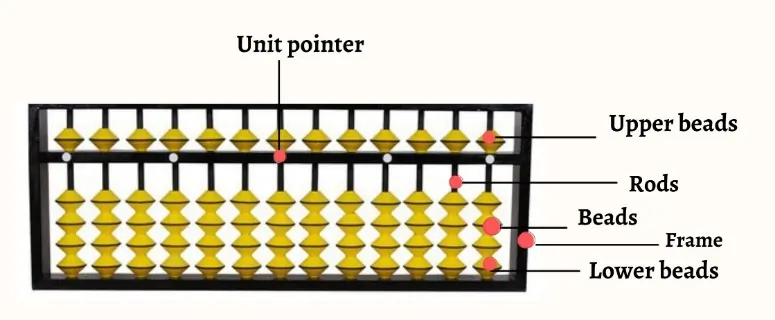
Abacus Maths is a learning system that uses a bead-based counting tool called an abacus.
Children begin by learning calculations on a physical abacus. As they progress, they develop the ability to visualize the abacus mentally and perform calculations without any physical tool.
This advanced stage is known as Mental Abacus.
Abacus training focuses on:
- Mental calculation
- Visualization
- Concentration
- Memory development
- Speed and accuracy
Unlike traditional maths, which often relies on written methods, Abacus encourages children to calculate mentally.
Abacus vs Traditional Maths: Key Differences
| Feature | Abacus Maths | Traditional Maths |
|---|---|---|
| Learning Style | Visual and interactive | Written and conceptual |
| Calculation Method | Mental visualization | Paper-based calculations |
| Speed Development | High focus on speed | Moderate focus on speed |
| Memory Training | Strong emphasis | Limited emphasis |
| Concentration Building | Excellent | Moderate |
| Brain Development | Both brain hemispheres engaged | Primarily logical thinking |
| Confidence Building | High due to quick results | Depends on student performance |
| School Curriculum Coverage | Limited | Complete curriculum coverage |
How Children Learn Through Traditional Maths
Traditional maths focuses heavily on understanding mathematical rules and procedures.
For example:
When solving:
245 + 378
Students typically:
- Write the numbers vertically.
- Add each column.
- Carry numbers when necessary.
- Write the final answer.
This method develops understanding but may require more time, especially for larger calculations.
How Children Learn Through Abacus
Using Abacus, children learn to represent numbers through bead positions.
Eventually, they visualize these beads mentally.
When solving:
245 + 378
They imagine moving beads on a mental abacus and quickly arrive at the answer.
With practice, calculations become extremely fast.
Which Method Improves Calculation Speed Faster?
One of the biggest advantages of Abacus training is calculation speed.
Children who regularly practice Abacus often become capable of solving:
- Addition problems
- Subtraction problems
- Multiplication problems
- Division problems
much faster than traditional written methods.
This speed develops because students rely on visualization rather than writing each step.
Winner: Abacus
For mental calculation speed, Abacus has a clear advantage.
Which Method Improves Concentration Better?
Concentration is essential for academic success.
Traditional maths develops concentration through:
- Completing worksheets
- Solving problems
- Following classroom instructions
However, Abacus requires continuous focus because students must:
- Visualize bead positions
- Track movements mentally
- Avoid distractions
Even a brief loss of concentration can result in mistakes.
Winner: Abacus
Abacus provides stronger concentration training.
Which Method Improves Memory More Effectively?
Memory plays an important role in learning.
Traditional maths often involves:
- Memorizing formulas
- Remembering procedures
- Learning multiplication tables
Abacus develops memory differently.
Children must remember:
- Bead positions
- Number patterns
- Visualization sequences
- Mental calculations
Regular practice strengthens working memory and visual memory.
Winner: Abacus
Abacus provides more direct memory training.
Which Method Builds Better Problem-Solving Skills?
Problem-solving is a major objective of mathematics education.
Traditional maths exposes students to:
- Word problems
- Logical reasoning
- Mathematical applications
- Complex concepts
These activities help students develop analytical thinking.
Abacus focuses primarily on numerical processing rather than complex problem-solving situations.
Winner: Traditional Maths
Traditional maths offers broader problem-solving opportunities.
Which Method Makes Children More Confident?
Many children struggle with maths because they fear making mistakes.
Abacus often produces noticeable improvements in speed and accuracy within a relatively short period.
As children experience success, their confidence grows.
Parents frequently observe that children who once disliked maths become enthusiastic learners after joining Abacus programmes.
Winner: Abacus
Abacus often boosts confidence more quickly.
Which Method Is Better for School Exams?
School exams assess a wide range of mathematical concepts.
Students must understand:
- Fractions
- Decimals
- Geometry
- Algebra
- Data handling
- Word problems
Abacus does not replace these topics.
Traditional maths remains essential for academic success.
Winner: Traditional Maths
School curriculum learning is indispensable.
Does Abacus Replace Traditional Maths?
This is one of the most common questions parents ask.
The answer is:
No.
Abacus is not a replacement for traditional maths.
Instead, it acts as a powerful supplement.
Traditional maths teaches:
- Concepts
- Formulas
- Mathematical reasoning
Abacus develops:
- Speed
- Concentration
- Memory
- Visualization
- Mental calculation
The two methods work best when used together.
Why Many Parents Choose Both Methods
The most successful students often combine:
School Maths
For conceptual understanding.
Abacus Training
For mental development and calculation skills.
This combination provides:
- Faster calculations
- Better concentration
- Improved confidence
- Stronger memory
- Better academic performance
Real-Life Benefits of Abacus Beyond Maths
Abacus training supports many areas of learning.
Children often experience improvements in:
Reading
Better focus and attention.
Writing
Greater concentration during assignments.
Science
Enhanced observation and analytical thinking.
Language Learning
Improved memory retention.
Daily Life
Better decision-making and confidence.
What Age Is Best for Learning Abacus?
Most experts recommend starting between:
5 and 14 years of age
This period is ideal because the brain is highly receptive to visualization and cognitive training.
However, older learners can also benefit from Abacus practice.
Signs Your Child May Benefit from Abacus
Your child may benefit if they:
- Make careless calculation errors
- Have difficulty concentrating
- Lack confidence in maths
- Depend heavily on calculators
- Need help developing memory skills
- Become frustrated during maths homework
How to Choose the Best Maths Program for Kids
When selecting a maths programme, parents should look for:
Experienced Teachers
Qualified instructors who understand child development.
Structured Curriculum
A clear progression from beginner to advanced levels.
Interactive Learning
Engaging activities that maintain motivation.
Regular Practice
Consistent exercises that reinforce learning.
Progress Tracking
Regular feedback for parents and students.
Why Online Abacus Classes Are Growing Worldwide
Parents in countries such as:
- Australia
- Singapore
- United Kingdom
- Finland
- Canada
- United States
are increasingly enrolling children in online Abacus programmes because they offer:
- Flexible schedules
- Interactive lessons
- Personal attention
- Convenient home learning
- Global access to experienced instructors
Frequently Asked Questions
Which is better, Abacus or Traditional Maths?
Both are valuable. Traditional Maths teaches concepts and curriculum content, while Abacus develops speed, concentration, memory, and mental calculation skills.
Can Abacus improve school performance?
Yes. Many students become more confident and accurate in calculations, which supports classroom learning.
Does Abacus make children smarter?
Abacus helps strengthen cognitive skills such as concentration, memory, visualization, and mental processing speed.
Can children learn both Abacus and school maths?
Absolutely. In fact, combining both methods often produces the best results.
What is the best age to start Abacus?
Most children begin between 5 and 14 years of age.
Conclusion
When comparing Abacus vs Traditiona
l Maths, it becomes clear that both approaches serve different purposes.
Traditional Maths provides the academic knowledge required for school success, while Abacus develops mental abilities such as concentration, visualization, memory, confidence, and rapid calculation skills.
Rather than choosing one over the other, parents should view Abacus as a valuable companion to traditional maths education. Together, these methods create a balanced learning experience that helps children become faster, more confident, and more capable learners.
For families searching for the best maths program for kids, combining traditional classroom learning with structured Abacus training can provide long-term academic and cognitive benefits.
About the Author
Niral Devnath is an experienced educator with more than 15 years of teaching experience. Through Easy Teach Academy, he provides online Abacus, Mental Maths, Vedic Maths, and English learning programmes for students worldwide. His mission is to help children build strong academic foundations while developing concentration, confidence, and lifelong learning skills.


⭐⭐⭐⭐⭐
I was impressed by how this article connects AI, technology, and the importance of phonics in such a practical way. Instead of viewing AI as a replacement for learning, it explains why strong phonics, literacy skills, and future reading skills are the real foundation for children’s long-term success. The examples used throughout the blog made the concepts easy to understand.
I particularly enjoyed the sections that explain how teaching phonics helps children become independent readers and why a structured phonics reading program remains essential in 2026. The information about Hooked on Phonics Reading, Hooked on Phonics Online, free phonics games, and even the CBEST Reading Practice Test added extra value for parents looking for different learning resources.
The article is engaging, relevant, and reassuring for parents navigating today’s technology-driven world. It clearly shows that while AI is a powerful tool, children who develop strong reading habits and comprehension skills will always have an advantage. A must-read for every parent who wants to prepare their child for the future.