Introduction
“My child knows addition, subtraction, multiplication, and division, but struggles with word problems.”
If this sounds familiar, you are not alone.
Word problems are one of the biggest challenges children face in mathematics. Many students know the calculations but cannot determine which operation to use.
This is exactly why schools using Singapore Math teach the Singapore Math Bar Model Method.
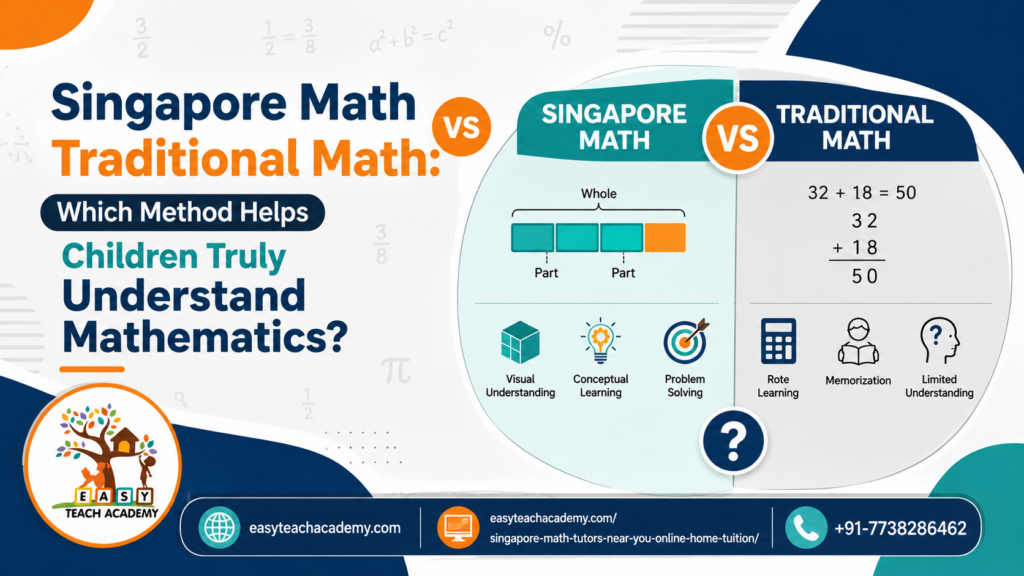
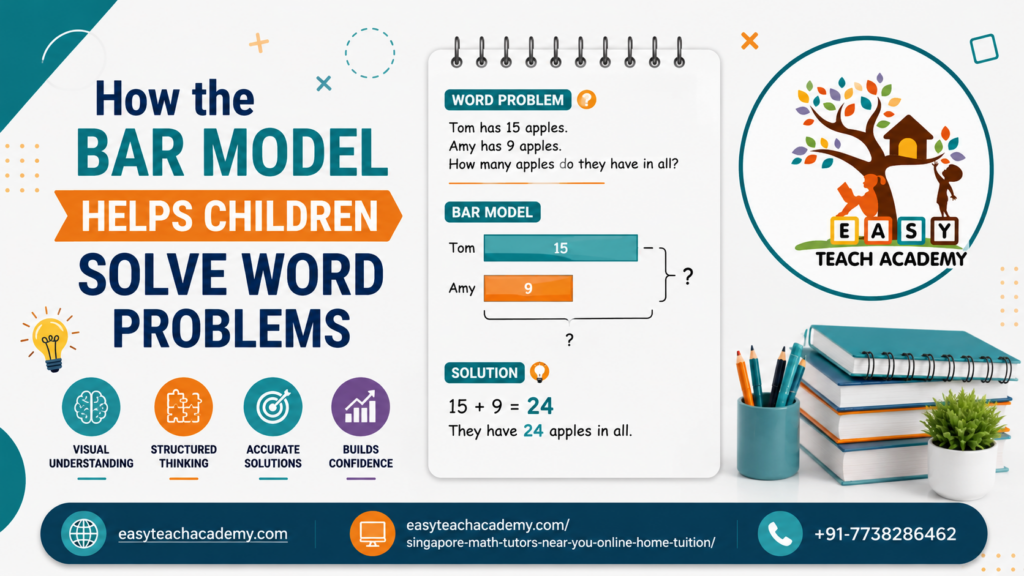
Bar modeling transforms confusing word problems into simple visual diagrams that children can understand.
Instead of guessing, students learn to see the relationships between numbers.
This approach has helped millions of students worldwide become confident problem solvers.
In this guide, you will learn:
- What a bar model is
- Why it works so well
- Different types of bar models
- Step-by-step examples
- Advanced challenge problems
- Common mistakes to avoid
- How parents can help at home
What Is a Bar Model?
A Singapore Math Bar Model is a visual diagram that represents quantities using rectangular bars.
Instead of immediately writing equations, children first draw bars.
The bars help students:
- Organize information
- Understand relationships
- Identify missing values
- Choose the correct operation
- Solve complex word problems
Think of bar models as a bridge between arithmetic and algebra.
Children learn to visualize mathematics before working with symbols.
Why Do Schools Teach Bar Modeling?
Bar modeling develops deeper understanding.
Rather than memorizing keywords such as:
- Altogether = add
- Left = subtract
- Each = multiply
Students learn to think.
Benefits include:
- Better problem-solving skills
- Improved reasoning
- Reduced guessing
- Stronger mathematical confidence
- Preparation for algebra
This is why Singapore Math Programs use bar models extensively.
Types of Bar Models
There are three major types.
1. Part-Whole Model
Used when smaller parts combine to form a total.
Example:
Sam has 35 red marbles and 25 blue marbles.
How many marbles does he have altogether?
Bar Model
Red = 35
Blue = 25
Total = ?
35 + 25 = 60
Answer = 60
2. Comparison Model
Used when comparing quantities.
Example:
Emma has 48 stickers.
Lucy has 15 more stickers than Emma.
How many stickers does Lucy have?
Bar Model
Emma = 48
Lucy = 48 + 15
48 + 15 = 63
Answer = 63
3. Multiplication Model
Used when equal groups are involved.
Example:
There are 8 baskets.
Each basket contains 6 apples.
How many apples are there?
Bar Model
6 + 6 + 6 + 6 + 6 + 6 + 6 + 6
8 × 6 = 48
Answer = 48
Why Bar Models Are So Powerful
Many children struggle because word problems contain lots of text.
Bar models help students:
Visualize
Children see the problem.
Organize Information
Important numbers become easier to identify.
Build Logical Thinking
Students learn relationships.
Prepare for Algebra
Unknown values become easier to understand.
Real Example 1: Part-Whole Problem
A school collected 275 books on Monday and 368 books on Tuesday.
How many books were collected altogether?
Bar Model
Monday = 275
Tuesday = 368
Total = ?
275 + 368 = 643
Answer = 643 books
Real Example 2: Comparison Problem
Ryan has $125.
David has $45 more than Ryan.
How much money does David have?
Bar Model
Ryan = 125
David = 125 + 45
125 + 45 = 170
Answer = $170
Real Example 3: Missing Part Problem
A box contains 95 chocolates.
35 chocolates were eaten.
How many remain?
Bar Model
Total = 95
Eaten = 35
Remaining = ?
95 − 35 = 60
Answer = 60 chocolates
Difficult Example 4: Advanced Comparison Problem
Sarah has three times as much money as Emma.
Together they have $280.
How much money does each girl have?
Step 1
Emma = 1 unit
Sarah = 3 units
Total = 4 units
Step 2
280 ÷ 4 = 70
Step 3
Emma = $70
Sarah = $210
Answer:
Emma = $70
Sarah = $210
Difficult Example 5: Ratio Bar Model
The ratio of boys to girls is 4 : 5.
There are 180 students.
How many girls are there?
Step 1
Total units
4 + 5 = 9
Step 2
One unit
180 ÷ 9 = 20
Step 3
Girls
20 × 5 = 100
Answer = 100 girls
Difficult Example 6: Fraction Bar Model
A water tank is 3/4 full.
The tank holds 1,200 litres when full.
How much water is currently in the tank?
Step 1
1/4 = 1200 ÷ 4 = 300
Step 2
3/4 = 300 × 3
= 900
Answer = 900 litres
Difficult Example 7: Multi-Step Problem
A library has 2,450 books.
It buys 375 more books and later donates 425 books.
How many books remain?
Step 1
2450 + 375 = 2825
Step 2
2825 − 425 = 2400
Answer = 2,400 books
Difficult Example 8: Advanced Singapore Math Challenge
The sum of two numbers is 420.
One number is twice the other.
Find both numbers.
Step 1
Small number = 1 unit
Large number = 2 units
Total = 3 units
Step 2
420 ÷ 3 = 140
Step 3
Small number = 140
Large number = 280
Answer:
140 and 280
Difficult Example 9: Olympiad-Style Problem
The sum of three numbers is 360.
The second number is twice the first.
The third number is three times the first.
Find all three numbers.
Step 1
First = 1 unit
Second = 2 units
Third = 3 units
Total = 6 units
Step 2
360 ÷ 6 = 60
Step 3
First = 60
Second = 120
Third = 180
Answer:
60, 120, 180
Difficult Example 10: Age Problem
A father is four times as old as his son.
Together their ages total 50 years.
Find their ages.
Step 1
Son = 1 unit
Father = 4 units
Total = 5 units
Step 2
50 ÷ 5 = 10
Step 3
Son = 10
Father = 40
Answer:
Son = 10 years
Father = 40 years
Common Mistakes Children Make
Skipping the Diagram
Many students immediately start calculating.
Bar models should come first.
Using Wrong Units
Children sometimes draw unequal bars.
Bars must represent correct relationships.
Guessing Operations
The purpose of bar modeling is to eliminate guessing.
Ignoring the Question
Always identify exactly what needs to be found.
Rushing Through the Problem
Drawing carefully often prevents mistakes.
How Parents Can Help at Home
Ask Your Child to Draw
Even simple problems can use bar models.
Encourage Explanation
Ask:
“Why did you draw the bars that way?”
Practice Daily
Ten minutes of word problems can make a huge difference.
Use Real-Life Situations
Shopping
Cooking
Travel planning
Sports statistics
Bar Models and NAPLAN Success
Bar modeling helps students solve many problem-solving questions that appear in:
- NAPLAN Test Questions
- NAPLAN Online Practice Test Year 5
- Free NAPLAN Practice Tests Year 7
- NAPLAN Year 3 Free Practice Tests
- NAPLAN Sample Tests Online Year 3
- NAPLAN Year 3 Example Test
- NAPLAN Practise Year 5
- NAPLAN Year 9 Practice Online
- NAPLAN Test Papers 2022
- NAPLAN Past Papers 2021
Many higher-level NAPLAN questions require students to interpret information, compare quantities, and solve multi-step word problems—exactly the skills developed through bar modeling.
Frequently Asked Questions
What age should children start bar modeling?
Most children can begin around Grades 1–2.
Is bar modeling only for Singapore Math?
No. It can support any curriculum.
Can bar models help struggling learners?
Yes. Visual learners often benefit greatly.
Can advanced students use bar models?
Absolutely. Many Olympiad-level problems can be solved using bar models.
Does bar modeling help with algebra?
Yes. It acts as a bridge to algebraic thinking.
Why do Singapore schools use bar models?
Because they improve understanding and problem-solving skills.
Why Choose Online Singapore Math Classes?
Parents increasingly choose Singapore Math Online learning because children receive:
- Live interactive instruction
- Individual attention
- Structured problem-solving practice
- Bar model training
- Progress tracking
- Flexible schedules
Why Parents Choose Easy Teach Academy
At Easy Teach Academy, we specialize in helping children develop strong mathematical foundations through Singapore Math Classes, visual problem-solving strategies, and personalized support.
Our programs include:
- Singapore Math Tutoring
- Bar Model Training
- Word Problem Solving
- Mental Math Development
- One-to-One Coaching
- Small Group Classes
- International Student Support
Website:
Singapore Math Program:
We help students move from confusion to confidence by teaching them how to think mathematically rather than simply memorize procedures.
Conclusion
The Singapore Math Bar Model Method is one of the most effective visual math strategies ever developed.
By turning complex word problems into simple diagrams, children learn to understand mathematical relationships, think logically, and solve problems with confidence.
Whether your child struggles with school math, NAPLAN questions, or advanced problem-solving tasks, bar modeling can provide the foundation needed for long-term success.
The goal is not just to find answers.
The goal is to understand why the answers work.