Best Ways to Support Singapore Math Homework
For many parents, homework time can become one of the most challenging parts of the day.
Your child sits at the table with a mathematics workbook, reads a question, and after a few minutes says,
“I don’t understand.”
As a parent, you naturally want to help.
But another question immediately follows:
“How much should I help?”
Should you explain the answer?
Should you solve the first question together?
Or should you allow your child to struggle until they figure it out independently?
These are common questions for families whose children are learning through the Singapore Math curriculum.
The good news is that supporting Singapore Math homework does not mean giving your child the answers.
Instead, it means helping them become confident thinkers who can solve problems independently.
This guide explains how parents can create a positive homework routine, encourage mathematical thinking, and support learning without creating dependency.
Why Singapore Math Homework Feels Different
Many parents notice that Singapore Math homework looks different from traditional mathematics worksheets.
Instead of page after page of repetitive calculations, children often encounter:
- Multi-step word problems.
- Visual diagrams.
- Number bonds.
- Bar model questions.
- Mental maths activities.
- Questions asking them to explain their thinking.
This is intentional.
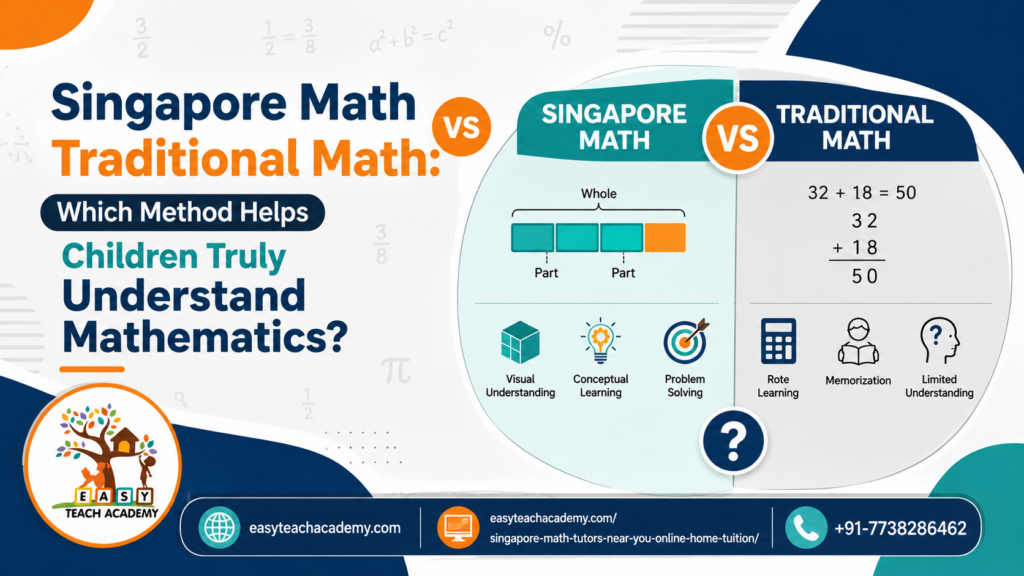
The Singapore Math method focuses on helping children understand mathematical concepts instead of simply memorising procedures. Students are encouraged to think deeply, explore different strategies, and explain why an answer works. This emphasis on conceptual understanding is one of the defining features of the approach.
Because of this, homework becomes an opportunity to strengthen reasoning rather than just practise calculations.
Your Role as a Parent
One of the biggest misconceptions is that parents must become mathematics teachers at home.
In reality, your role is different.
You are not expected to replace the teacher.
Instead, you become:
- A coach.
- A guide.
- An encourager.
- A good listener.
Children benefit most when parents help them think instead of simply showing them the solution.
Research and experienced Singapore Math educators recommend guiding children through the learning process—first understanding concepts, then practising together, and finally encouraging independent work.
Why Giving Answers Can Slow Learning
Imagine your child asks,
“What is the answer to this question?”
The quickest response would be to solve it yourself.
However, this creates a hidden problem.
Your child learns the answer, but not the thinking process.
Next time a similar question appears, they may become dependent on another explanation.
The Singapore Math curriculum encourages children to discover solutions through reasoning.
Instead of answering immediately, try asking questions such as:
- What is the question asking?
- Which information do you already know?
- Can you explain the problem in your own words?
- Have you solved something similar before?
- Can you draw a picture?
These questions help children build confidence and independence.
Create a Positive Homework Routine
Children perform better when homework becomes part of a predictable daily routine.
Simple habits make a big difference.
Choose a Quiet Learning Space
Select a place that is:
- Comfortable.
- Well lit.
- Free from television.
- Free from unnecessary mobile phone distractions.
- Organised with pencils, rulers, and notebooks nearby.
A calm environment helps children concentrate more effectively.
Set a Regular Homework Time
Consistency is more important than studying for long hours.
Choose a time when your child is alert rather than tired.
For many families, homework works best after:
- A short snack.
- Some physical activity.
- A brief period of relaxation after school.
Keep Sessions Focused
Long study sessions often reduce concentration.
Instead, encourage focused learning with short breaks when needed.
A child who studies attentively for 30–40 minutes usually learns more effectively than one who spends two distracted hours at the table.
Encourage Thinking Before Writing
Many children immediately begin calculating as soon as they see numbers.
The Singapore Math method encourages a different habit.
Before writing anything, ask your child to:
- Read the entire question.
- Explain the situation.
- Identify what needs to be found.
- Decide which strategy might work best.
This habit improves understanding and reduces careless mistakes.
Help Your Child Understand Mistakes
Mistakes are an important part of learning.
Instead of saying,
“That’s wrong.”
Try asking,
- Can you explain your thinking?
- Where do you think the mistake happened?
- Is there another strategy you could try?
- Does your answer seem reasonable?
These conversations encourage reflection and help children become more independent learners.
Celebrate Effort, Not Just Correct Answers
Parents naturally feel happy when children get every question right.
However, confidence grows even more when effort is recognised.
Praise behaviours such as:
- Careful thinking.
- Persistence.
- Asking good questions.
- Trying different strategies.
- Checking answers.
Children who feel encouraged are often more willing to tackle challenging questions in the future.
Part 2: Practical Ways Parents Can Support Singapore Math Homework Every Day
In Part 1, we discussed why Singapore Math homework is different from traditional maths homework and how parents can create a positive learning environment at home.
Now, let’s explore practical strategies that successful families use to make homework time more productive, enjoyable, and less stressful.
These methods encourage children to become independent learners while strengthening the problem-solving skills that are at the heart of the Singapore Math curriculum.
Strategy 1: Read the Question Together
One of the biggest reasons children struggle with maths homework is that they rush through the question.
Many students begin calculating before they fully understand what is being asked.
Instead, encourage your child to:
- Read the entire question aloud.
- Read it a second time quietly.
- Explain the problem in their own words.
Ask questions such as:
- What is happening in this question?
- What information do we already know?
- What are we trying to find?
This simple routine improves understanding before any calculations begin.
Strategy 2: Encourage Your Child to Think Before Solving
The Singapore Math method teaches children to think first and calculate second.
When your child asks,
“What should I do?”
avoid giving the answer immediately.
Instead, ask guiding questions:
- Which numbers are important?
- What happened first?
- Is this asking you to find the total, the difference, or something else?
- Have you solved a similar question before?
These conversations help children become independent problem solvers.
Strategy 3: Use Visual Models
One of the greatest strengths of Singapore Math is visual learning.
Instead of relying only on equations, encourage your child to represent ideas using:
- Number bonds.
- Part-whole diagrams.
- Number lines.
- Place value charts.
- Arrays.
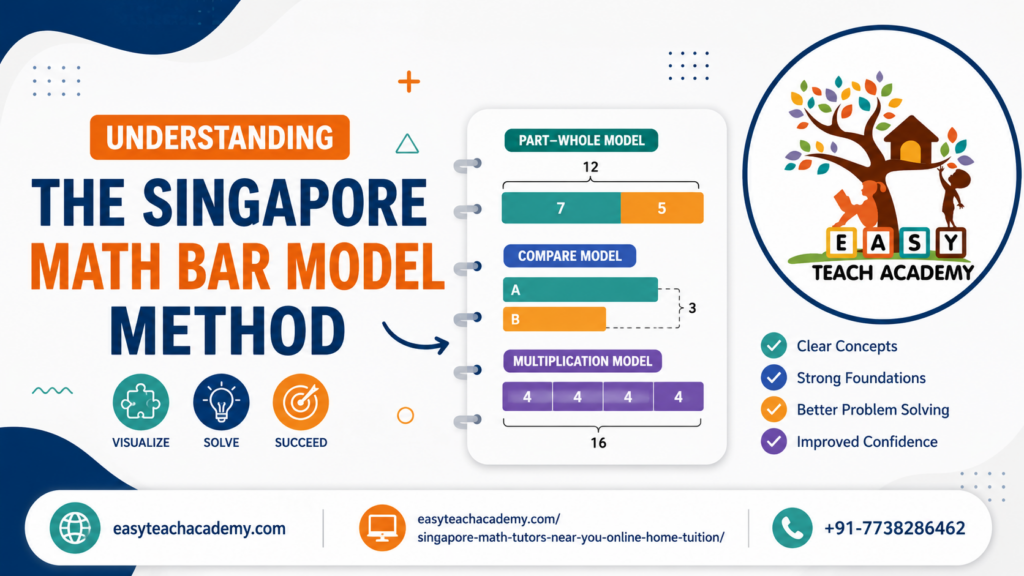
- The Singapore Math Bar Model.
Many children understand concepts much faster when they can see relationships visually.
Strategy 4: Let Your Child Explain Their Thinking
Children often know more than they realise.
Ask them to explain:
- Why they chose a particular method.
- How they reached the answer.
- Whether another strategy might also work.
When children explain their reasoning, they strengthen both mathematical understanding and communication skills.
Even if the answer is incorrect, their explanation helps identify where confusion began.
Strategy 5: Encourage Mental Maths
Before reaching for paper, encourage your child to estimate the answer mentally.
For example:
- Is the answer likely to be bigger or smaller?
- Approximately what should the answer be?
- Does the final answer seem reasonable?
Mental estimation develops strong number sense, which is one of the key goals of the Singapore Math curriculum.
Strategy 6: Break Difficult Questions into Smaller Parts
Some homework questions contain several steps.
Instead of trying to solve everything at once, encourage your child to work through each part separately.
For example:
- What information is given?
- What needs to be found first?
- What should be calculated next?
- What is the final answer?
Breaking problems into smaller sections reduces anxiety and improves accuracy.
Strategy 7: Teach Your Child to Check Their Work
Many mistakes happen because children finish a calculation and immediately move to the next question.
Successful learners develop the habit of reviewing their work.
Encourage your child to ask:
- Did I answer the question?
- Does my answer make sense?
- Have I copied every number correctly?
- Could I solve this another way?
Checking work helps children become more careful and independent.
Common Homework Mistakes Parents Should Avoid
Even with good intentions, parents sometimes make homework more difficult.
Mistake 1: Solving the Question Yourself
It may save time today, but it reduces learning tomorrow.
Guide your child instead of completing the work for them.
Mistake 2: Expecting Every Question to Be Easy
Learning happens when children face appropriate challenges.
Allow your child enough time to think before offering help.
Mistake 3: Correcting Every Small Mistake Immediately
Children benefit from finding and correcting their own errors.
Instead of pointing out every mistake, ask:
“Would you like to check this answer one more time?”
Mistake 4: Comparing Your Child with Others
Every child learns differently.
Focus on improvement rather than comparison.
Steady progress builds lasting confidence.
Make Mathematics Part of Everyday Life
Homework is only one opportunity to practise mathematics.
Children also learn through everyday experiences.
Try asking simple questions while:
Shopping
- Which item costs more?
- How much change should we receive?
- Which product offers better value?
Cooking
- Measure ingredients.
- Double a recipe.
- Divide food equally.
Travelling
- Estimate travel time.
- Compare distances.
- Read timetables.
At Home
- Count objects.
- Organise toys into groups.
- Compare lengths and weights.
- Create simple budgeting activities.
These experiences show children that mathematics is useful beyond school.
How Homework Builds Long-Term Success
Homework is not only about completing assignments.
It helps children develop:
- Responsibility.
- Time management.
- Independent learning.
- Persistence.
- Problem-solving skills.
- Confidence.
When supported correctly, homework becomes an opportunity to strengthen both mathematical understanding and positive learning habits.
Homework Should Build Understanding, Not Frustration
Homework should reinforce learning, not become a daily source of stress.
Unfortunately, many children experience homework like this:
- They become stuck on the first difficult question.
- They lose confidence quickly.
- They guess answers without understanding.
- They become dependent on parents for every step.
- They finish feeling frustrated instead of successful.
Over time, these experiences can reduce a child’s confidence in mathematics.
The Singapore Math method takes a different approach.
Instead of asking children to memorise procedures, it encourages them to understand concepts deeply before applying them independently.
As understanding grows, homework becomes more manageable and enjoyable.
Independence Is the Real Goal
Many parents measure homework success by asking:
“Did my child finish the worksheet?”
A more valuable question is:
“Could my child explain how they solved the questions?”
Children who can explain their thinking are developing genuine mathematical understanding.
The goal of Singapore Math homework is not simply to complete today’s assignment.
The goal is to help children become independent learners who can confidently solve tomorrow’s problems without relying on constant assistance.
Building Strong Homework Habits
Children who consistently succeed in mathematics often develop simple but powerful habits.
Encourage your child to:
Plan Before Solving
Read every question carefully before writing anything.
Organise Their Work
Keep calculations neat and easy to follow.
Well-organised work reduces careless mistakes.
Think Before Asking for Help
Instead of immediately saying,
“I don’t know,”
encourage your child to try one possible strategy first.
Even an unsuccessful attempt provides valuable learning.
Reflect After Completing Homework
Ask questions such as:
- Which question was easiest?
- Which one was most difficult?
- What did you learn today?
- Which strategy helped you the most?
Reflection strengthens long-term understanding.
Why Children Improve at Different Speeds
Parents sometimes worry when another child seems to learn mathematics more quickly.
However, learning speed varies naturally.
Some children:
- Learn quickly through visual diagrams.
- Need repeated examples.
- Prefer practical activities.
- Learn best through discussion.
The Singapore Math curriculum supports these different learning styles by introducing concepts gradually and building understanding step by step.
Progress should be measured against a child’s own previous performance rather than compared with classmates.
Meet Your Teacher – Niral Devnath
Hello, I’m Niral Devnath, founder of Easy Teach Academy.
For more than 15 years, I have been teaching mathematics to children from different countries, helping them develop confidence through concept-based learning.
During my teaching career, I have worked with students from:
- Singapore
- Australia
- United States
- United Kingdom
- Norway
- India
- Other international communities
Working with children from different educational systems has shown me one important truth:
Every child can improve in mathematics when concepts are explained clearly, patiently, and in a way that matches their learning style.
That belief forms the foundation of every lesson I teach.
My Teaching Philosophy
I believe that mathematics should help children become confident thinkers, not anxious learners.
Every lesson follows several important principles.
Understanding Before Memorisation
Children should know why a method works before learning shortcuts.
Encourage Questions
Children learn more when they feel comfortable asking questions and exploring different ideas.
Build Confidence Step by Step
Small achievements create motivation for greater success.
Every concept mastered becomes the foundation for future learning.
Make Learning Enjoyable
Children are naturally curious.
When mathematics is taught through discussion, visual models, and meaningful examples, learning becomes far more engaging.
Why Families Choose Easy Teach Academy
At Easy Teach Academy, we believe every child deserves personalised attention and structured guidance.
Our Online Singapore Math Classes are designed to help children:
- Build strong mathematical foundations.
- Improve problem-solving skills.
- Strengthen logical reasoning.
- Develop confidence.
- Enjoy learning mathematics.
Parents appreciate our teaching because we provide:
- Live interactive online classes.
- Small learning groups.
- Personalised instruction.
- Step-by-step concept building.
- Regular assessments.
- Parent progress updates.
- Flexible international class timings.
Our lessons are based on the proven principles of the Singapore Math curriculum, helping children understand concepts rather than memorise procedures.
Homework Becomes Easier with the Right Support
Many parents tell us that homework time changes significantly after children begin learning through structured Online Singapore Math Classes.
Instead of asking for constant help, students gradually begin to:
- Read questions independently.
- Choose suitable strategies.
- Solve problems confidently.
- Check their own work.
- Explain their reasoning.
These improvements often extend beyond homework into classroom learning and examinations.
Learn More About Our Singapore Math Programme
If you’re looking for a structured, engaging, and personalised approach to mathematics, we’d love to help.
Explore our Singapore Math programme:
Singapore Math Tutors
Visit our website to discover all our educational programmes:
Easy Teach Academy
A Simple Homework Success Plan for Parents
If you would like homework time to become calmer and more productive, try following this simple routine.
Step 1: Create the Right Environment
Choose a quiet place where your child can concentrate without unnecessary distractions.
Keep essential materials nearby, such as:
- Pencils
- Eraser
- Ruler
- Notebook
- Calculator (only if appropriate for the lesson)
A comfortable learning space helps children stay focused.
Step 2: Encourage Independent Thinking
Before helping, give your child time to think.
Ask questions like:
- What is the question asking?
- Which information is important?
- What strategy could you try first?
- Can you draw a diagram?
These questions guide children without taking away the opportunity to think for themselves.
Step 3: Review Together
After homework is complete, spend a few minutes discussing the work.
Instead of asking only,
“Did you finish?”
try asking:
- Which question was the most challenging?
- Which strategy helped you?
- What new idea did you learn today?
- Is there another way to solve this problem?
Reflection helps children remember concepts for longer.
Turning Mistakes into Learning Opportunities
Every child makes mistakes.
The difference between successful learners and struggling learners is how they respond to them.
When your child gets a question wrong:
Avoid saying:
“That’s incorrect.”
Instead, try:
- Let’s look at the question again.
- Can you explain your thinking?
- Where do you think the mistake happened?
- Is there another strategy we could try?
These conversations encourage children to analyse their own thinking instead of becoming discouraged.
How Homework Supports Future Success
Homework is about much more than completing assignments.
With consistent practice, children gradually develop:
- Stronger number sense.
- Better logical reasoning.
- Improved concentration.
- Independent learning habits.
- Greater confidence.
- Effective problem-solving skills.
These qualities support learning in mathematics, science, technology, engineering, economics, and many other subjects.
About Me – Niral Devnath
Hello, I’m Niral Devnath, founder of Easy Teach Academy.
For more than 15 years, I have been teaching mathematics to children from different educational systems and helping them become confident learners through concept-based instruction.
Over the years, I have taught students from Singapore, Australia, the United States, the United Kingdom, Norway, India, and several other countries.
Every child has unique strengths, challenges, and learning styles.
That is why I focus on personalised teaching that helps each student understand mathematical concepts rather than memorise procedures.
My teaching philosophy is based on four simple principles:
- Build understanding before speed.
- Encourage logical thinking.
- Develop confidence step by step.
- Make mathematics meaningful and enjoyable.
Watching children become confident enough to solve challenging problems independently is one of the most rewarding parts of my teaching journey.
Why Parents Choose Easy Teach Academy
Parents from different countries trust Easy Teach Academy because we focus on building lasting mathematical understanding.
Our Online Singapore Math Classes are designed to help children:
- Build strong mathematical foundations.
- Improve problem-solving skills.
- Develop logical reasoning.
- Strengthen confidence.
- Enjoy learning mathematics.
Our programme includes:
- Live interactive online lessons.
- Small class sizes.
- Personalised attention.
- Structured learning plans.
- Regular assessments.
- Parent progress reports.
- Flexible international schedules.
Rather than simply preparing children for the next test, we help them develop skills that support long-term academic success.
Learn more about our Singapore Math programme:
Explore all our educational programmes:
Frequently Asked Questions
How much help should I give my child with Singapore Math homework?
Guide your child with questions rather than giving answers. Encourage independent thinking and allow them time to explore different strategies before stepping in.
What should I do if my child gets stuck?
Ask your child to explain the problem in their own words, identify the important information, and consider drawing a diagram or using a visual model such as the Singapore Math Bar Model.
How long should homework take?
The ideal duration depends on your child’s age and school requirements. Focus on consistent, high-quality learning rather than long study sessions.
Can Online Singapore Math Classes help with homework?
Yes.
Live Online Singapore Math Classes help children strengthen concepts, improve problem-solving skills, and become more confident when completing school homework independently.
Is Singapore Math only for children who struggle?
No.
The Singapore Math curriculum benefits both children who need additional support and those looking for greater mathematical challenges.
Final Thoughts
Supporting Singapore Math homework is not about having all the answers.
It is about helping your child develop curiosity, confidence, and the ability to think independently.
When parents create a positive learning environment, encourage thoughtful discussion, and celebrate steady progress, homework becomes an opportunity for meaningful growth rather than a daily struggle.
Combined with structured teaching and consistent practice, these habits can help children develop a lifelong appreciation for mathematics.
Help Your Child Build Confidence in Mathematics
If you are looking for expert guidance and engaging Online Singapore Math Classes, Easy Teach Academy is here to support your child’s learning journey.
Our lessons are designed to help students:
- Understand mathematical concepts deeply.
- Master Singapore Math strategies.
- Improve logical reasoning.
- Solve problems with confidence.
- Enjoy learning mathematics.
Why Families Trust Easy Teach Academy
✔ 15+ years of teaching experience
✔ Live interactive Online Singapore Math Classes
✔ Personalised learning in small groups
✔ Structured lessons based on the Singapore Math curriculum
✔ Regular progress updates for parents
✔ Flexible class timings for students worldwide
Start Your Child’s Singapore Math Journey
Learn more about our classes:
Singapore Math Programme
Visit our website:
Easy Teach Academy