Singapore Math Word Problem Strategies
For many children, solving a page of addition, subtraction, multiplication, or division questions is manageable. But the moment those same numbers appear inside a story, everything changes.
A simple word problem can suddenly seem confusing.
Children often ask:
- “Where do I start?”
- “Should I add or subtract?”
- “Which numbers are important?”
- “What is the question really asking?”
If this sounds familiar, your child is not alone.
Word problems are one of the biggest challenges in primary mathematics. They require much more than calculation skills. Children must read carefully, understand the situation, identify important information, choose the correct mathematical operation, and explain their reasoning.
This is exactly where Singapore Math Word Problem Strategies make a remarkable difference.
Instead of encouraging children to guess which operation to use, the Singapore Math method teaches them to think logically, organise information visually, and solve problems step by step.
As a result, children become more confident, more accurate, and much less anxious when tackling unfamiliar questions.
In this guide, we’ll explore why word problems are difficult, how the Singapore Math curriculum approaches them differently, and the practical strategies that help children become successful problem solvers.
Why Do Children Find Word Problems Difficult?
Many parents are surprised when their child performs well in basic calculations but struggles with word problems.
The reason is simple.
Word problems require several different skills working together at the same time.
Children must:
- Read the question carefully.
- Understand the meaning of the story.
- Identify important information.
- Ignore unnecessary details.
- Decide which mathematical operation is required.
- Perform accurate calculations.
- Check whether the final answer makes sense.
If one of these steps is difficult, solving the entire problem becomes much harder.
This is why practising calculations alone does not always improve performance on word problems.
Word Problems Are About Thinking, Not Just Calculating
One of the biggest misconceptions about mathematics is that success depends mainly on fast calculations.
In reality, many word problems require children to think before they calculate.
For example:
Emma has 48 stickers. She gives 15 stickers to her friend and then buys 12 more. How many stickers does she have now?
The calculations themselves are not difficult.
The challenge is understanding the sequence of events.
Children must recognise that they should subtract first and then add.
The Singapore Math curriculum helps children organise this thinking instead of rushing into calculations.
This structured approach develops stronger reasoning skills and reduces careless mistakes.
Why Singapore Math Approaches Word Problems Differently
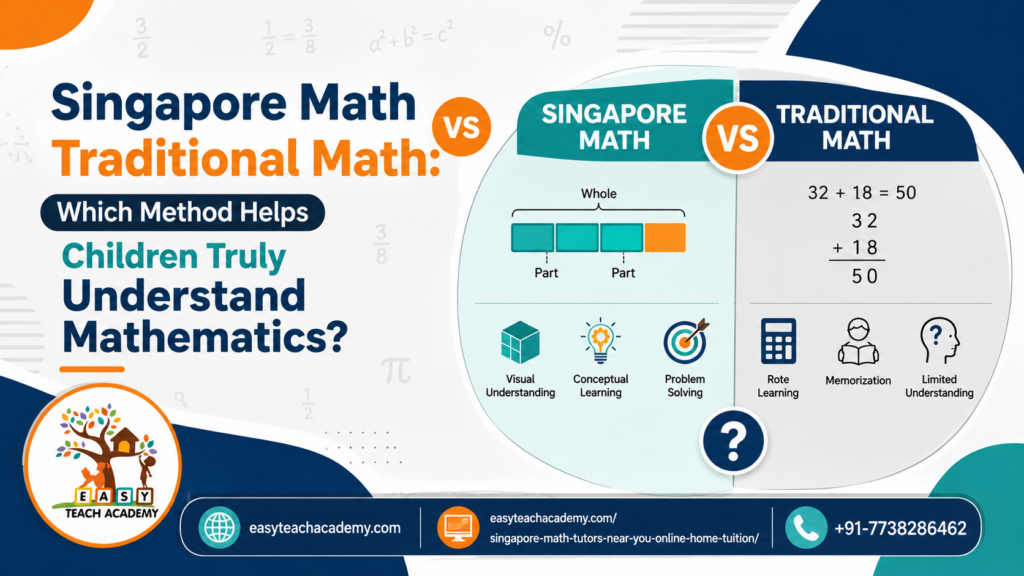
Traditional maths lessons often teach operations first and leave children to decide independently how to apply them in word problems.
The Singapore Math method takes a different approach.
Instead of asking children to memorise rules, it teaches them to understand relationships between quantities.
Children learn to:
- Identify known information.
- Recognise missing information.
- Compare quantities.
- Break large problems into smaller parts.
- Represent information visually.
- Explain why a particular strategy works.
This process builds confidence because children understand what they are doing instead of simply guessing.
The Importance of Understanding Before Solving
Imagine giving two children exactly the same word problem.
The first child immediately searches for numbers and starts calculating.
The second child pauses to understand the situation before choosing a strategy.
Which child is more likely to solve unfamiliar questions successfully?
Usually, the second.
The Singapore Math approach encourages children to slow down, think carefully, and understand the problem before reaching for a calculator or writing equations.
This habit becomes one of the most valuable mathematical skills they develop.
The Four-Step Singapore Math Thinking Process
Although every problem is different, many successful students naturally follow a simple thinking process.
Step 1: Read Carefully
Children should read the entire question without rushing.
Encourage them to understand the story rather than looking immediately for numbers.
Step 2: Identify Important Information
Students learn to separate useful information from unnecessary details.
They ask themselves:
- What do I already know?
- What am I trying to find?
- Which numbers matter?
Step 3: Choose a Strategy
Instead of guessing, children consider different approaches.
They may:
- Draw a diagram.
- Use a Singapore Math bar model.
- Create a table.
- Write a number sentence.
- Break the problem into smaller parts.
Step 4: Check the Answer
Strong problem solvers always ask:
- Does my answer make sense?
- Have I answered the question?
- Could there be another method?
This final habit helps children identify mistakes before finishing their work.
Why Visual Learning Makes Word Problems Easier
Children often understand pictures faster than long written explanations.
This is why visual learning is one of the biggest strengths of the Singapore Math curriculum.
Instead of relying only on numbers, students use:
- Number bonds.
- Part-whole diagrams.
- Number lines.
- Arrays.
- Place value charts.
- The famous Singapore Math Bar Model.
Visual representations reduce confusion and help children see mathematical relationships more clearly.
Many children who once found word problems difficult become much more confident after learning to represent information visually.
Why Parents Around the World Choose Singapore Math
Parents from Singapore, Australia, the United States, the United Kingdom, Canada, and many other countries are increasingly choosing Singapore Math because it develops much more than calculation skills.
Children learn to:
- Think logically.
- Solve unfamiliar problems.
- Explain their reasoning.
- Build confidence.
- Apply mathematics to everyday situations.
These abilities support success not only in school mathematics but also in science, technology, engineering, and many future careers.
Strategy 1: Understand the Story Before Looking at the Numbers
One of the most common mistakes children make is searching for numbers as soon as they read a question.
For example, when they see the numbers 45, 18, and 12, they immediately begin adding or subtracting without understanding what the question is asking.
Successful students do the opposite.
They first understand the story.
Encourage your child to ask:
- Who is the problem about?
- What happened first?
- What happened next?
- What is the final question asking?
Understanding the situation makes it much easier to choose the correct mathematical operation.
Strategy 2: Highlight Important Information
Many word problems contain extra words that distract children.
The Singapore Math method teaches students to identify only the information that is needed.
For example:
Olivia has 36 coloured pencils. She receives 14 more for her birthday and later gives 8 to her cousin. How many coloured pencils does she have now?
Children should identify:
- Starting amount: 36
- Received: 14
- Gave away: 8
- Find the final total
Breaking the information into smaller pieces makes the problem easier to understand.
Strategy 3: Draw the Singapore Math Bar Model
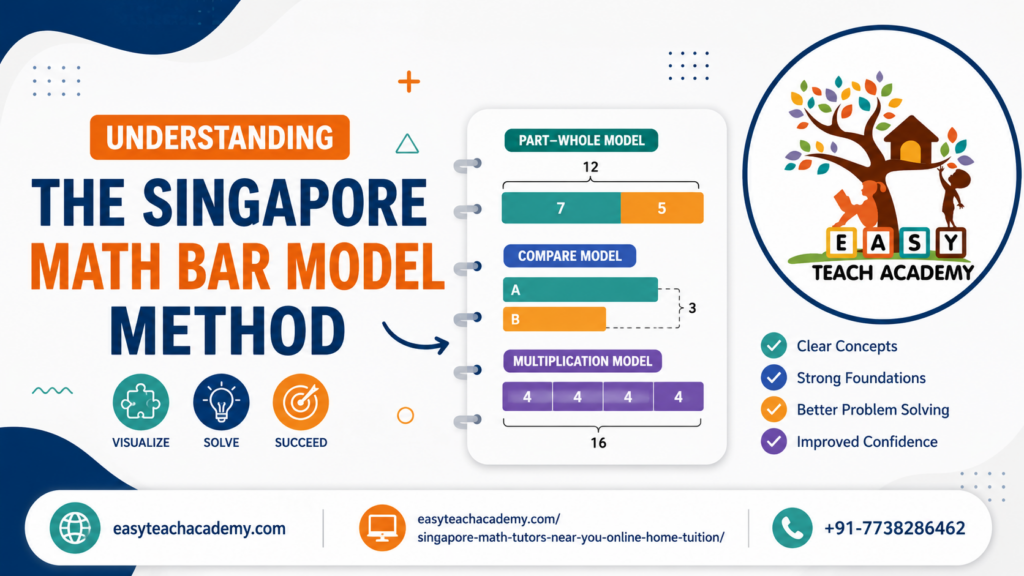
One of the most powerful Singapore Math Word Problem Strategies is the Singapore Math Bar Model.
Instead of guessing which operation to use, children draw simple rectangular bars to represent quantities.
The visual model helps students see:
- What is known.
- What is unknown.
- How quantities are related.
- Which mathematical operation is needed.
Because children understand the relationships first, they are less likely to make careless mistakes.
Example 1: Addition Bar Model
Question
Sophia collected 27 shells at the beach.
Later, she found 15 more.
How many shells does she have altogether?
Instead of immediately writing an equation, children imagine two connected bars.
Bar 1 = 27
Bar 2 = 15
Together they represent the total number of shells.
The visual model clearly shows that the two quantities should be combined.
Example 2: Comparison Bar Model
Question
Ryan has 64 marbles.
Lucas has 49 marbles.
How many more marbles does Ryan have than Lucas?
Instead of adding the numbers, children draw two bars of different lengths.
The extra part of the longer bar represents the difference.
The picture immediately shows that subtraction is needed.
Example 3: Multiplication Bar Model
Question
There are 8 baskets.
Each basket contains 6 apples.
How many apples are there altogether?
Children draw eight equal bars representing the baskets.
The repeated groups make multiplication much easier to understand.
This strategy also prepares students for fractions, ratios, and algebra in later years.
Strategy 4: Break Complex Problems into Smaller Steps
Many children become overwhelmed when a word problem contains several pieces of information.
The Singapore Math curriculum encourages students to divide large problems into smaller, manageable parts.
For example:
Emma baked 48 cupcakes.
She sold 19 cupcakes in the morning.
She baked 12 more in the afternoon.
Then she sold 15 cupcakes.
How many cupcakes does she have now?
Instead of trying to solve everything at once, children work through each event in order.
Step-by-step thinking reduces confusion and improves accuracy.
Strategy 5: Ask Questions While Solving
Strong mathematical thinkers constantly ask themselves questions.
For example:
- What information do I already know?
- What do I need to find?
- Which operation makes sense?
- Can I represent this visually?
- Does my answer seem reasonable?
These self-checking habits improve both confidence and accuracy.
Strategy 6: Use Simple Language
Sometimes mathematical vocabulary creates unnecessary confusion.
Encourage children to rewrite difficult questions in their own words.
Instead of reading:
“Determine the remaining quantity…”
Children can think:
“How many are left?”
Simplifying the language helps children focus on the mathematics rather than unfamiliar wording.
Strategy 7: Check Every Answer
Many children finish a calculation and immediately move to the next question.
The Singapore Math method teaches students to pause and review.
Ask your child:
- Does the answer fit the story?
- Is the number too big or too small?
- Did I answer the actual question?
- Can I solve it another way?
This habit catches many simple mistakes before they become marks lost in an examination.
Common Mistakes Children Make with Word Problems
Understanding these common errors helps parents provide better support.
Guessing the Operation
Children often assume every problem requires addition because they see two numbers.
Instead, they should understand the situation before choosing a strategy.
Ignoring Important Words
Words such as:
- altogether
- difference
- remaining
- each
- shared equally
- increased
- decreased
provide valuable clues about the mathematical relationships.
Solving Too Quickly
Many mistakes happen because children rush.
The Singapore Math curriculum encourages careful thinking before calculating.
Skipping the Final Check
Even correct calculations can produce incorrect answers if the wrong operation was chosen.
Reviewing the solution is an important final step.
Why These Strategies Build Lifelong Skills
The greatest strength of Singapore Math Word Problem Strategies is that they teach children how to think rather than what to memorise.
Students gradually develop:
- Logical reasoning.
- Pattern recognition.
- Analytical thinking.
- Mathematical communication.
- Confidence in unfamiliar situations.
These skills continue helping children long after individual school lessons have been completed.
Helping Children Practise at Home
Parents do not need expensive resources to improve word-problem skills.
Simple daily activities can help.
For example:
- Ask maths questions while shopping.
- Estimate the total cost of groceries.
- Compare prices.
- Measure ingredients while cooking.
- Plan travel times.
- Divide food equally during meals.
These real-life situations show children that mathematics is useful beyond textbooks.
Why Word Problems Are More Important Than Ever
Modern education is changing.
Schools are placing greater emphasis on reasoning, communication, and real-world application instead of routine calculations alone.
Many school examinations now include multi-step word problems because they measure deeper understanding.
A child who can solve word problems successfully is usually able to:
- Read carefully.
- Think logically.
- Connect mathematical ideas.
- Apply knowledge in unfamiliar situations.
- Explain their reasoning.
These are exactly the skills developed through the Singapore Math curriculum.
From Memorising Answers to Understanding Concepts
One of the biggest differences between traditional teaching and the Singapore Math method is the focus on conceptual understanding.
Imagine two students learning fractions.
The first memorises rules for adding fractions.
The second understands fractions by using diagrams, visual models, and real-life examples.
Months later, who is more likely to remember the concept?
Usually the child who understood it rather than memorised it.
The same principle applies to word problems.
Children who understand mathematical relationships become much more flexible when questions change.
Why Children Become Better Problem Solvers
Every challenging word problem encourages children to think in a structured way.
Instead of rushing towards an answer, they learn to:
- Read carefully.
- Identify key information.
- Organise ideas.
- Choose an effective strategy.
- Check their work.
These habits gradually become automatic.
Over time, children begin approaching new mathematical situations with confidence rather than uncertainty.
This is one of the reasons why parents across the world value Singapore Math Word Problem Strategies.
Building Confidence Through Small Successes
Confidence rarely appears overnight.
It grows through repeated experiences of success.
At first, a child may need guidance to solve a word problem.
Later, they solve similar questions independently.
Eventually, they begin tackling unfamiliar problems using the same thinking process.
Every successful experience strengthens confidence.
Children who once said,
“I don’t know where to start,”
often begin saying,
“Let me try drawing a bar model first.”
This change in attitude is just as important as improved examination results.
Why Parents Choose Online Singapore Math Classes
Families today have more educational options than ever before.
Many parents now choose Online Singapore Math Classes because they can access experienced teachers regardless of location.
Quality online lessons provide:
- Live interaction.
- Immediate feedback.
- Step-by-step explanations.
- Visual demonstrations.
- Individual attention.
- Flexible scheduling.
Children can learn from home while still receiving structured instruction based on the Singapore Math curriculum.
Common Challenges Parents Face at Home
Parents naturally want to help their children with homework.
However, many tell us:
- “I know the answer but don’t know how to explain it.”
- “My child understands during class but struggles at home.”
- “Word problems take much longer than calculations.”
- “My child becomes frustrated after making one mistake.”
These situations are very common.
Instead of giving answers immediately, parents can encourage children to think by asking:
- What is the question asking?
- Which information is important?
- Can you draw a picture?
- Would a bar model help?
- Does your answer make sense?
These questions encourage independent thinking and strengthen problem-solving habits.
Meet Your Teacher – Niral Devnath
Hello, I’m Niral Devnath, founder of Easy Teach Academy.
For more than 15 years, I have been teaching mathematics to children from different countries, helping them develop confidence through concept-based learning.
During my teaching journey, I have worked with students from Singapore, Australia, the United States, the United Kingdom, Norway, India, and several other countries.
One thing has remained consistent throughout my career:
Children achieve their best results when they understand mathematics instead of memorising it.
That belief shapes every lesson I teach.
My teaching philosophy focuses on:
- Building understanding before speed.
- Encouraging logical thinking.
- Developing strong problem-solving skills.
- Creating an enjoyable learning environment.
- Helping every child gain confidence.
Watching children who once feared word problems begin solving them independently is one of the most rewarding parts of teaching.
Why Families Choose Easy Teach Academy
At Easy Teach Academy, our goal is not only to improve examination scores but also to help children become confident mathematical thinkers.
Our Online Singapore Math Classes are designed around the proven principles of the Singapore Math curriculum.
Parents choose us because we provide:
- Live interactive online lessons.
- Small class sizes.
- Personalised attention.
- Step-by-step concept building.
- Regular assessments.
- Progress updates for parents.
- Flexible class schedules for international students.
Every lesson encourages children to ask questions, think independently, and understand mathematical concepts deeply.
Learning Beyond the Classroom
The skills children develop through Singapore Math Word Problem Strategies extend far beyond mathematics.
Students also strengthen:
- Critical thinking.
- Decision-making.
- Analytical reasoning.
- Communication skills.
- Patience.
- Persistence.
These qualities support success in science, technology, engineering, economics, and many other areas of education.
More importantly, they help children become confident learners who enjoy tackling new challenges.
Learn More About Our Singapore Math Programme
If you would like your child to develop stronger problem-solving skills and greater confidence in mathematics, explore our Online Singapore Math Classes.
Singapore Math Tutors
You can also learn more about Easy Teach Academy and our educational programmes:
Helping Your Child Master Word Problems with Confidence
By now, you have learned why children often struggle with word problems, how the Singapore Math approach is different, and the practical Singapore Math Word Problem Strategies that help students become confident problem solvers.
The final question many parents ask is:
“What can I do now to help my child improve?”
The good news is that consistent guidance, the right teaching approach, and regular practice can make a remarkable difference.
Children do not become confident problem solvers overnight. They improve gradually by learning to understand problems, think logically, and apply mathematical concepts step by step.
Practical Tips for Parents
Parents play an important role in helping children develop strong mathematical thinking. You do not need to be a mathematics expert to support your child’s learning.
Here are some simple but effective habits.
Encourage Your Child to Read the Entire Question
Many children rush straight to the numbers without understanding the story.
Ask your child to read the question slowly and explain it in their own words before attempting any calculations.
This simple habit improves comprehension and reduces careless mistakes.
Don’t Focus Only on the Final Answer
Instead of asking,
“Did you get the correct answer?”
try asking:
- How did you solve it?
- Why did you choose that method?
- Can you think of another strategy?
- Does your answer make sense?
These conversations help children develop reasoning skills rather than memorising procedures.
Use Everyday Situations
Real-life experiences provide excellent opportunities to practise Singapore Math Word Problem Strategies.
For example:
- Compare prices while shopping.
- Calculate discounts.
- Measure ingredients while cooking.
- Divide food equally at the dinner table.
- Estimate travel times.
- Plan a family budget.
Children begin to understand that mathematics is a practical life skill rather than simply a school subject.
Encourage Drawing
Many children understand ideas more clearly when they create visual representations.
Encourage them to:
- Draw simple diagrams.
- Use number lines.
- Sketch part-whole models.
- Practise the Singapore Math Bar Model.
Visual thinking often makes difficult word problems much easier to understand.
Praise Effort, Not Just Correct Answers
Children become more confident when their effort is recognised.
Celebrate:
- Careful thinking.
- Good strategies.
- Improvement.
- Persistence.
- Willingness to try challenging questions.
Positive encouragement helps children develop a growth mindset and become more resilient learners.
Common Mistakes Parents Should Avoid
Even with the best intentions, some habits can make learning more difficult.
Giving the Answer Too Quickly
When children become stuck, many parents immediately explain the solution.
Instead, guide them with questions that encourage independent thinking.
Expecting Speed Before Understanding
Fast calculations are helpful, but understanding should always come first.
The Singapore Math method focuses on accuracy and reasoning before speed.
Comparing Children
Every child learns differently.
Avoid comparing your child’s progress with classmates or siblings.
Celebrate individual growth and steady improvement.
Practising Without Understanding
Completing dozens of similar questions is not always the best way to learn.
Quality practice that develops understanding is far more valuable than repetitive memorisation.
Why the Right Teacher Makes a Difference
A well-designed curriculum becomes even more effective when combined with an experienced teacher.
An excellent Singapore Math tutor helps children:
- Understand concepts clearly.
- Build confidence gradually.
- Learn from mistakes.
- Develop logical thinking.
- Enjoy solving challenging problems.
Children who feel supported are more willing to ask questions and explore different problem-solving strategies.
About Me – Niral Devnath
Hello, I’m Niral Devnath, founder of Easy Teach Academy.
For more than 15 years, I have been helping children develop confidence in mathematics through structured, concept-based teaching.
During my teaching career, I have worked with students from Singapore, Australia, the United States, the United Kingdom, Norway, India, and many other countries.
My experience has taught me that every child can become a successful mathematics learner when lessons focus on understanding rather than memorisation.
My teaching approach is built on four key principles:
- Build strong concepts before introducing shortcuts.
- Encourage children to think independently.
- Develop confidence through consistent practice.
- Make mathematics enjoyable and meaningful.
One of the most rewarding moments as a teacher is seeing a child who once struggled with word problems begin solving them confidently and explaining their thinking with pride.
Why Parents Choose Easy Teach Academy
At Easy Teach Academy, our Online Singapore Math Classes are designed to help children build lasting mathematical skills, not just prepare for the next test.
Parents appreciate our approach because we provide:
- Live interactive online lessons.
- Personalised attention.
- Small class sizes.
- Step-by-step concept building.
- Regular progress assessments.
- Parent feedback and communication.
- Flexible schedules for international students.
Every lesson follows the proven principles of the Singapore Math curriculum, helping students strengthen problem-solving skills, logical reasoning, and mathematical confidence.
Learn more about our Singapore Math programme:
Singapore Math Tutors
Explore all our educational programmes:
Easy Teach Academy
Frequently Asked Questions
What makes Singapore Math word problems different?
Singapore Math word problems focus on understanding relationships between quantities instead of simply choosing an operation. Students use visual strategies such as the Singapore Math Bar Model to organise information before solving.
Why do children struggle with word problems?
Many children find it difficult because word problems require reading comprehension, logical reasoning, mathematical understanding, and careful planning all at the same time.
What is the Singapore Math Bar Model?
The Singapore Math Bar Model is a visual strategy that represents quantities using simple rectangular bars. It helps children understand mathematical relationships and choose the correct solving method.
Can Online Singapore Math Classes improve problem-solving?
Yes.
Live Online Singapore Math Classes provide structured teaching, immediate feedback, guided practice, and personalised support that help children become more confident problem solvers.
Is Singapore Math suitable for children who already perform well in maths?
Absolutely.
The Singapore Math curriculum benefits both struggling learners and advanced students by encouraging deeper understanding, flexible thinking, and stronger reasoning skills.
Final Thoughts
Word problems are often where children discover whether they truly understand mathematics.
A child who learns to analyse information, organise ideas, and choose effective strategies develops much more than calculation skills.
The Singapore Math approach gives children the confidence to approach unfamiliar problems with curiosity instead of fear.
That confidence can influence not only school performance but also future learning in science, technology, engineering, and many other fields.
When children understand how to think, they become lifelong learners.
Help Your Child Become a Confident Problem Solver
If your child finds word problems challenging or would like to build stronger mathematical thinking, Easy Teach Academy is here to help.
Our Online Singapore Math Classes are designed to help students:
- Master Singapore Math Word Problem Strategies.
- Build confidence step by step.
- Strengthen logical reasoning.
- Improve mathematical communication.
- Develop independent problem-solving skills.
- Enjoy learning mathematics.
Why Families Trust Easy Teach Academy
✔ 15+ years of teaching experience
✔ Live interactive Online Singapore Math Classes
✔ Small classes with personalised attention
✔ Proven Singapore Math curriculum
✔ Strong focus on word problems and problem-solving
✔ Regular progress updates for parents
✔ Flexible schedules for students around the world
Start Your Child’s Singapore Math Journey Today
Visit our Singapore Math page to learn more:
Singapore Math Tutors
Explore our website:
Easy Teach Academy