How to Teach Singapore Math at Home
Many parents want to play a more active role in their child’s education. They help with homework, read together, and encourage good study habits. When it comes to mathematics, however, many parents feel uncertain.
They often ask:
- “Can I teach Singapore Math at home?”
- “Do I need special training?”
- “What if I wasn’t good at maths myself?”
- “Will I confuse my child if I explain it differently?”
The good news is that you can support your child’s learning at home, even if you are not a mathematics teacher.
You do not need expensive equipment or advanced mathematical knowledge. What matters most is creating an environment where your child feels comfortable exploring ideas, asking questions, and developing confidence.
The Singapore Math method is built on understanding rather than memorisation. That makes it an excellent approach for parents because it encourages discussion, visual learning, and step-by-step thinking instead of simply remembering formulas.
In this guide, you will learn practical ways to introduce Singapore Math at home, help your child build strong mathematical foundations, and create enjoyable learning experiences that support long-term success.
Why More Parents Are Teaching Singapore Math at Home
Education has changed significantly over the past decade.
Parents are now more involved in their children’s learning than ever before.
Many families want to:
- Strengthen school learning.
- Build confidence.
- Close learning gaps.
- Prepare for future topics.
- Encourage a positive attitude towards mathematics.
Teaching Singapore Math at home does not mean replacing your child’s school teacher.
Instead, it means reinforcing important ideas through meaningful conversations and everyday activities.
Even spending 20–30 minutes a few times each week can help children develop stronger mathematical understanding.
What Makes Singapore Math Different?
Before teaching Singapore Math, it helps to understand why this approach has become popular around the world.
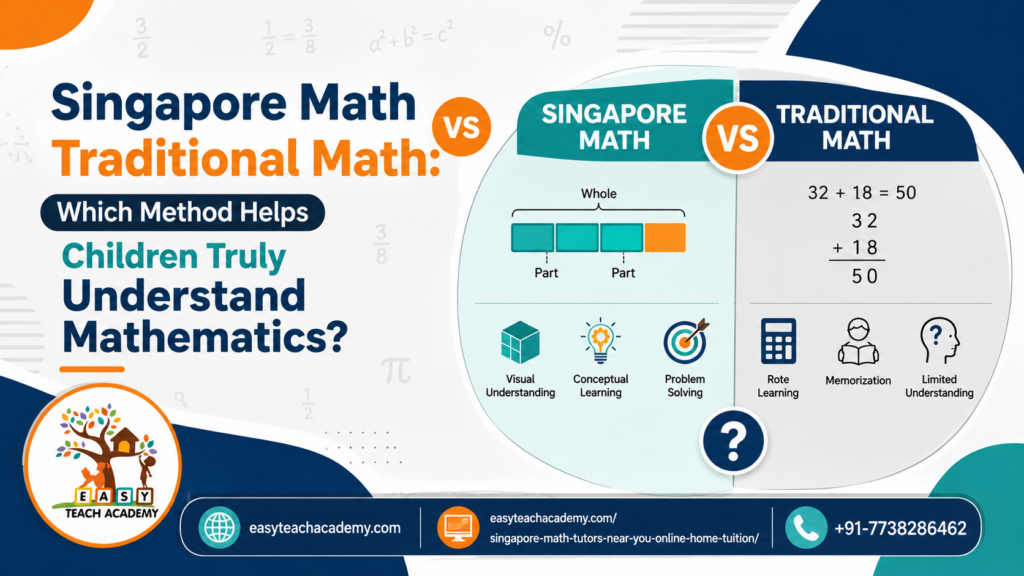
Traditional mathematics lessons often begin with formulas and procedures.
Children memorise rules, complete similar exercises, and practise until they remember the steps.
The Singapore Math curriculum follows a different philosophy.
Instead of asking children to memorise first, it encourages them to understand mathematical concepts before introducing formal methods.
Children learn to:
- Explore ideas.
- Recognise patterns.
- Explain their thinking.
- Solve problems logically.
- Build confidence through understanding.
This deeper approach helps children apply mathematics in many different situations rather than only answering familiar questions.
Your Role as a Parent
One of the biggest misunderstandings is that parents must become teachers.
In reality, your role is different.
You are your child’s:
- Encourager.
- Guide.
- Learning partner.
- Listener.
- Motivator.
Instead of explaining every answer, you help your child discover solutions.
Children often remember ideas much better when they find answers themselves.
Start with Everyday Mathematics
The best place to begin teaching Singapore Math at home is not with worksheets.
It is with everyday life.
Mathematics is everywhere.
Children can explore mathematical thinking while:
Shopping
Ask:
- Which item costs more?
- Which product is cheaper?
- How much change should we receive?
Cooking
Children can:
- Measure ingredients.
- Compare quantities.
- Double recipes.
- Divide food equally.
Travelling
Encourage children to:
- Estimate travel time.
- Compare distances.
- Read timetables.
- Count stops.
At Home
Simple activities include:
- Sorting toys.
- Counting objects.
- Comparing lengths.
- Measuring furniture.
- Organising books by size.
These experiences help children understand that mathematics is useful, practical, and interesting.
Create a Positive Learning Environment
Children learn best when they feel relaxed and encouraged.
Choose a regular learning time that suits your family’s routine.
Your learning space should be:
- Quiet.
- Comfortable.
- Well lit.
- Organised.
- Free from unnecessary distractions.
A positive environment allows children to concentrate without feeling pressured.
Focus on Understanding Before Speed
Many parents become concerned when children solve questions slowly.
However, speed is not the first goal of Singapore Math.
Understanding comes first.
When children truly understand concepts, speed develops naturally through practice.
Encourage your child to explain:
- Why a method works.
- How they found the answer.
- Whether another strategy is possible.
These conversations strengthen reasoning skills far more than rushing through worksheets.
Encourage Questions Every Day
Children are naturally curious.
Instead of worrying when they ask questions, encourage them.
Questions such as:
- Why does this work?
- Is there another method?
- What happens if…?
- Can I draw a picture?
show that children are actively thinking.
The Singapore Math method values curiosity because questioning leads to deeper understanding.
Celebrate Small Successes
Learning mathematics is a journey.
Children build confidence one concept at a time.
Celebrate achievements such as:
- Solving a difficult problem.
- Explaining an idea clearly.
- Trying a new strategy.
- Learning from mistakes.
- Completing a challenging activity independently.
Positive encouragement creates motivated learners who are willing to tackle increasingly complex ideas.
The CPA Approach: The Foundation of Singapore Math
One of the biggest reasons children understand Singapore Math so well is the CPA Approach.
CPA stands for:
- Concrete
- Pictorial
- Abstract
Instead of asking children to memorise numbers immediately, they gradually move through these three stages.
This progression helps children build strong conceptual understanding.
Stage 1: Concrete Learning
Children first learn mathematics using real objects they can touch and move.
You do not need expensive teaching materials.
Simple household items work perfectly.
For example, use:
- Coins
- Buttons
- Building blocks
- Pencils
- Bottle caps
- Spoons
- Small toys
- Fruit
Example Activity
Place eight grapes on a plate.
Ask your child:
“If we eat three grapes, how many are left?”
Allow them to remove the grapes physically before writing the number sentence.
This helps children connect mathematical ideas with real experiences.
Stage 2: Pictorial Learning
Once children understand a concept using real objects, they move to drawings.
Instead of using grapes, they draw circles.
Instead of toy blocks, they draw rectangles.
Pictures help children visualise mathematical relationships.
Simple pictorial strategies include:
- Number bonds
- Part-whole diagrams
- Number lines
- Arrays
- Place value charts
These visual models make mathematical thinking easier to understand.
Stage 3: Abstract Learning
Only after children understand the idea through objects and pictures do they begin using numbers and mathematical symbols.
For example:
Concrete:
🍎🍎🍎🍎🍎
Remove two apples.
Pictorial:
○ ○ ○ ○ ○
Cross out two circles.
Abstract:
5 – 2 = 3
Because children already understand the idea, the mathematical equation becomes meaningful instead of something to memorise.
Introduce the Singapore Math Bar Model
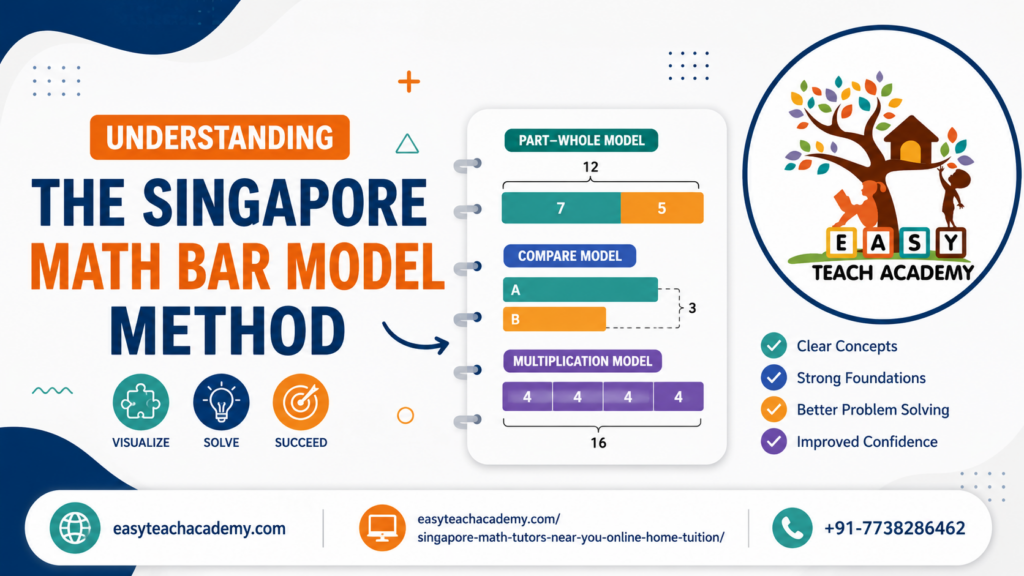
One of the most powerful tools in the Singapore Math method is the Singapore Math Bar Model.
Parents sometimes think bar models are only for school.
In reality, they are excellent home-learning tools.
The bar model helps children:
- Organise information.
- Compare quantities.
- Understand relationships.
- Solve word problems.
- Prepare for algebra later.
Simple Bar Model Example
Imagine this question:
Sarah has 18 stickers.
Her friend gives her 12 more.
How many stickers does Sarah have now?
Instead of writing an equation immediately, encourage your child to draw:
One bar showing 18
Another connected bar showing 12
Together they represent the total.
Children often understand addition much more clearly when they can see the relationship visually.
Use Everyday Conversations to Teach Mathematics
Mathematics should not exist only in textbooks.
Parents can create valuable learning opportunities throughout the day.
For example:
While Shopping
Ask:
- Which item costs more?
- Which product is cheaper?
- If we buy two, how much will we pay?
While Cooking
Encourage children to:
- Measure ingredients.
- Compare weights.
- Double recipes.
- Divide food equally.
While Travelling
Discuss:
- Distance.
- Time.
- Speed.
- Estimated arrival.
During Family Games
Board games, card games, and puzzles naturally strengthen:
- Counting.
- Strategy.
- Pattern recognition.
- Logical thinking.
Children often learn best when they are enjoying themselves.
Encourage Mathematical Discussion
One of the most valuable things parents can do is simply talk about mathematics.
Instead of asking only:
“What is the answer?”
Ask questions such as:
- Why did you choose that method?
- Can you explain your thinking?
- Is there another strategy?
- How do you know your answer is correct?
These discussions develop reasoning skills and improve confidence.
Keep Lessons Short but Consistent
Parents sometimes believe longer lessons produce better results.
Usually, the opposite is true.
Young children learn best through regular, focused sessions.
For many families:
- 20–30 minutes
- Three or four times each week
is more effective than one long study session every weekend.
Consistency builds stronger learning habits.
Avoid These Common Home Teaching Mistakes
Teaching Only Procedures
Instead of saying,
“This is how you do it,”
help children understand why the method works.
Correcting Every Mistake Immediately
Allow your child time to think and identify errors independently.
This builds confidence and resilience.
Moving Too Quickly
Children need time to master one concept before beginning the next.
Strong foundations support future learning.
Expecting Perfection
Learning mathematics is a gradual process.
Celebrate improvement rather than expecting perfect answers every time.
When Home Support Is Not Enough
Teaching Singapore Math at home can make a tremendous difference.
However, there are times when children benefit from additional expert guidance.
For example, if your child:
- Continues struggling despite regular practice.
- Finds word problems confusing.
- Has significant learning gaps.
- Is losing confidence.
- Needs greater academic challenge.
Working with an experienced Singapore Math tutor can provide the personalised support needed to rebuild confidence and strengthen understanding.
Confidence Comes Before Speed
Many parents worry because their child solves questions slowly.
However, solving a problem carefully is often far more valuable than solving it quickly.
The Singapore Math method encourages children to:
- Understand the problem.
- Choose a strategy.
- Explain their reasoning.
- Check their answer.
When children develop these habits, speed improves naturally over time.
Trying to force speed before understanding often creates unnecessary stress and confusion.
Every Child Learns at a Different Pace
One of the biggest mistakes parents make is expecting every child to learn in the same way.
Some children:
- Learn through pictures.
- Learn through discussion.
- Learn by using real objects.
- Learn through repeated practice.
- Learn best by teaching others.
The Singapore Math curriculum is effective because it allows concepts to be explored in different ways before moving to abstract calculations.
As a parent, your role is to encourage progress rather than compare your child with classmates or siblings.
Turn Mistakes into Learning Opportunities
Mistakes should never be seen as failures.
They provide valuable information about what a child understands and where extra guidance is needed.
Instead of saying,
“That’s wrong.”
Try asking:
- Which part of the question was difficult?
- Can you explain your thinking?
- What could we try differently?
- Does another strategy make more sense?
These conversations encourage children to analyse their own thinking instead of becoming discouraged.
Encourage Independent Thinking
Parents naturally want to help.
However, solving every question for your child prevents them from developing confidence.
Instead, encourage them to think independently.
For example:
Instead of saying:
“Subtract these numbers.”
Ask:
- What do you notice?
- Which strategy might help?
- Can you draw a diagram?
- Have you solved something similar before?
These questions guide learning without removing the opportunity to think.
Make Mathematics Enjoyable
Children learn more effectively when mathematics becomes part of everyday life rather than feeling like another school subject.
Simple activities include:
Family Shopping
- Compare prices.
- Estimate totals.
- Calculate discounts.
- Work out change.
Cooking Together
- Measure ingredients.
- Compare quantities.
- Double or halve recipes.
- Estimate cooking times.
Games
Board games, puzzles, and card games naturally develop:
- Counting.
- Logical thinking.
- Strategy.
- Pattern recognition.
Children often strengthen mathematical thinking without even realising they are practising.
Know When Your Child Needs Extra Support
Teaching Singapore Math at home is highly beneficial, but some children need additional guidance.
Consider seeking support if your child:
- Frequently becomes frustrated with mathematics.
- Avoids homework.
- Finds word problems confusing.
- Struggles to explain mathematical ideas.
- Has difficulty applying concepts independently.
- Needs more advanced challenges than school provides.
Additional support does not replace your involvement as a parent.
Instead, it works alongside your encouragement to strengthen understanding and confidence.
Meet Your Teacher – Niral Devnath
Hello, I’m Niral Devnath, founder of Easy Teach Academy.
For more than 15 years, I have been helping children from different countries build confidence in mathematics through concept-based learning.
Throughout my teaching career, I have worked with students from:
- Singapore
- Australia
- United States
- United Kingdom
- Norway
- India
- Other international communities
Every child I teach reminds me that mathematical ability is not something children are simply born with.
It develops through:
- Clear explanations.
- Consistent practice.
- Positive encouragement.
- The right learning strategies.
That belief shapes every lesson I teach.
My Teaching Philosophy
I believe mathematics should help children become confident thinkers rather than anxious learners.
Every lesson is built around four important principles.
Build Strong Foundations
Children should understand concepts before learning shortcuts.
Encourage Curiosity
Questions are welcomed because curiosity leads to deeper understanding.
Develop Independent Learners
Children become successful when they can solve problems confidently without depending on constant help.
Make Learning Enjoyable
Children learn more when mathematics is engaging, interactive, and meaningful.
Why Families Choose Easy Teach Academy
Parents from around the world choose Easy Teach Academy because our teaching focuses on understanding rather than memorisation.
Our Online Singapore Math Classes are designed to complement what children learn at school and the support they receive at home.
Families appreciate our programme because it includes:
- Live interactive lessons.
- Small class sizes.
- Personalised attention.
- Step-by-step concept building.
- Regular assessments.
- Parent progress updates.
- Flexible schedules for international students.
Our goal is to help every child become a confident mathematical thinker who enjoys solving problems.
Home Learning and Expert Guidance Work Together
Parents provide encouragement, motivation, and daily support.
Teachers provide structured instruction, deeper explanations, and personalised learning strategies.
When these two forms of support work together, children often make remarkable progress.
Many parents tell us that after joining our Online Singapore Math Classes, homework becomes easier, confidence improves, and children begin approaching mathematics with a much more positive attitude.
Learn More About Our Singapore Math Programme
If you’re looking for expert guidance to support your child’s home learning, we’d be delighted to help.
Explore our Singapore Math programme:
Singapore Math Tutors
Visit Easy Teach Academy to learn more about our educational programmes:
Your Home Learning Plan, Frequently Asked Questions, and Final Thoughts
Teaching Singapore Math at home is one of the most valuable investments you can make in your child’s education.
You do not need to be a professional mathematics teacher.
You do not need expensive resources.
What children need most is a supportive environment, consistent practice, patient guidance, and opportunities to think independently.
When these elements are combined with the proven principles of the Singapore Math curriculum, children develop skills that last far beyond school examinations.
A Simple Weekly Singapore Math Home Learning Plan
Many parents ask,
“How often should I teach Singapore Math at home?”
The answer is consistency rather than long study hours.
Here is a simple weekly plan that many families find effective.
Monday – Build Number Sense
Focus on:
- Mental maths
- Counting strategies
- Number bonds
- Place value
Spend 20–30 minutes playing simple number games or solving short exercises.
Tuesday – Practise Concepts
Review the topic your child learned at school.
Encourage them to explain the concept in their own words.
If necessary, use household objects to demonstrate the idea.
Wednesday – Solve Word Problems
Practise one or two carefully selected word problems.
Encourage your child to:
- Read carefully.
- Identify important information.
- Draw a Singapore Math Bar Model if appropriate.
- Explain each step.
Quality practice is more valuable than completing many questions.
Thursday – Real-Life Mathematics
Use everyday situations such as:
- Shopping
- Cooking
- Measuring
- Budgeting
- Planning travel
Show your child how mathematics is used in daily life.
Friday – Review the Week
Instead of introducing something new:
- Review difficult questions.
- Correct mistakes together.
- Celebrate improvements.
- Discuss what your child learned.
Reflection helps strengthen long-term understanding.
Weekend – Make Mathematics Fun
Keep learning enjoyable.
Play:
- Board games
- Logic puzzles
- Number games
- Building activities
- Pattern challenges
Children often develop mathematical thinking naturally through play.
Signs Your Home Teaching Is Working
Parents sometimes wonder whether their efforts are making a difference.
Positive signs include:
- Your child asks more mathematical questions.
- Homework becomes less stressful.
- They explain ideas more confidently.
- They attempt difficult questions independently.
- They begin checking their own work.
- They become more willing to try new strategies.
These improvements often appear before examination marks increase.
Confidence usually develops first.
When Professional Support Can Help
Home learning is extremely valuable, but some children benefit from additional expert guidance.
Professional Singapore Math tuition may be helpful if your child:
- Continues struggling despite regular home practice.
- Has significant gaps in mathematical understanding.
- Finds multi-step word problems difficult.
- Needs enrichment beyond the school curriculum.
- Is preparing for more advanced mathematics.
- Has lost confidence in the subject.
Working with an experienced Singapore Math tutor complements home learning by providing structured instruction and personalised feedback.
About Me – Niral Devnath
Hello, I’m Niral Devnath, founder of Easy Teach Academy.
For more than 15 years, I have been teaching mathematics to children from different educational systems and helping them build confidence through concept-based learning.
Over the years, I have had the privilege of working with students from Singapore, Australia, the United States, the United Kingdom, Norway, India, and many other countries.
Every child I teach has unique strengths, learning styles, and goals.
That is why I focus on creating lessons that are:
- Clear and engaging.
- Interactive and enjoyable.
- Structured and progressive.
- Personalised to each learner.
My teaching philosophy is simple:
- Build understanding before memorisation.
- Encourage logical thinking.
- Develop confidence through consistent practice.
- Help every child enjoy mathematics.
Nothing is more rewarding than seeing a child who once found mathematics difficult begin solving problems with confidence and enthusiasm.
Why Parents Choose Easy Teach Academy
At Easy Teach Academy, we believe mathematics should be understood, not feared.
Our Online Singapore Math Classes are designed to help children:
- Develop strong mathematical foundations.
- Strengthen problem-solving skills.
- Improve logical reasoning.
- Build lasting confidence.
- Enjoy learning mathematics.
Parents appreciate our programme because we provide:
- Live interactive online lessons.
- Small class sizes.
- Individual attention.
- Structured learning plans.
- Regular assessments.
- Parent progress updates.
- Flexible schedules for international students.
Whether your child needs extra support or wants to move ahead, our lessons are designed to help them succeed.
Learn more about our Singapore Math programme:
Singapore Math Tutors
Visit our website:
Easy Teach Academy
Frequently Asked Questions
Can parents teach Singapore Math at home?
Yes.
Parents can successfully support Singapore Math learning by encouraging curiosity, using visual models, asking thoughtful questions, and creating regular opportunities for practice.
Do I need to be good at maths to help my child?
No.
You do not need advanced mathematical knowledge.
Your role is to guide, encourage, and help your child think independently rather than provide every answer.
How much time should we spend learning each week?
Short, consistent sessions are usually more effective than occasional long study periods.
Many families benefit from 20–30 minutes of focused practice several times each week.
What if my child keeps making the same mistakes?
Repeated mistakes often indicate that a concept needs to be strengthened.
Slow down, revisit the basics, use visual models, and encourage your child to explain their thinking before moving on.
Are Online Singapore Math Classes helpful?
Yes.
Live Online Singapore Math Classes provide structured teaching, personalised guidance, and regular feedback that can strengthen the learning taking place at home.
Final Thoughts
Teaching Singapore Math at home is not about creating perfect lessons.
It is about creating meaningful learning experiences.
When children are encouraged to explore ideas, ask questions, explain their thinking, and solve problems independently, they develop far more than mathematical skills.
They become confident learners who are prepared to tackle new challenges with curiosity and determination.
The time you invest today can have a lasting impact on your child’s academic journey and future success.
Help Your Child Build Strong Mathematical Foundations
If you would like expert guidance to complement your home teaching, Easy Teach Academy is here to help.
Our Online Singapore Math Classes combine the proven principles of the Singapore Math curriculum with personalised instruction that helps every child learn with confidence.
Why Families Trust Easy Teach Academy
✔ 15+ years of teaching experience
✔ Live interactive Online Singapore Math Classes
✔ Small groups with personalised attention
✔ Step-by-step concept-based teaching
✔ Strong focus on problem-solving and logical reasoning
✔ Regular parent communication and progress tracking
✔ Flexible class schedules for families around the world
Begin Your Child’s Singapore Math Journey
Explore our Singapore Math programme:
Singapore Math Tutors
Visit Easy Teach Academy to learn more about all our educational programmes: