How Singapore Math Prepares Children for AI
Artificial Intelligence (AI) is changing the world faster than ever before.
From voice assistants and self-driving technology to healthcare, finance, education, and robotics, AI is becoming part of everyday life. The careers today’s children will have may look very different from those that exist today.
As parents, this raises an important question:
“How can I prepare my child for a future shaped by AI?”
Many people assume the answer is to teach children coding at a very young age.
Coding is certainly valuable, but it is only one part of the picture.
Before children learn programming languages, they need something even more important:
- Strong logical thinking
- Problem-solving skills
- Critical thinking
- Creativity
- Mathematical reasoning
- Confidence when facing unfamiliar challenges
These are the very skills that the Singapore Math curriculum is designed to develop.
This is one of the main reasons why parents across Singapore, Australia, the United States, the United Kingdom, Canada, and many other countries are choosing Singapore Math. They are not only preparing their children for school examinations—they are helping them become adaptable thinkers who can succeed in a rapidly changing world.
In this guide, you’ll discover why Singapore Math is considered one of the best approaches for developing future-ready learners and how it can help children thrive in the age of AI.
The World Is Changing Faster Than Ever
Think about how much technology has changed over the last ten years.
Children now interact with:
- AI-powered search tools
- Smart assistants
- Language translation apps
- Recommendation systems
- Educational platforms
- Robotics
- Automation
Many routine tasks that once required human effort are now completed by intelligent software.
As AI continues to improve, employers will increasingly value skills that machines cannot easily replace.
These include:
- Critical thinking
- Creativity
- Decision-making
- Communication
- Problem-solving
- Adaptability
Developing these abilities should begin during childhood, and mathematics provides one of the strongest foundations.
Why Memorising Facts Is No Longer Enough
For many years, success in mathematics was often associated with memorising formulas and practising similar questions repeatedly.
While practice remains important, the future demands much more.
Imagine two students.
The first student memorises every formula perfectly but becomes confused whenever a question is presented in a new way.
The second student understands mathematical relationships and can apply ideas to unfamiliar situations.
Which student is likely to succeed in a world where AI can instantly provide formulas and calculations?
The second student.
The Singapore Math method focuses on developing understanding before memorisation.
Instead of simply teaching children what to do, it helps them understand why mathematical ideas work.
That deeper understanding encourages flexible thinking—an ability that remains valuable even as technology continues to evolve.
What Skills Will Children Need in the AI Era?
Technology changes rapidly, but certain human abilities remain essential.
Children entering tomorrow’s workforce will benefit from developing:
Logical Reasoning
The ability to analyse information and make sound decisions.
Critical Thinking
The confidence to evaluate ideas instead of accepting information without questioning it.
Problem-Solving
Breaking complex situations into manageable steps and choosing effective solutions.
Creativity
Looking for different approaches instead of relying on one fixed method.
Communication
Explaining ideas clearly and working collaboratively with others.
Adaptability
Learning new skills throughout life as technology continues to change.
These qualities support success not only in mathematics but also in science, engineering, technology, business, medicine, and countless other professions.
How Singapore Math Develops Future-Ready Skills
The Singapore Math curriculum is internationally recognised because it develops mathematical thinking instead of encouraging children to memorise procedures.
Children learn to:
- Understand concepts deeply.
- Recognise patterns.
- Explain their reasoning.
- Compare different solving strategies.
- Solve unfamiliar problems confidently.
These habits mirror the type of thinking required in many modern careers.
When children regularly analyse information, make decisions, and explain their thinking, they strengthen the same mental skills that help them work effectively alongside advanced technology.
Problem-Solving Is the Heart of Singapore Math
One of the defining features of Singapore Math is its emphasis on problem-solving.
Instead of asking children to repeat one method over and over, lessons encourage them to explore ideas, test strategies, and think independently.
For example, students often learn to:
- Represent information visually.
- Break large problems into smaller parts.
- Compare different solutions.
- Check whether answers make sense.
- Explain why a method works.
This approach develops confident thinkers rather than children who rely entirely on memorisation.
Learning to Think, Not Just Calculate
Imagine your child is given a completely new mathematics question.
A child who depends only on memorised steps may feel unsure.
A child who understands mathematical relationships is more likely to ask:
- What information do I know?
- What am I trying to find?
- Which strategy could work?
- Is there another way to solve this?
This habit of structured thinking is one of the greatest strengths of the Singapore Math method.
It helps children become independent learners who are prepared to tackle unfamiliar challenges with confidence.
Why Parents Around the World Are Choosing Singapore Math
Parents today are thinking beyond school examinations.
They want their children to develop abilities that remain valuable throughout life.
Families increasingly choose Singapore Math because it helps children:
- Build confidence.
- Strengthen logical reasoning.
- Improve problem-solving.
- Develop resilience.
- Enjoy learning mathematics.
- Prepare for future academic and career success.
Rather than focusing only on marks, they focus on developing the thinking skills that children will continue using in an AI-driven world.
The CPA Approach: Building Understanding Step by Step
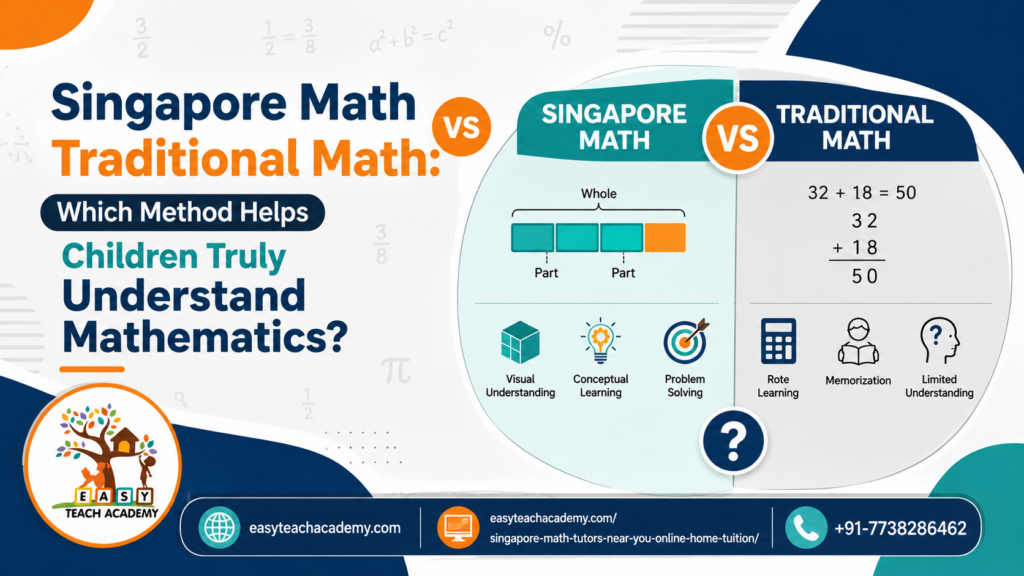
One of the reasons Singapore Math is respected around the world is its CPA (Concrete–Pictorial–Abstract) learning approach.
Instead of introducing mathematical symbols immediately, children move through three carefully planned stages.
Concrete
Children begin with real objects.
They might use:
- Counters
- Blocks
- Coins
- Buttons
- Cubes
Handling real objects helps children understand mathematical ideas before working with numbers.
Pictorial
Once children understand a concept physically, they represent it using pictures and diagrams.
Visual learning helps students recognise relationships and organise information.
Abstract
Only after children understand the concept do they begin solving problems using numbers, symbols, and equations.
Because understanding comes first, abstract mathematics becomes much easier.
This gradual progression encourages deeper thinking instead of memorising procedures.
Why Visual Thinking Matters in the AI Era
Artificial Intelligence processes enormous amounts of information.
Humans, however, often solve problems by recognising patterns and relationships.
The Singapore Math method develops this ability through visual learning.
Children regularly use:
- Number bonds
- Part-whole models
- Number lines
- Arrays
- Place value charts
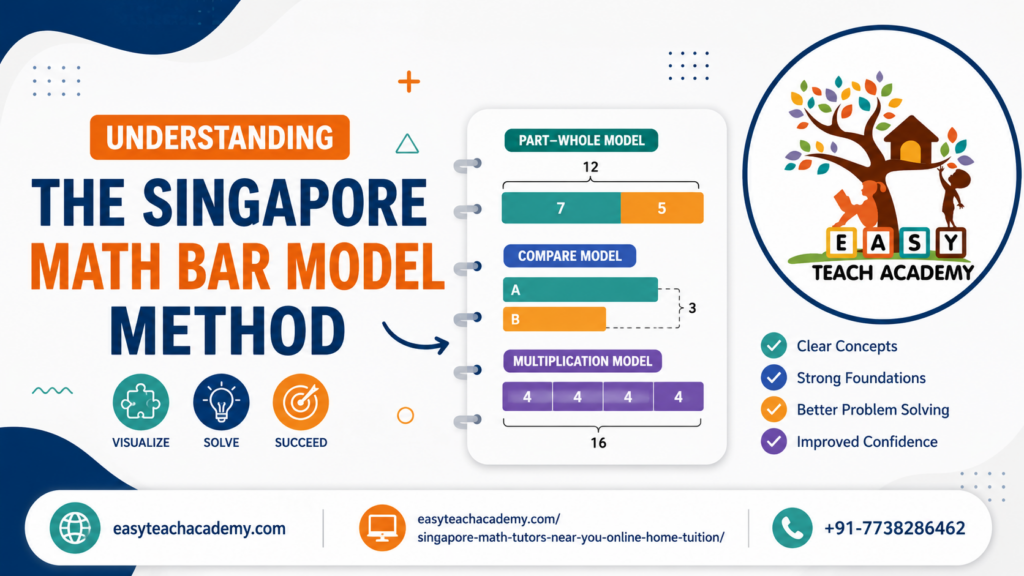
- The Singapore Math Bar Model
Instead of seeing mathematics as isolated numbers, children begin seeing connections between ideas.
Pattern recognition is one of the most valuable thinking skills in mathematics, science, engineering, and technology.
The Singapore Math Bar Model: A Powerful Thinking Tool
Perhaps the most recognised feature of Singapore Math is the Singapore Math Bar Model.
Parents sometimes think children are simply drawing rectangles.
In reality, they are learning to organise information logically.
The bar model teaches children to:
- Identify known information.
- Recognise missing information.
- Compare quantities.
- Break complicated questions into manageable parts.
- Choose suitable solving strategies.
These habits mirror the structured thinking used in programming, engineering, and data analysis.
The goal is not only to solve one mathematics question but also to develop a systematic way of approaching new challenges.
Learning to Ask Better Questions
One of the biggest differences between traditional teaching and the Singapore Math curriculum is the type of questions children are encouraged to ask.
Instead of asking:
“Which formula should I memorise?”
Students begin asking:
- Why does this work?
- Is there another method?
- What pattern do I notice?
- Does my answer make sense?
- Can I solve this differently?
Curiosity is one of the most valuable qualities for lifelong learning.
As technology changes, people who continue asking thoughtful questions will adapt more successfully.
Building Critical Thinking Through Everyday Mathematics
Critical thinking is not developed through one special lesson.
It grows through consistent opportunities to reason and make decisions.
For example, during Singapore Math lessons children often:
- Compare multiple solving methods.
- Explain why one strategy works better.
- Estimate answers before calculating.
- Identify mistakes.
- Evaluate different solutions.
These activities teach children to think carefully before making decisions.
Such habits are useful far beyond mathematics.
Why AI Makes Problem-Solving More Valuable
Artificial Intelligence can complete many routine calculations almost instantly.
However, AI still depends on people to:
- Define problems.
- Interpret results.
- Make ethical decisions.
- Apply knowledge creatively.
- Communicate solutions.
Children who learn Singapore Math problem solving develop these human-centred abilities from an early age.
Instead of competing with technology, they learn skills that help them work alongside it.
Real-Life Skills Developed Through Singapore Math
Parents often ask whether mathematics really influences other areas of life.
The answer is yes.
Children who regularly practise Singapore Math often strengthen:
Decision-Making
Learning to compare options before choosing the best solution.
Analytical Thinking
Breaking large problems into smaller, manageable parts.
Persistence
Continuing to work through difficult questions instead of giving up.
Communication
Explaining mathematical reasoning clearly.
Confidence
Believing they can solve unfamiliar problems through careful thinking.
These qualities support academic achievement and everyday life.
Why Strong Number Sense Still Matters
Some parents wonder whether children still need strong mathematics skills when calculators and AI are readily available.
The answer is absolutely.
Technology provides answers.
Children still need to understand whether those answers make sense.
Strong number sense helps children:
- Estimate quickly.
- Recognise unreasonable answers.
- Understand relationships between numbers.
- Apply mathematics confidently.
Technology is most powerful when combined with strong human understanding.
Helping Children Become Independent Learners
One of the greatest long-term benefits of the Singapore Math method is independence.
Instead of relying on memorised procedures, children gradually learn to:
- Think independently.
- Test different strategies.
- Learn from mistakes.
- Evaluate their own work.
- Continue learning throughout life.
These habits prepare children not only for examinations but also for future careers where continuous learning will be essential.
Future Careers Will Reward Thinking, Not Memorisation
Many careers are already changing because of Artificial Intelligence.
Routine tasks are increasingly being automated, while jobs requiring human judgement, creativity, communication, and problem-solving continue to grow in importance.
Children entering the workforce over the next 10 to 20 years will need to:
- Analyse information.
- Evaluate different solutions.
- Make informed decisions.
- Learn new technologies.
- Work collaboratively.
- Adapt to changing environments.
These are exactly the types of thinking habits encouraged by the Singapore Math method.
Rather than teaching children to remember one correct procedure, it encourages them to understand concepts and apply them flexibly.
Confidence Is One of the Most Important Future Skills
Technology changes quickly.
Confident learners are more willing to explore, experiment, and adapt.
Children who believe they can solve unfamiliar problems are less afraid of new challenges.
The Singapore Math curriculum helps build confidence by encouraging children to:
- Understand ideas before memorising.
- Solve problems step by step.
- Learn from mistakes.
- Explain their thinking.
- Explore different strategies.
As children experience success through understanding, they begin believing in their own ability to learn.
That confidence often extends far beyond mathematics.
Learning How to Learn
One of the greatest gifts parents can give their children is the ability to learn independently.
Knowledge continues changing.
Technology continues evolving.
New careers continue emerging.
Children who know how to learn will always have an advantage.
The Singapore Math method develops lifelong learning habits by encouraging children to:
- Ask thoughtful questions.
- Explore patterns.
- Test ideas.
- Reflect on mistakes.
- Improve through practice.
Instead of depending entirely on teachers, children gradually become independent learners.
Why Curiosity Matters in an AI World
Artificial Intelligence can answer many questions.
Human curiosity creates new questions.
Children who remain curious are more likely to:
- Explore different ideas.
- Develop creative solutions.
- Discover new interests.
- Continue learning throughout life.
Parents can encourage curiosity by asking:
- What do you notice?
- Why do you think that happened?
- Can you solve it another way?
- What would happen if we changed the numbers?
These conversations help children develop flexible thinking.
Real-Life Benefits Beyond Mathematics
The skills developed through Singapore Math are useful in many situations.
Children strengthen:
Decision-Making
Carefully analysing information before choosing a solution.
Communication
Explaining ideas clearly and listening to different viewpoints.
Resilience
Continuing to work through challenges even when the answer is not immediately obvious.
Organisation
Breaking large problems into smaller, manageable steps.
Creativity
Finding different ways to approach unfamiliar situations.
These qualities support learning in science, engineering, technology, business, economics, and many other fields.
Preparing Children for Careers That Do Not Yet Exist
Many of today’s fastest-growing careers did not exist twenty years ago.
The same will likely be true for the next generation.
Instead of preparing children for one specific profession, education should prepare them to:
- Learn continuously.
- Think independently.
- Solve new problems.
- Adapt confidently.
- Work alongside technology.
The Singapore Math curriculum provides an excellent foundation because it develops thinking skills rather than teaching only fixed procedures.
Meet Your Teacher – Niral Devnath
Hello, I’m Niral Devnath, founder of Easy Teach Academy.
For more than 15 years, I have been teaching mathematics to children from different educational systems while helping them build confidence through concept-based learning.
Throughout my teaching journey, I have had the privilege of working with students from:
- Singapore
- Australia
- United States
- United Kingdom
- Norway
- India
- Other international communities
Working with students from different countries has shown me that every child learns differently.
Some need stronger foundations.
Some need greater challenges.
Some simply need mathematics explained in a way that finally makes sense.
That understanding shapes every lesson I teach.
My Teaching Philosophy
I believe mathematics should prepare children for life, not just examinations.
Every lesson I teach follows four important principles.
Build Understanding First
Children should know why mathematical ideas work before learning shortcuts.
Encourage Independent Thinking
Children become successful when they learn to solve problems confidently on their own.
Develop Confidence Step by Step
Small successes create motivation for greater learning.
Every concept mastered becomes a foundation for future growth.
Make Learning Meaningful
Children learn more when mathematics is connected to real-life situations and taught through engaging discussions.
Why Parents Choose Easy Teach Academy
Families from around the world choose Easy Teach Academy because we focus on developing confident mathematical thinkers.
Our Online Singapore Math Classes are designed to help children:
- Build strong mathematical foundations.
- Improve logical reasoning.
- Strengthen critical thinking.
- Develop excellent problem-solving skills.
- Prepare for future academic success.
Parents appreciate our teaching because we provide:
- Live interactive online lessons.
- Small class sizes.
- Personalised attention.
- Structured learning plans.
- Regular assessments.
- Parent progress updates.
- Flexible schedules for international students.
Rather than simply preparing children for the next test, we help them develop habits that support lifelong learning.
Preparing Children Together
Parents and teachers each play an important role.
Parents encourage curiosity, confidence, and consistent practice at home.
Teachers provide structured guidance, expert explanations, and personalised support.
When home encouragement and expert instruction work together, children often achieve far more than either approach alone.
Learn More About Our Singapore Math Programme
If you would like your child to develop future-ready thinking skills through Singapore Math, we’d be delighted to help.
Explore our Singapore Math programme:
Singapore Math Tutors
Visit Easy Teach Academy to discover all our educational programmes:
Part 4: Preparing Your Child for the Future Starts Today
Artificial Intelligence will continue to transform education, workplaces, and everyday life. While no one can predict exactly what the future will look like, one thing is becoming increasingly clear:
Children who know how to think will always have an advantage over those who simply memorise information.
This is why the Singapore Math curriculum continues to attract parents from around the world. It helps children develop the confidence, reasoning, and problem-solving skills that remain valuable regardless of how technology changes.
The goal is not to compete with AI.
The goal is to help children develop the uniquely human abilities that AI cannot replace.
Practical Ways Parents Can Prepare Children for the AI Era
Parents often ask,
“What can I do today to prepare my child for tomorrow?”
The answer begins with creating opportunities for children to think independently.
Here are some simple habits that can make a lasting difference.
Encourage Questions
Instead of focusing only on correct answers, encourage curiosity.
Ask questions such as:
- Why do you think that works?
- Is there another way?
- What pattern do you notice?
- How could you solve this differently?
Children who ask thoughtful questions become stronger learners.
Encourage Problem-Solving
When children face a challenge, resist the temptation to solve it immediately.
Instead, ask:
- What do you already know?
- What could you try first?
- Can you draw a diagram?
- Does your answer make sense?
These conversations help children become independent thinkers.
Make Mathematics Part of Daily Life
Real-world experiences help children understand that mathematics is useful beyond the classroom.
For example:
Shopping
- Compare prices.
- Estimate totals.
- Calculate discounts.
Cooking
- Measure ingredients.
- Double recipes.
- Compare quantities.
Travelling
- Estimate travel time.
- Compare distances.
- Read maps.
Games
Play games that encourage:
- Strategy.
- Pattern recognition.
- Logical reasoning.
- Decision-making.
Children often develop important thinking skills while enjoying themselves.
Skills That Will Always Be Valuable
Technology will continue changing.
Human thinking will always matter.
The Singapore Math method helps children strengthen skills such as:
- Critical thinking.
- Logical reasoning.
- Creativity.
- Communication.
- Persistence.
- Decision-making.
- Adaptability.
- Independent learning.
These qualities support success in school today and in careers of the future.
About Me – Niral Devnath
Hello, I’m Niral Devnath, founder of Easy Teach Academy.
For more than 15 years, I have been teaching mathematics to children from different educational systems and helping them build confidence through concept-based learning.
Throughout my teaching journey, I have worked with students from Singapore, Australia, the United States, the United Kingdom, Norway, India, and several other countries.
Teaching children from different backgrounds has shown me that every child has the potential to succeed when mathematics is taught with patience, clarity, and encouragement.
My teaching philosophy is based on four important principles:
- Build understanding before memorisation.
- Encourage independent thinking.
- Develop confidence through consistent practice.
- Make mathematics enjoyable and meaningful.
Watching children become confident problem solvers is one of the most rewarding parts of my work.
Why Families Choose Easy Teach Academy
Parents choose Easy Teach Academy because they want more than better examination results.
They want children to become confident thinkers who enjoy learning.
Our Online Singapore Math Classes help students:
- Build strong mathematical foundations.
- Improve logical reasoning.
- Strengthen critical thinking.
- Develop problem-solving skills.
- Gain confidence.
- Prepare for future learning.
Our programme includes:
- Live interactive online classes.
- Small learning groups.
- Personalised attention.
- Structured lesson plans.
- Regular assessments.
- Parent progress updates.
- Flexible schedules for international families.
Every lesson is designed to help children understand concepts deeply and apply them confidently.
Learn more about our Singapore Math programme:
Visit our website:
Frequently Asked Questions
Why is Singapore Math important in the AI era?
The Singapore Math curriculum develops logical reasoning, critical thinking, and problem-solving skills that help children work effectively in a world where Artificial Intelligence is becoming increasingly common.
Does Singapore Math teach coding?
No.
Singapore Math focuses on mathematical understanding and reasoning.
However, these skills provide an excellent foundation for coding, computer science, engineering, and many other technical subjects.
Is Singapore Math suitable for all children?
Yes.
The Singapore Math method supports children with different learning styles by introducing concepts gradually and encouraging understanding before memorisation.
Can Online Singapore Math Classes prepare children for future careers?
Live Online Singapore Math Classes help children strengthen mathematical thinking, communication, and problem-solving skills that are valuable across many future professions.
What is the best age to begin Singapore Math?
Many children begin during their primary school years.
Starting early allows them to develop strong number sense, confidence, and logical reasoning before more advanced topics are introduced.
Final Thoughts
Artificial Intelligence will continue changing the world.
However, qualities such as curiosity, logical thinking, creativity, resilience, and problem-solving will always remain valuable.
The Singapore Math approach develops these abilities by encouraging children to understand concepts deeply instead of relying only on memorisation.
Parents who invest in these skills today are helping prepare their children not only for examinations but also for lifelong learning and future opportunities.
The future belongs to children who can think, adapt, and continue learning throughout their lives.
Help Your Child Build Future-Ready Skills
If you would like your child to develop strong mathematical thinking, confidence, and problem-solving abilities, Easy Teach Academy is here to support your family.
Our Online Singapore Math Classes are designed to help students:
- Develop future-ready thinking skills.
- Build confidence in mathematics.
- Strengthen logical reasoning.
- Master problem-solving strategies.
- Enjoy learning through the Singapore Math curriculum.
Why Families Trust Easy Teach Academy
✔ 15+ years of teaching experience
✔ Live interactive Online Singapore Math Classes
✔ Small groups with personalised attention
✔ Structured teaching based on the Singapore Math curriculum
✔ Strong focus on critical thinking and problem-solving
✔ Flexible schedules for students across different countries
✔ Regular communication and progress updates for parents
Start Your Child’s Singapore Math Journey
Learn more about our programme:
Singapore Math Tutors
Explore all our educational programmes:
Easy Teach Academy