Everything Parents Should Know About Singapore Math
Choosing the right mathematics programme for your child is one of the most important educational decisions you can make.
Every parent wants to know:
- Will my child understand mathematics better?
- Will they become more confident?
- Will this method prepare them for future learning?
- Is it worth the investment?
If you have been researching mathematics programmes, you have probably come across Singapore Math.
It is recommended by educators, used in many international schools, and trusted by parents around the world.
But what exactly is Singapore Math, and why has it become one of the most respected mathematics teaching approaches internationally?
This guide answers the questions parents ask most often. Whether your child is just beginning primary school or already needs additional support, understanding the Singapore Math curriculum can help you make informed decisions about their education.
What Is Singapore Math?
Singapore Math is a teaching approach that focuses on helping children understand mathematical concepts before introducing formal procedures and shortcuts.
Rather than encouraging children to memorise formulas, it helps them build strong mathematical thinking through:
- Visual learning.
- Logical reasoning.
- Problem-solving.
- Discussion.
- Gradual concept development.
Children learn why mathematics works, not simply how to calculate answers.
This difference is one of the main reasons Singapore Math has gained worldwide recognition.
Why Is Singapore Math So Popular?
Over the past several decades, many countries have studied the success of the Singapore Math curriculum.
Parents appreciate that the programme develops:
- Confidence.
- Deep understanding.
- Flexible thinking.
- Strong number sense.
- Excellent problem-solving abilities.
Instead of preparing children only for examinations, it helps them develop thinking skills that continue benefiting them throughout school and later life.
For many families, this long-term focus is one of the greatest strengths of Singapore Math.
How Singapore Math Is Different
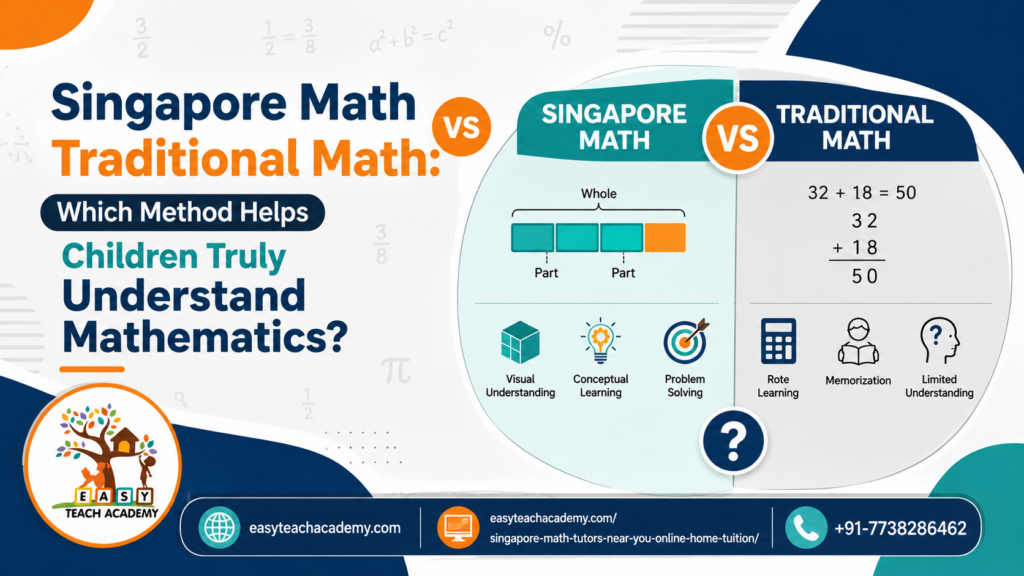
Many traditional mathematics lessons follow a familiar pattern.
The teacher explains a formula.
Students copy examples.
Homework includes many similar questions.
Children remember the steps for the next test.
The Singapore Math method follows a different philosophy.
Instead of beginning with formulas, children first explore mathematical ideas.
They use:
- Real objects.
- Pictures.
- Visual models.
- Discussion.
- Logical reasoning.
Only after understanding develops do they move to abstract calculations.
This gradual progression helps children develop genuine mathematical understanding.
Understanding Before Memorisation
Imagine two students.
The first memorises every formula perfectly.
The second understands how mathematical ideas connect.
When an unfamiliar question appears, which child is more likely to succeed?
Usually, the student who understands the concept rather than simply remembering procedures.
The Singapore Math curriculum encourages children to become thinkers instead of memorizers.
This prepares them to solve unfamiliar problems with greater confidence.
Why Parents Choose Singapore Math
Parents today want more than higher examination scores.
They want children to:
- Think independently.
- Solve problems confidently.
- Develop resilience.
- Enjoy learning.
- Prepare for future challenges.
These goals align closely with the philosophy of Singapore Math.
Instead of asking,
“Can my child memorise this?”
the programme asks,
“Does my child truly understand this?”
That simple difference changes the entire learning experience.
Who Can Benefit from Singapore Math?
One common misconception is that Singapore Math is only suitable for academically gifted children.
In reality, it benefits many different learners.
Children Who Need Extra Support
Students who struggle often benefit because concepts are introduced gradually and explained using visual methods.
Confident Learners
Children who already enjoy mathematics remain challenged through deeper reasoning and more complex problem-solving.
International School Students
Many international schools use teaching methods inspired by the Singapore Math curriculum, making additional support especially valuable.
Children Preparing for Advanced Mathematics
Strong mathematical foundations make later topics such as algebra, geometry, ratios, and statistics much easier to understand.
What Skills Does Singapore Math Develop?
Although the subject is mathematics, children develop many additional abilities.
These include:
- Logical reasoning.
- Critical thinking.
- Pattern recognition.
- Communication.
- Decision-making.
- Persistence.
- Confidence.
These qualities help children succeed not only in mathematics but also in science, technology, engineering, economics, and many everyday situations.
Why Parents Should Learn About Singapore Math
Parents do not need to become mathematics teachers.
However, understanding how Singapore Math works allows them to:
- Support homework more effectively.
- Encourage independent thinking.
- Understand classroom strategies.
- Build confidence at home.
- Communicate more effectively with teachers.
Even small changes in the way parents ask questions can strengthen a child’s mathematical thinking.
The CPA Approach: The Heart of Singapore Math
One of the defining features of the Singapore Math method is the CPA Approach.
CPA stands for:
- Concrete
- Pictorial
- Abstract
Rather than introducing mathematical symbols immediately, children gradually move through these three learning stages.
This progression makes mathematics easier to understand because children experience ideas before they calculate them.
Stage 1: Concrete Learning
Children first learn using real objects they can see and touch.
Teachers may use:
- Building blocks
- Counters
- Coins
- Cubes
- Buttons
- Toy animals
- Everyday household objects
For example, instead of simply writing:
7 + 5 = ?
Children first combine seven counters with five counters.
They physically see that the total is twelve.
This hands-on experience creates meaningful understanding.
Stage 2: Pictorial Learning
After working with real objects, children move to pictures.
Instead of using counters, they draw circles, rectangles, or simple diagrams.
They also learn to use:
- Number bonds
- Part-whole models
- Number lines
- Arrays
- Place value charts
Visual learning helps children recognise relationships between numbers.
Many children who struggle with traditional methods understand mathematical ideas much more easily through pictures.
Stage 3: Abstract Learning
Only after children understand the concept through objects and pictures do they begin working with mathematical symbols.
For example:
Concrete:
🍎🍎🍎🍎🍎🍎🍎
Remove three apples.
Pictorial:
○ ○ ○ ○ ○ ○ ○
Cross out three circles.
Abstract:
7 – 3 = 4
Because children already understand the concept, equations become meaningful rather than something to memorise.
The Singapore Math Bar Model
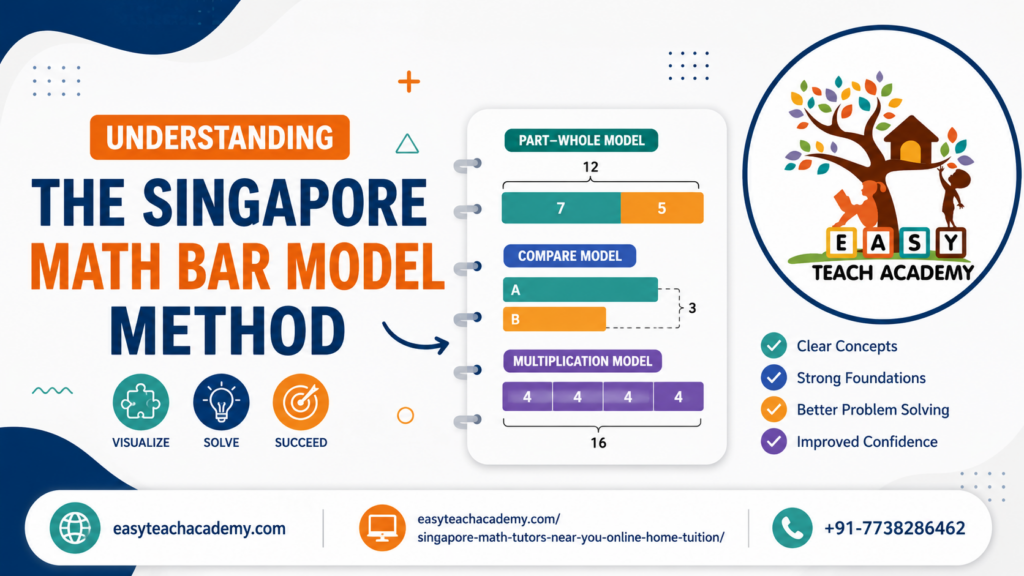
One of the best-known features of Singapore Math is the Singapore Math Bar Model.
Parents often notice children drawing rectangles before solving a question.
These simple diagrams are incredibly powerful.
The Bar Model helps children:
- Organise information.
- Compare quantities.
- Understand relationships.
- Solve word problems logically.
- Prepare for algebra later.
Instead of guessing which operation to use, children can see the mathematical relationships visually.
Example of a Bar Model
Imagine this question:
Emma has 24 books.
Her grandmother gives her 16 more books.
How many books does Emma have altogether?
Instead of immediately writing:
24 + 16
Children first draw two connected bars.
One represents 24.
The other represents 16.
The complete bar shows the total.
This visual representation helps children understand why addition is needed.
Why Word Problems Become Easier
Word problems are often one of the most difficult parts of mathematics.
Many children know how to calculate but struggle to decide which operation to use.
The Singapore Math method solves this problem by encouraging children to:
- Read carefully.
- Understand the situation.
- Identify important information.
- Draw visual models.
- Solve the problem step by step.
Instead of guessing, children develop confidence through logical thinking.
Mental Maths Is More Than Fast Calculation
Many parents think mental maths is simply about answering quickly.
In reality, Singapore Math develops flexible thinking.
Children learn to:
- Estimate answers.
- Recognise number patterns.
- Break numbers apart.
- Combine numbers efficiently.
- Check whether answers are reasonable.
Strong number sense allows children to solve problems with greater confidence.
Encouraging Children to Explain Their Thinking
One of the biggest differences between traditional mathematics teaching and the Singapore Math curriculum is communication.
Instead of asking only,
“What is the answer?”
Teachers often ask:
- Why did you choose that method?
- Can you explain your thinking?
- Is there another strategy?
- How do you know your answer is correct?
These discussions strengthen reasoning and improve long-term understanding.
Why Mistakes Are Part of Learning
Some children become discouraged when they make mistakes.
The Singapore Math method treats mistakes differently.
Instead of seeing mistakes as failures, teachers encourage children to:
- Analyse what happened.
- Identify where the misunderstanding began.
- Try another strategy.
- Learn from the experience.
This approach builds resilience and confidence.
Why Parents Appreciate the Singapore Math Approach
Parents often notice several positive changes after children begin learning Singapore Math.
Children frequently become:
- More confident.
- Better problem solvers.
- More willing to ask questions.
- Less afraid of challenging problems.
- More independent learners.
Instead of relying on memorisation, they begin trusting their own reasoning.
Part 3: Why Singapore Math Helps Children Succeed in School and Beyond
In Part 1, we explored what Singapore Math is and why it has become one of the world’s most respected mathematics programmes. In Part 2, we learned how the Singapore Math curriculum teaches children through the CPA (Concrete–Pictorial–Abstract) approach, visual learning, and problem-solving.
Now, let’s look at the long-term benefits that make Singapore Math much more than a school subject.
Parents naturally want their children to perform well in mathematics, but they also want them to become confident learners who can think independently, solve unfamiliar problems, and adapt to new challenges.
These are exactly the qualities that the Singapore Math method is designed to develop.
Singapore Math Builds More Than Mathematical Skills
Many people think mathematics is only about numbers.
In reality, children develop many life skills while learning through the Singapore Math curriculum.
These include:
- Logical reasoning.
- Critical thinking.
- Analytical skills.
- Decision-making.
- Communication.
- Patience.
- Persistence.
- Confidence.
These abilities help children succeed not only in mathematics but also in science, technology, engineering, finance, economics, and everyday decision-making.
Strong Foundations Lead to Long-Term Success
One of the greatest strengths of Singapore Math is its emphasis on building strong foundations.
Children do not simply memorise today’s lesson.
Each topic is carefully connected to future learning.
For example:
- Strong number sense supports fractions.
- Fractions prepare children for ratios.
- Ratios support percentages.
- Percentages lead naturally into algebra and data handling.
Because concepts are introduced in a logical sequence, children are less likely to develop learning gaps.
This makes advanced mathematics much less intimidating.
Confidence Changes the Way Children Learn
Many children begin to believe they are “not good at maths” after experiencing repeated difficulties.
Confidence can change that story.
When children understand mathematical ideas instead of memorising them, they begin approaching new questions with curiosity rather than fear.
The Singapore Math method helps children:
- Solve unfamiliar problems.
- Learn from mistakes.
- Explain their thinking.
- Try different strategies.
- Celebrate gradual improvement.
As confidence grows, children become more willing to participate in class, complete homework independently, and tackle more challenging questions.
Why Singapore Math Supports Future Learning
Today’s children are preparing for a future that will continue changing.
Technology, Artificial Intelligence, and new industries are creating careers that require adaptable thinkers.
The Singapore Math curriculum develops skills that remain valuable regardless of future career choices.
Children strengthen:
Problem-Solving
Learning how to approach unfamiliar situations logically.
Critical Thinking
Evaluating information before reaching conclusions.
Creativity
Looking for more than one possible solution.
Communication
Explaining ideas clearly and listening to different viewpoints.
Independent Learning
Developing confidence to explore new ideas without depending on constant guidance.
These qualities prepare children for lifelong learning.
What Parents Can Do at Home
Parents play an important role in supporting mathematical development.
You do not need to teach every lesson.
Small daily conversations can make a significant difference.
For example:
Ask Open-Ended Questions
Instead of asking:
“What is the answer?”
Try asking:
- Why did you choose that method?
- Can you explain your thinking?
- Is there another way?
- What happens if we change the numbers?
Encourage Real-Life Mathematics
Children learn naturally while:
- Shopping.
- Cooking.
- Measuring.
- Travelling.
- Playing board games.
- Planning family budgets.
These activities show children that mathematics is useful in everyday life.
Celebrate Effort
Praise:
- Careful thinking.
- Persistence.
- Improvement.
- Curiosity.
- Good problem-solving strategies.
Positive encouragement builds long-term confidence.
Meet Your Teacher – Niral Devnath
Hello, I’m Niral Devnath, founder of Easy Teach Academy.
For more than 15 years, I have been teaching mathematics to children from different countries through structured, concept-based learning.
During my teaching journey, I have had the privilege of working with students from:
- Singapore
- Australia
- United States
- United Kingdom
- Norway
- India
- Other international communities
Working with children from different educational systems has shown me that every child can become successful in mathematics when concepts are explained clearly and patiently.
Every learner progresses at a different pace.
My role is to help children build confidence while developing strong mathematical foundations.
My Teaching Philosophy
I believe mathematics should prepare children for life, not just examinations.
Every lesson is built around four important principles.
Understanding Before Memorisation
Children should know why methods work before learning shortcuts.
Encourage Independent Thinking
Students become successful when they learn to solve problems confidently on their own.
Build Confidence Step by Step
Every small success becomes a foundation for future learning.
Make Mathematics Enjoyable
Children learn best when lessons are interactive, meaningful, and engaging.
A positive learning experience encourages curiosity and long-term success.
Why Parents Choose Easy Teach Academy
At Easy Teach Academy, we believe every child deserves personalised guidance and high-quality mathematics education.
Our Online Singapore Math Classes help children:
- Build strong conceptual understanding.
- Improve logical reasoning.
- Strengthen problem-solving skills.
- Develop confidence.
- Enjoy learning mathematics.
Families appreciate our programme because we provide:
- Live interactive online classes.
- Small class sizes.
- Personalised attention.
- Structured learning plans.
- Regular assessments.
- Parent progress updates.
- Flexible schedules for international students.
Our goal is not only to improve marks but also to help children become confident learners prepared for future success.
Learn More About Our Singapore Math Programme
If you would like your child to experience the benefits of Singapore Math, we would be delighted to support their learning journey.
Explore our Singapore Math programme:
Singapore Math Tutors
Visit Easy Teach Academy to learn more about all our educational programmes:
Part 4: Frequently Asked Questions, Common Myths, and Final Thoughts
By now, you have learned what Singapore Math is, how the Singapore Math curriculum works, and why millions of parents around the world choose this approach for their children.
The final step is understanding some common misconceptions and learning how to choose the right support for your child’s mathematical journey.
Common Myths About Singapore Math
Many parents hear about Singapore Math from friends, schools, or online discussions. Unfortunately, some myths prevent families from exploring its true benefits.
Let’s look at the facts.
Myth 1: Singapore Math Is Only for Gifted Children
This is one of the most common misunderstandings.
The truth is that Singapore Math is designed for children with different learning abilities.
Because concepts are introduced gradually using the CPA (Concrete–Pictorial–Abstract) approach, many children who struggle with traditional mathematics actually find Singapore Math easier to understand.
Advanced learners also benefit because they are encouraged to think deeply, solve complex problems, and explain their reasoning.
Myth 2: Singapore Math Is Only About Difficult Questions
Parents sometimes believe the curriculum focuses only on challenging problems.
In reality, the programme builds understanding step by step.
Children first master basic concepts before moving to more advanced applications.
This structured progression helps them develop confidence rather than frustration.
Myth 3: Parents Must Be Mathematics Experts
Many parents worry that they cannot support their children because they learned mathematics differently.
Fortunately, your role is not to become another teacher.
Your role is to:
- Encourage curiosity.
- Ask thoughtful questions.
- Celebrate effort.
- Create regular learning habits.
- Support independent thinking.
Even small daily conversations about mathematics can strengthen your child’s confidence.
Myth 4: Singapore Math Is Only Useful for School Exams
Good examination results are certainly important.
However, the real strength of the Singapore Math method lies in the lifelong skills it develops.
Children learn to:
- Think logically.
- Analyse information.
- Solve unfamiliar problems.
- Communicate mathematical ideas.
- Learn independently.
These abilities support success far beyond the classroom.
How to Choose the Right Singapore Math Tutor
Choosing the right Singapore Math tutor can have a significant impact on your child’s learning experience.
When comparing programmes, look for a tutor who:
- Explains concepts clearly.
- Encourages questions.
- Builds confidence gradually.
- Uses visual teaching strategies.
- Focuses on understanding rather than memorisation.
- Provides regular feedback.
- Adapts lessons to each child’s learning style.
The right teacher helps children enjoy mathematics while developing strong conceptual foundations.
About Me – Niral Devnath
Hello, I’m Niral Devnath, founder of Easy Teach Academy.
For more than 15 years, I have been teaching mathematics to children from different countries through personalised, concept-based instruction.
During my teaching journey, I have worked with students from:
- Singapore
- Australia
- United States
- United Kingdom
- Norway
- India
- Other international communities
Every child I teach reminds me that success in mathematics is not determined by natural talent alone.
It grows through:
- Clear explanations.
- Consistent practice.
- Positive encouragement.
- Strong conceptual understanding.
My teaching philosophy is simple.
I believe every child deserves the opportunity to become a confident mathematical thinker.
That is why every lesson focuses on:
- Understanding before memorisation.
- Logical reasoning.
- Independent problem-solving.
- Building confidence step by step.
- Making mathematics enjoyable and meaningful.
Watching students overcome their fear of mathematics and begin solving problems independently is one of the most rewarding parts of my career.
Why Families Choose Easy Teach Academy
At Easy Teach Academy, we believe mathematics should inspire confidence, curiosity, and lifelong learning.
Our Online Singapore Math Classes are carefully designed to help children:
- Build strong mathematical foundations.
- Develop logical reasoning.
- Improve critical thinking.
- Master problem-solving skills.
- Gain confidence in every lesson.
- Enjoy learning mathematics.
Parents appreciate our programme because we provide:
- Live interactive online classes.
- Small class sizes.
- Individual attention.
- Structured lesson plans.
- Regular assessments.
- Progress updates for parents.
- Flexible class schedules for students around the world.
Whether your child needs additional support or greater academic challenge, our lessons are designed to help them succeed.
Learn more about our Singapore Math programme:
Visit our website:
Frequently Asked Questions
What is the biggest advantage of Singapore Math?
The biggest advantage is its focus on understanding concepts before memorising procedures. This helps children become confident problem solvers rather than simply remembering formulas.
Is Singapore Math suitable for all children?
Yes.
The Singapore Math curriculum supports children with different learning styles and abilities by introducing concepts gradually through visual and hands-on learning.
At what age should children begin Singapore Math?
Many children begin during the early primary years. Starting early helps build strong number sense, confidence, and problem-solving skills before more advanced topics are introduced.
Can Singapore Math help children who struggle with mathematics?
Absolutely.
Because the programme uses visual models, logical progression, and step-by-step instruction, many children gain confidence after understanding concepts that previously seemed confusing.
Are Online Singapore Math Classes effective?
Yes.
High-quality Online Singapore Math Classes provide live interaction, personalised guidance, immediate feedback, and structured learning that can significantly improve a child’s understanding and confidence.
Final Thoughts
Choosing the right mathematics programme is about much more than improving examination scores.
It is about helping your child develop confidence, curiosity, resilience, and the ability to think independently.
The Singapore Math curriculum achieves this by encouraging children to understand concepts deeply, communicate their reasoning, and solve unfamiliar problems with confidence.
These are skills that support success throughout school, higher education, and future careers.
When children enjoy learning mathematics and believe in their ability to solve challenging problems, they develop habits that benefit them for life.
Give Your Child the Gift of Confident Mathematical Thinking
If you would like your child to experience the benefits of Singapore Math, Easy Teach Academy is here to help.
Our Online Singapore Math Classes combine proven teaching methods with personalised guidance to help every child reach their full potential.
Why Parents Trust Easy Teach Academy
✔ 15+ years of teaching experience
✔ Live interactive Online Singapore Math Classes
✔ Small class sizes with personalised attention
✔ Concept-based learning following the Singapore Math curriculum
✔ Strong focus on logical reasoning and problem-solving
✔ Flexible schedules for families across different countries
✔ Regular parent communication and progress updates
Start Your Child’s Singapore Math Journey Today
Learn more about our programme:
Singapore Math Tutors
Visit Easy Teach Academy: