How Singapore Math Builds Confidence in Children
Many children do not dislike mathematics because they are incapable of learning it.
They lose confidence because they do not understand it.
As parents, you may have heard your child say:
- “Math is too difficult.”
- “I’m just not good at maths.”
- “Everyone else is smarter than me.”
- “I always get the wrong answer.”
- “I don’t want to do my maths homework.”
These words can be worrying.
The good news is that confidence in mathematics is not something children are born with.
Confidence develops when children experience success, understand concepts clearly, and believe they can solve problems independently.
This is where Singapore Math makes a real difference.
Rather than focusing only on memorising formulas, Singapore Math helps children understand mathematical ideas, think logically, and enjoy the learning process.
Over time, this approach transforms hesitant learners into confident problem-solvers.
Why Confidence Matters More Than High Marks
Many parents naturally focus on examination results.
While good marks are important, confidence is often the foundation that leads to academic success.
A confident child is more likely to:
- Attempt difficult questions.
- Ask questions without fear.
- Learn from mistakes.
- Think independently.
- Complete homework willingly.
- Continue improving over time.
By contrast, a child who lacks confidence may avoid mathematics altogether—even if they have the ability to succeed.
Helping children build confidence early creates a stronger foundation for future learning.
Why Children Lose Confidence in Mathematics
Understanding the cause of low confidence is the first step toward solving it.
Learning Too Quickly
Sometimes children move to new topics before fully understanding earlier concepts.
Small learning gaps gradually become larger problems.
Eventually, children begin believing mathematics is simply “too hard.”
Memorising Without Understanding
Some students can remember formulas for a short time but struggle when questions are presented differently.
Instead of recognising this as a learning issue, they often assume they are “bad at maths.”
Fear of Making Mistakes
Children who are criticised for incorrect answers may become afraid of trying.
Instead of thinking carefully, they worry about getting the answer wrong.
Over time, this fear reduces participation and confidence.
Constant Comparison
Comparing children with classmates, siblings, or friends can damage motivation.
Every child develops mathematical understanding at a different pace.
Healthy progress should be measured against the child’s own improvement—not someone else’s.
Negative Learning Experiences
A difficult test, repeated frustration, or confusion during lessons can affect a child’s attitude toward mathematics for years.
The encouraging news is that confidence can be rebuilt through positive learning experiences.
How Singapore Math Takes a Different Approach
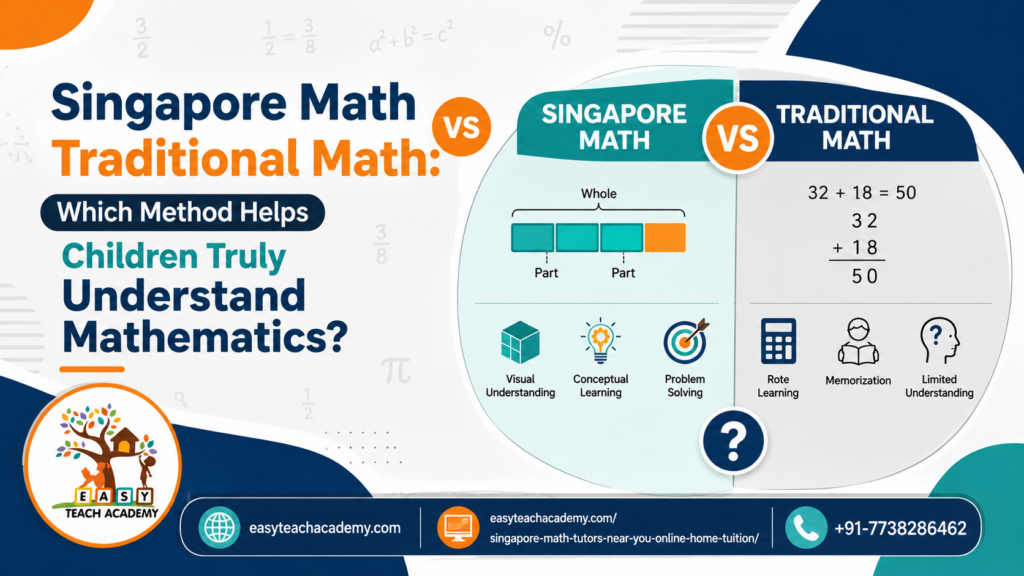
Singapore Math is designed to help children understand before they memorise.
Instead of asking children to repeat methods without explanation, lessons encourage them to:
- Explore mathematical ideas.
- Use visual models.
- Explain their thinking.
- Solve problems step by step.
- Discover multiple ways to reach an answer.
When children understand why something works, they become more willing to attempt challenging questions.
Understanding naturally leads to confidence.
Building Confidence Through Small Successes
Confidence does not appear overnight.
It grows through many small successes.
Singapore Math introduces concepts gradually.
Each lesson builds on previous understanding.
Children experience regular achievements instead of repeated frustration.
For example:
A child who confidently understands addition is more prepared to learn multiplication.
A child who understands multiplication finds fractions less intimidating.
Each success encourages the next.
Why Mistakes Are Valuable
Many children believe mistakes mean failure.
Singapore Math encourages a different way of thinking.
Mistakes become opportunities to learn.
Teachers guide children to ask questions such as:
- What happened?
- Which step was confusing?
- Is there another way to solve this?
- What can I learn from this mistake?
This mindset helps children become more resilient.
Instead of giving up, they continue searching for solutions.
Confidence Leads to Curiosity
Confident learners become curious learners.
Children who believe they can solve problems begin asking questions like:
- Can I try another method?
- Why does this answer work?
- Is there a quicker strategy?
- What happens if the numbers change?
Curiosity leads to deeper understanding.
Deeper understanding leads to greater confidence.
This creates a positive cycle that supports long-term learning.
Parents Around the World Value Confident Learners
Families from many countries recognise that mathematics is about much more than calculations.
Parents living in Singapore, Melbourne, Brisbane, San Francisco, Houston, Toronto, and London increasingly look for mathematics programmes that help children become independent thinkers rather than simply strong test-takers.
Many respected schools, including Raffles Institution, encourage students to develop reasoning and analytical skills that support long-term academic growth.
Parents also understand that strong mathematical foundations can support future learning at universities such as National University of Singapore, University of Melbourne, University of Toronto, Stanford University, and University of Cambridge. While admission depends on many factors, confidence and strong mathematical reasoning provide valuable preparation for higher education.
Could Your Child Benefit from Singapore Math?
Ask yourself these questions:
- Does my child avoid mathematics whenever possible?
- Does my child lose confidence after making mistakes?
- Does my child memorise methods without understanding them?
- Does my child struggle with word problems?
- Does my child need more challenge than the current school curriculum provides?
- Would my child benefit from learning mathematics in a more visual and structured way?
If you answered “yes” to several of these questions, Singapore Math may be an excellent choice for your child’s learning journey.
Part 2: How Singapore Math Builds Confidence Step by Step
In Part 1, we explored why many children lose confidence in mathematics and how Singapore Math helps them develop a more positive attitude toward learning.
Now let’s look at how confidence is built.
Confidence does not come from being told, “You’re good at maths.”
Real confidence comes from understanding concepts, solving problems independently, and experiencing regular success.
That is exactly what Singapore Math is designed to achieve.
1. Every Lesson Starts with Understanding
Many children lose confidence because they are asked to memorise rules before they understand the ideas behind them.
Singapore Math takes the opposite approach.
Children first learn:
- What the concept means.
- Why it works.
- Where it can be used.
- How it connects to previous learning.
Only after building understanding do they move on to practice.
This allows children to answer questions with confidence instead of guessing.
2. Visual Learning Makes Difficult Topics Easier
Children often become anxious when mathematics feels too abstract.
Singapore Math introduces visual strategies that make ideas easier to understand.
Students regularly use:
- Number bonds
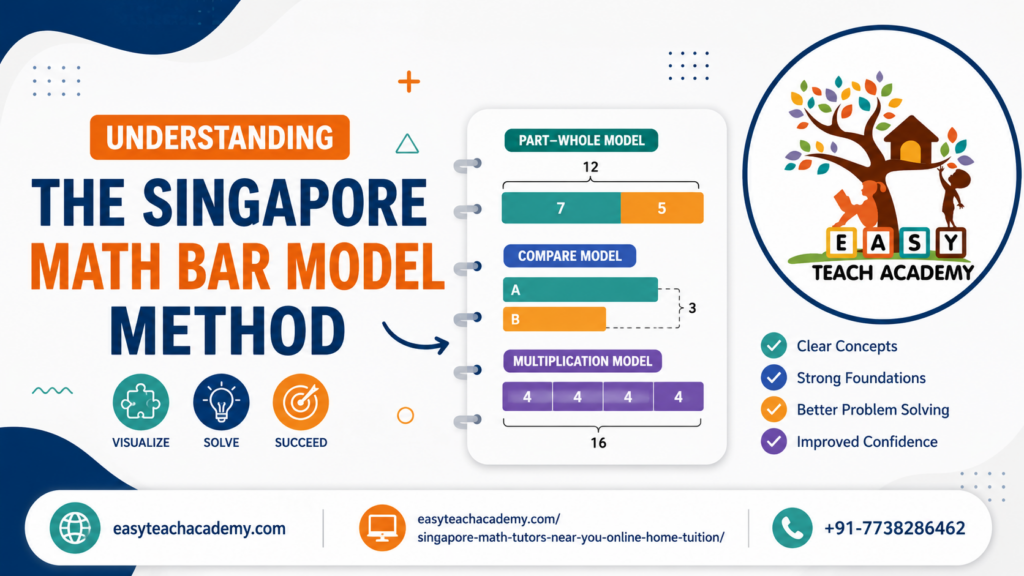
- Bar models
- Number lines
- Part-whole diagrams
- Arrays
- Place value charts
Instead of trying to imagine a problem, children can see it.
Visual learning reduces confusion and increases confidence.
3. Small Successes Build Big Confidence
Children become discouraged when lessons move too quickly.
Singapore Math introduces concepts in manageable steps.
For example:
A child first understands addition.
Then they explore repeated addition.
Next they discover multiplication.
Later they apply multiplication to fractions and algebra.
Each new topic builds on earlier success.
As children master one concept after another, their confidence naturally grows.
4. Children Learn That There Can Be More Than One Correct Method
Traditional lessons sometimes encourage only one solution.
Singapore Math encourages children to explore different strategies.
For example, two students may solve the same question using different methods.
Both methods can be correct.
This teaches children to:
- Think flexibly.
- Compare strategies.
- Explain their reasoning.
- Respect different approaches.
Knowing there is more than one way to solve a problem helps children become more confident thinkers.
5. Problem-Solving Develops Independence
One of the biggest confidence boosters is solving a difficult problem independently.
Singapore Math teaches children to:
- Read carefully.
- Break problems into smaller parts.
- Organise information.
- Choose appropriate strategies.
- Check their answers.
Each successful problem solved independently strengthens self-belief.
Children begin thinking,
“I can do this myself.”
6. Mistakes Become Learning Opportunities
Many children stop trying because they fear making mistakes.
Singapore Math encourages a healthy attitude toward errors.
Teachers ask questions such as:
- What can we learn from this?
- Which step needs another look?
- Can we solve it differently?
- Why did this happen?
Children discover that mistakes are a normal part of learning.
This reduces anxiety and encourages persistence.
7. Positive Feedback Encourages Growth
Confidence grows when children receive encouragement based on effort and progress.
Instead of saying only,
“Correct.”
Teachers recognise:
- Careful thinking.
- Good reasoning.
- Creative ideas.
- Improvement.
- Persistence.
Children begin focusing on learning rather than worrying about perfection.
How Parents Can Build Confidence at Home
Parents play a powerful role in shaping their child’s attitude toward mathematics.
Simple daily habits can make a significant difference.
Celebrate Effort
Praise determination, careful thinking, and improvement—not only correct answers.
Encourage Questions
Ask your child:
- Why do you think that works?
- Can you explain your idea?
- Is there another solution?
These conversations strengthen understanding.
Use Maths in Everyday Life
Children enjoy mathematics more when they see its practical value.
Examples include:
- Shopping
- Cooking
- Measuring
- Budgeting
- Sports statistics
- Travel planning
Real-life experiences make learning meaningful.
Keep Practice Positive
Short, regular practice sessions are usually more effective than long periods of forced study.
Consistency builds confidence.
Signs Your Child’s Confidence Is Growing
Parents often notice gradual improvements rather than dramatic changes.
Positive signs include:
- Asking more questions.
- Attempting difficult problems.
- Completing homework more independently.
- Explaining answers clearly.
- Feeling less anxious before tests.
- Showing curiosity about numbers.
These changes often indicate growing confidence and stronger mathematical understanding.
Why Parents Across the World Appreciate This Approach
Families living in Singapore, Sydney, Melbourne, San Jose, Dallas, Toronto, and London increasingly value mathematics programmes that help children become confident, independent learners.
Parents also understand that confidence developed during the primary years can support future success in schools and universities such as National University of Singapore, University of Melbourne, University of Toronto, Stanford University, and University of Cambridge. While admission depends on many factors, confidence, resilience, and strong mathematical reasoning support success throughout a student’s education.
Confidence Changes the Way Children Learn
Children who believe they can succeed usually approach learning differently.
Instead of avoiding challenges, they become willing to explore new ideas.
A confident learner is more likely to:
- Try difficult questions.
- Ask for help when needed.
- Learn from mistakes.
- Think independently.
- Complete work without constant reminders.
- Enjoy discovering new concepts.
These habits support success not only in mathematics but across the entire school curriculum.
Better Confidence Often Leads to Better Results
Confidence alone does not guarantee high marks.
However, confidence encourages the behaviours that help children improve over time.
Children who feel capable are more likely to:
- Practise regularly.
- Stay focused during lessons.
- Read questions carefully.
- Check their work.
- Continue trying when problems become difficult.
These positive habits often contribute to stronger academic performance.
Confidence Helps Beyond Mathematics
Parents are often surprised to see improvements in areas outside maths.
As children become more confident, they frequently develop stronger:
Communication Skills
They become more comfortable explaining their ideas and discussing different solutions.
Critical Thinking
Children learn to analyse information instead of rushing to answers.
Decision-Making
They become more confident making choices based on logical reasoning.
Resilience
Instead of giving up after one mistake, they continue searching for solutions.
Independent Learning
Children gradually rely less on constant adult assistance.
These are valuable life skills that extend well beyond the classroom.
Choosing the Right Singapore Math Teacher
The curriculum is important.
The teacher is even more important.
A great Singapore Math teacher does much more than explain textbook exercises.
They inspire confidence.
They encourage curiosity.
They help children believe in their own abilities.
What Parents Should Look For
When choosing a Singapore Math programme, consider the following.
Concept-Based Teaching
Children should understand ideas before learning shortcuts.
A teacher should explain why mathematical methods work.
Individual Attention
Every child learns differently.
A good teacher adjusts lessons according to:
- Learning pace.
- Confidence level.
- Previous knowledge.
- Individual goals.
Positive Encouragement
Children should feel comfortable asking questions and making mistakes.
Encouragement creates a safe learning environment where confidence can grow.
Clear Parent Communication
Regular feedback helps parents understand:
- Progress.
- Strengths.
- Areas for improvement.
- Future learning goals.
Strong communication creates a successful partnership between teacher and family.
Structured Learning
Lessons should follow a logical sequence rather than random practice.
Step-by-step learning helps children build strong foundations for future success.
Why Families Around the World Choose Singapore Math
Parents from different educational systems often share the same goal:
Helping children become confident learners.
Families living in:
- Singapore
- Melbourne
- Brisbane
- San Diego
- Dallas
- Toronto
- London
increasingly choose concept-based mathematics programmes because they value reasoning, confidence, and independent thinking.
These qualities help children succeed regardless of which school curriculum they follow.
Building a Strong Foundation for the Future
Strong mathematical confidence supports learning throughout school and into higher education.
Many parents hope their children will one day study at respected institutions such as:
- National University of Singapore
- Nanyang Technological University
- University of Melbourne
- University of Sydney
- Stanford University
- Harvard University
- University of Toronto
- University of Cambridge
Although admission depends on many academic and personal factors, students with strong reasoning, confidence, and problem-solving skills are well prepared for future learning.
About Me – Niral Devnath
Hello, I’m Niral Devnath, founder of Easy Teach Academy.
For more than 15 years, I have been teaching mathematics to children from different countries through live online classes.
During my teaching journey, I have worked with students from:
- Singapore
- Australia
- United States
- United Kingdom
- Norway
- India
- Other international communities
One lesson has remained constant throughout my career:
Confidence grows when children truly understand mathematics.
Many students who joined my classes initially believed they were “not good at maths.”
With patient guidance, structured lessons, and concept-based teaching, they gradually became more confident, independent learners.
My goal is not simply to improve examination results.
I want every child to:
- Understand mathematics deeply.
- Enjoy solving problems.
- Think independently.
- Believe in their own abilities.
- Develop skills that will benefit them throughout life.
Why Parents Choose Easy Teach Academy
At Easy Teach Academy, we believe that every child can become confident in mathematics with the right teaching approach.
Our Online Singapore Math Classes are designed to help children:
- Build strong conceptual understanding.
- Develop logical reasoning.
- Strengthen problem-solving abilities.
- Gain confidence through regular success.
- Enjoy learning mathematics.
Parents choose our programme because we provide:
- Live interactive online classes.
- Small class sizes.
- Individual attention.
- Structured lesson plans.
- Regular assessments.
- Progress reports for parents.
- Flexible schedules for students across different countries.
Every lesson is carefully planned to help children achieve steady progress while enjoying the learning process.
Learn More About Our Singapore Math Programme
If you would like your child to become a more confident mathematical thinker, we would be delighted to support your family.
Singapore Math Tutors
Visit Easy Teach Academy
Frequently Asked Questions, Parent Action Plan, and Final Thoughts
By now, you’ve learned why confidence is one of the most important ingredients in a child’s mathematical success.
Children who believe in their abilities are more willing to:
- Try challenging questions.
- Learn from mistakes.
- Ask thoughtful questions.
- Solve problems independently.
- Enjoy learning mathematics.
The goal of Singapore Math is not simply to help children score higher on tests.
Its goal is to help children become confident, curious, and capable learners who can apply mathematics throughout their lives.
Before making your decision, let’s answer some of the questions parents ask most often.
Frequently Asked Questions
Is Singapore Math Only for Children Who Are Good at Maths?
No.
One of the biggest misconceptions is that Singapore Math is only suitable for high-achieving students.
In reality, it is designed for children with different learning abilities.
Children who need extra support benefit from its structured, step-by-step teaching.
Advanced learners enjoy the deeper problem-solving and critical thinking opportunities.
My Child Has Lost Confidence. Can Singapore Math Help?
Yes.
Many children lose confidence because they memorise procedures without understanding the concepts.
Singapore Math focuses on building understanding first.
As children begin solving problems independently, their confidence often improves naturally.
How Long Does It Take to Build Confidence?
Every child is different.
Some children become more willing to participate within a few weeks.
Others need several months of consistent learning to rebuild confidence.
The important goal is steady improvement rather than instant results.
Will Singapore Math Help My Child at School?
In many cases, yes.
Because children develop stronger mathematical understanding, they often feel more prepared for classroom lessons, homework, and assessments.
The skills learned through Singapore Math support many different school curricula.
Are Online Singapore Math Classes Effective?
Yes.
Live online lessons allow students to:
- Interact with experienced teachers.
- Receive immediate feedback.
- Ask questions comfortably.
- Learn in small groups.
- Study from home with flexible schedules.
With the right teacher and structured lessons, online learning can be highly effective.
Common Myths About Confidence in Mathematics
Myth 1: Some Children Are Simply “Not Maths People”
This is one of the most common myths.
Mathematical ability develops through good teaching, regular practice, encouragement, and understanding.
Confidence is built over time.
Myth 2: Fast Learners Are Always Better Learners
Learning quickly does not always mean learning deeply.
Children who understand concepts thoroughly often build stronger long-term mathematical foundations.
Myth 3: Mistakes Mean Failure
Mistakes are a natural part of learning.
Every mistake provides an opportunity to improve understanding and develop resilience.
Children who learn from mistakes often become stronger problem-solvers.
Myth 4: Confidence Comes Only from High Marks
Good marks can increase confidence.
However, lasting confidence usually comes from understanding concepts and solving problems independently.
Children who understand mathematics are more likely to remain confident even when questions become more challenging.
A Parent’s Action Plan for Building Maths Confidence
You can help your child develop confidence every day.
Encourage Effort Instead of Perfection
Praise your child’s persistence, careful thinking, and willingness to try difficult questions.
Ask Open-Ended Questions
Instead of asking only,
“What is the answer?”
try asking:
- How did you solve it?
- Can you explain your thinking?
- Is there another strategy?
- Why do you think this works?
These conversations strengthen understanding.
Make Mathematics Part of Everyday Life
Use real situations such as:
- Grocery shopping.
- Cooking.
- Measuring ingredients.
- Reading timetables.
- Planning holidays.
- Managing pocket money.
Children become more confident when they see mathematics used in everyday life.
Create a Positive Learning Routine
Regular short practice sessions are usually more effective than occasional long study sessions.
Consistency helps children build confidence gradually.
Celebrate Progress
Remember that confidence grows through many small achievements.
Celebrate improvements, no matter how small they seem.
Every step forward helps your child believe they can succeed.
Why Parents Across the World Value Confident Learners
Families living in Singapore, Sydney, Melbourne, San Francisco, Austin, Toronto, and London increasingly seek educational programmes that develop confidence alongside academic knowledge.
Many parents also hope their children will one day study at respected institutions such as National University of Singapore, University of Melbourne, University of Toronto, Stanford University, Harvard University, and University of Cambridge. While admission depends on many factors, confidence, resilience, and strong mathematical reasoning provide an excellent foundation for future academic success.
About Me – Niral Devnath
Hello, I’m Niral Devnath, founder of Easy Teach Academy.
For over 15 years, I have helped children from Singapore, Australia, the United States, the United Kingdom, Norway, India, and many other countries improve their mathematical understanding through live online classes.
Throughout my teaching journey, I have worked with students who arrived feeling nervous, frustrated, or convinced they were “not good at maths.”
The greatest reward has been watching those same students become confident learners who solve problems independently and enjoy mathematics.
My teaching philosophy is built on five simple principles:
- Understand before memorising.
- Build confidence step by step.
- Encourage independent thinking.
- Make learning engaging and enjoyable.
- Help every child reach their full potential.
I believe that every child can succeed when they receive patient guidance, personalised instruction, and consistent encouragement.
Why Parents Choose Easy Teach Academy
At Easy Teach Academy, confidence is at the heart of every lesson.
Our Online Singapore Math Classes are designed to help children:
- Build deep conceptual understanding.
- Strengthen logical reasoning.
- Improve problem-solving skills.
- Develop independent thinking.
- Enjoy learning mathematics with confidence.
Parents trust our programme because we offer:
- Live interactive online classes.
- Small groups for personalised attention.
- Step-by-step concept-based teaching.
- Regular assessments and progress tracking.
- Individual feedback for every student.
- Flexible class schedules for international families.
- A supportive learning environment where children are encouraged to ask questions and grow.
Whether your child needs extra support, enrichment, or preparation for future academic challenges, we are committed to helping them become confident mathematical thinkers.
Begin Your Child’s Confidence Journey Today
Every confident learner starts with one important step—a learning environment where questions are welcomed, mistakes become opportunities, and understanding comes before memorisation.
If you would like your child to experience this approach, we would love to help.
Learn More About Our Singapore Math Classes
Visit Easy Teach Academy
We proudly teach students from Singapore, Australia, the United States, Canada, the United Kingdom, India, and many other countries through live, interactive online classes.
Final Thoughts
Confidence is not built by telling children they are smart.
It is built by giving them the tools, guidance, and opportunities to succeed.
Singapore Math helps children develop that confidence by encouraging understanding, logical thinking, and independent problem-solving.
When children believe they can solve mathematical challenges, they approach learning with greater curiosity and resilience.
Those qualities do more than improve mathematics—they prepare children for success in school, higher education, and future careers.
If you are looking for a learning approach that helps your child build both mathematical skills and self-confidence, Singapore Math is an excellent place to begin.