Why Do Some Children Learn Mathematics More Easily Than Others?
Have you ever wondered why one child quickly understands a maths concept while another struggles despite practising every day?
Many parents believe the answer is intelligence.
In reality, educational research suggests something different.
Children learn mathematics more effectively when they understand concepts, build strong number sense, and connect new ideas with previous knowledge.
This is one of the key reasons why Singapore Math has attracted worldwide attention.
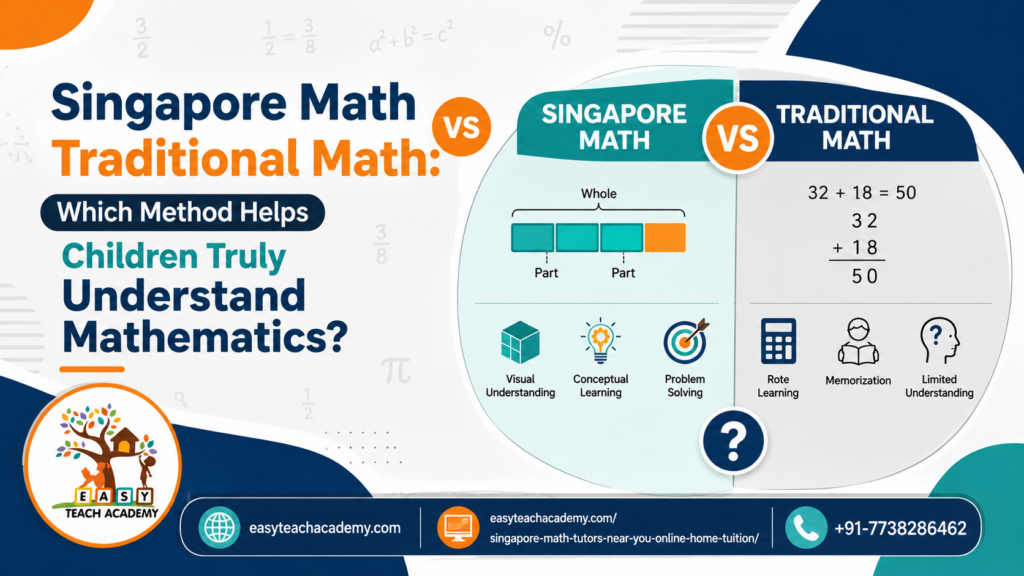
Rather than asking children to memorise procedures, it encourages them to understand how mathematics works.
That simple difference changes the way the brain learns.
The Brain Was Designed to Recognise Patterns
From a very young age, children naturally look for patterns.
Babies begin recognising:
- Shapes
- Colours
- Sounds
- Sizes
- Quantities
- Sequences
As they grow, this natural pattern-recognition ability becomes the foundation for mathematical thinking.
When children recognise that:
- 2 + 3 is connected to 3 + 2,
- multiplication is repeated addition,
- fractions represent equal parts,
- percentages relate to fractions and decimals,
they begin building a network of connected ideas rather than isolated facts.
Singapore Math encourages exactly this kind of connected learning.
Why Memorisation Alone Often Fails
Many traditional maths lessons depend heavily on repetition.
Children may memorise:
- Times tables
- Formulas
- Procedures
- Rules
Memorisation certainly has its place.
However, when children face unfamiliar questions, memorised procedures alone are often not enough.
For example:
A child may know that 7 × 8 = 56.
But if asked:
“Why does multiplication work this way?”
or
“Can you solve this problem differently?”
they may struggle.
Singapore Math helps children understand the reasoning behind mathematical ideas, making learning more flexible and meaningful.
Understanding Creates Stronger Memory
Educational psychologists have long observed that children remember information better when it is meaningful.
When a child understands a mathematical concept, the brain creates stronger connections between ideas.
Instead of remembering one isolated fact, children begin linking concepts together.
For example:
Understanding place value makes addition easier.
Addition supports multiplication.
Multiplication leads naturally to fractions.
Fractions help children understand percentages.
Each concept strengthens the next.
This connected learning is one reason why many children retain mathematical knowledge for longer.
How Singapore Math Supports Brain-Friendly Learning
Singapore Math follows a learning process that matches the way many children naturally develop understanding.
Instead of introducing abstract symbols immediately, children first explore ideas through meaningful experiences.
Lessons encourage children to:
- Observe patterns.
- Compare quantities.
- Ask questions.
- Solve problems.
- Explain their thinking.
- Apply ideas in different situations.
This active learning process helps children build deeper understanding rather than relying only on memory.
Why Visual Learning Is So Powerful
Research in education consistently shows that many children understand new ideas more easily when they can see them.
Singapore Math makes extensive use of visual representations such as:
- Number bonds
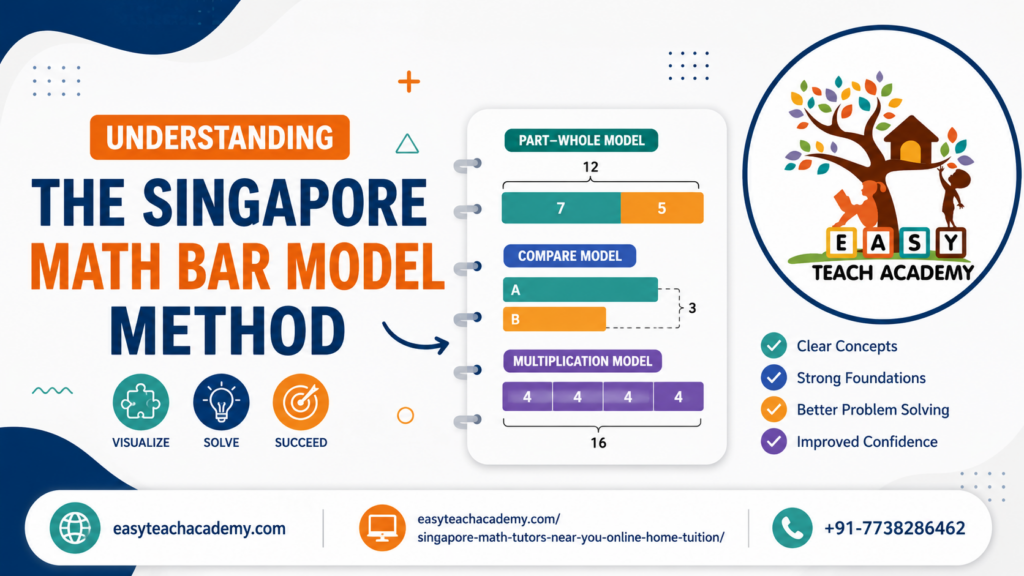
- Bar models
- Number lines
- Arrays
- Place value charts
- Part-whole diagrams
These tools help children organise information, identify relationships, and solve problems with greater confidence.
Instead of guessing, children can visualise the mathematics.
Building Mathematical Thinking Instead of Short-Term Memory
One of the biggest goals of Singapore Math is to develop mathematical thinking.
Children learn to ask questions like:
- Why does this method work?
- Is there another strategy?
- What happens if the numbers change?
- Can I explain my answer?
These habits strengthen reasoning skills that support learning throughout school.
Rather than remembering today’s lesson only until the next test, children gradually build knowledge that remains useful for years.
Why Parents Around the World Are Interested
Parents from many countries are increasingly looking for mathematics programmes that develop thinking skills instead of memorisation.
Families living in Singapore, Sydney, Melbourne, San Jose, Dallas, Toronto, and London are exploring programmes such as Singapore Maths, Singapore Math Homeschool, Math Enrichment Singapore, and Singapore Math Online Classes because they value deep understanding and long-term academic growth.
Many parents searching online for Singapore Math near me, Singapore Math classes near me, or the best math enrichment Singapore programme are looking for experienced teachers who can provide personalised, concept-based instruction regardless of location.
Strong Foundations Support Future Success
A strong understanding of mathematics can benefit children throughout their education.
Many respected schools, including Raffles Institution and Hwa Chong Institution, are known for high academic standards.
Likewise, universities such as National University of Singapore, Nanyang Technological University, University of Melbourne, Stanford University, Harvard University, and University of Cambridge value strong analytical and quantitative skills.
Although admission to these institutions depends on many factors, developing mathematical reasoning during the primary years creates an excellent academic foundation.
Is Singapore Math Based on Science?
While no single teaching method works perfectly for every child, Singapore Math incorporates several well-established educational principles, including:
- Learning from concrete experiences before abstract symbols.
- Building conceptual understanding.
- Using visual representations to organise ideas.
- Connecting new knowledge with previous learning.
- Encouraging active problem-solving instead of passive memorisation.
These principles are widely recognised as effective ways to support children’s mathematical learning.
Part 2: The Learning Science Behind Singapore Math
In Part 1, we explored why many children learn mathematics more effectively when they understand concepts instead of memorising procedures. We also looked at how the brain naturally recognises patterns and builds connections between ideas.
Now let’s explore how Singapore Math applies these learning principles in everyday lessons.
Rather than relying on one teaching technique, Singapore Math combines several evidence-informed educational practices that help children build lasting mathematical understanding.
1. The Concrete–Pictorial–Abstract (CPA) Learning Journey
One of the best-known features of the Singapore Math curriculum is the Concrete–Pictorial–Abstract (CPA) approach.
This learning sequence introduces ideas in three carefully planned stages.
Stage 1 – Concrete Learning
Children first use real objects to understand mathematical concepts.
Examples include:
- Counting blocks
- Beads
- Coins
- Cubes
- Counters
- Measuring tools
Instead of immediately writing:
9 + 5 = ?
children physically combine nine counters with five counters.
They experience addition before learning the mathematical symbols.
This practical experience helps many children understand what the numbers actually represent.
Stage 2 – Pictorial Learning
Once children understand the idea using real objects, they move to visual representations.
These include:
- Bar models
- Number bonds
- Arrays
- Number lines
- Place value charts
- Part-whole diagrams
Pictures reduce the mental effort needed to process information.
Instead of imagining relationships, children can see them clearly.
Visual thinking often makes complex word problems much easier to solve.
Stage 3 – Abstract Learning
Only after children understand the concept do they work confidently with mathematical symbols.
For example:
Concrete:
🍎🍎🍎🍎 + 🍎🍎🍎
Pictorial:
■■■■ + ■■■
Abstract:
4 + 3 = 7
By this stage, the symbols already have meaning.
Children are not simply memorising equations—they understand what the equations represent.
2. Why Visual Learning Supports Long-Term Memory
Many educational researchers agree that visual learning can make mathematical ideas easier to remember.
When children use diagrams and models, they organise information in meaningful ways.
Singapore Math encourages children to use visual tools such as:
- Bar models
- Number bonds
- Arrays
- Place value charts
- Fraction models
- Comparison diagrams
These visual representations help children:
- Understand relationships.
- Identify patterns.
- Solve multi-step problems.
- Recall concepts more easily.
This is one reason many parents notice that their children retain mathematical ideas for longer.
3. Pattern Recognition Strengthens Mathematical Thinking
The human brain naturally looks for patterns.
Singapore Math helps children discover mathematical patterns instead of simply memorising answers.
For example, children learn to recognise:
- Number relationships.
- Multiplication patterns.
- Fraction equivalence.
- Place value structures.
- Repeating sequences.
Recognising patterns makes learning more efficient because children understand how ideas connect.
4. Active Learning Builds Stronger Understanding
Children learn more effectively when they actively participate.
Singapore Math lessons encourage students to:
- Ask questions.
- Explain their reasoning.
- Compare different methods.
- Discuss solutions.
- Solve real-life problems.
Instead of listening passively, children become active learners.
This type of participation helps strengthen understanding and keeps students engaged.
5. Problem-Solving Strengthens the Brain
Problem-solving is one of the most valuable parts of Singapore Math.
Rather than practising identical questions repeatedly, children learn to analyse unfamiliar situations.
They develop habits such as:
- Reading carefully.
- Identifying important information.
- Choosing appropriate strategies.
- Checking whether answers are reasonable.
- Reflecting on their thinking.
These habits strengthen reasoning skills that support learning far beyond mathematics.
6. Learning Through Meaningful Connections
One reason children sometimes forget mathematics is that topics are taught separately.
Singapore Math encourages children to connect ideas.
For example:
- Addition supports multiplication.
- Multiplication helps explain fractions.
- Fractions lead naturally to decimals.
- Decimals connect with percentages.
- Percentages prepare students for algebra.
These connections make mathematics easier to understand and remember.
7. Why Understanding Lasts Longer Than Memorisation
Imagine two children preparing for an examination.
One memorises formulas without understanding them.
The other understands why the formulas work.
Months later, which child is more likely to remember?
In many cases, the child with conceptual understanding is better prepared to apply knowledge in new situations.
This is why Singapore Math emphasises understanding before repetition.
Why Families Around the World Appreciate This Approach
Parents living in Singapore, Brisbane, Melbourne, San Diego, Austin, Toronto, and London are increasingly choosing Singapore Math Online Classes, Singapore Math Homeschool, and Math Enrichment Singapore programmes because they value structured, concept-based learning.
Parents searching for Singapore Math near me, Singapore Math classes near me, or the best math enrichment Singapore programme often want experienced teachers who can help children build deep understanding rather than short-term memorisation.
Students interested in advanced competitions such as Math Olympiad Singapore also benefit from strong reasoning and problem-solving skills developed through concept-based learning, although competition preparation may require additional specialised practice.
Building Skills for Future Learning
Strong mathematical understanding supports children throughout their education.
Parents often hope their children will one day study at respected institutions such as National University of Singapore, Singapore Management University, University of Melbourne, University of Sydney, Stanford University, Harvard University, University of Toronto, and University of Cambridge.
While success at these institutions depends on many academic and personal factors, developing logical reasoning, analytical thinking, and problem-solving abilities during childhood provides an excellent educational foundation.
Part 3: The Long-Term Benefits of Singapore Math and Why Parents Trust This Approach
In Part 1, we explored the science behind how children learn mathematics. In Part 2, we looked at how the Singapore Math curriculum uses brain-friendly teaching strategies such as the Concrete–Pictorial–Abstract (CPA) approach, visual learning, and concept-based instruction.
Now let’s answer an important question many parents ask:
“How will Singapore Math benefit my child over the next 5, 10, or even 15 years?”
The answer goes far beyond higher mathematics marks.
Singapore Math helps children build thinking skills that continue to support them throughout school, university, and future careers.
From Learning Mathematics to Learning How to Think
One of the greatest strengths of Singapore Math is that it teaches children how to think, not simply what to remember.
As students progress, they gradually learn to:
- Analyse information carefully.
- Recognise mathematical patterns.
- Explain their reasoning.
- Compare different solution methods.
- Make logical decisions.
- Solve unfamiliar problems confidently.
These thinking habits become valuable in many areas of education.
Why Strong Mathematical Thinking Matters
The world is changing rapidly.
Children growing up today will work in careers that require:
- Critical thinking.
- Problem-solving.
- Data interpretation.
- Creativity.
- Logical reasoning.
- Adaptability.
Whether a child becomes an engineer, doctor, scientist, software developer, architect, entrepreneur, financial analyst, or researcher, mathematical thinking remains an important foundation.
Singapore Math develops these abilities from the primary school years.
Building Skills Beyond Mathematics
Parents often notice that children who develop stronger mathematical understanding also improve in other subjects.
These include:
Science
Children become better at interpreting information, conducting investigations, and analysing results.
Technology
Logical thinking supports coding, robotics, and computational thinking.
Reading Comprehension
Word problems encourage children to read carefully, identify key information, and understand meaning before solving.
Everyday Decision-Making
Mathematics helps children make informed decisions about:
- Time management.
- Budgeting.
- Shopping.
- Measurements.
- Planning.
These practical skills become increasingly valuable as children grow.
Supporting International Learning Pathways
Many families choose Singapore Math Online Classes because they complement a wide range of school curricula.
Whether a child studies in Singapore, Sydney, Melbourne, Los Angeles, Dallas, Toronto, or London, concept-based learning can strengthen mathematical understanding alongside the local curriculum.
Families following Singapore Math Homeschool programmes also appreciate the clear progression and structured learning pathway that helps children master one concept before moving to the next.
Preparing for Advanced Academic Challenges
As children grow older, they may choose to participate in enrichment programmes or mathematical competitions.
Strong conceptual understanding can support preparation for challenges such as Math Olympiad Singapore, where students are encouraged to apply reasoning and creative problem-solving. Competition success depends on additional preparation, but a solid conceptual foundation is a valuable starting point.
Likewise, many parents choose Math Enrichment Singapore programmes to extend classroom learning and encourage deeper mathematical thinking.
Looking Toward Higher Education
Parents naturally hope their children will have opportunities to study at excellent schools and universities.
Strong mathematical reasoning developed during childhood supports future study at respected institutions such as:
- National University of Singapore
- Nanyang Technological University
- Singapore Management University
- University of Melbourne
- University of Sydney
- Stanford University
- Harvard University
- Massachusetts Institute of Technology
- University of Toronto
- University of Cambridge
- University of Oxford
Although admission to these universities depends on many academic and personal factors, students with strong reasoning, persistence, and analytical thinking are well prepared for future learning.
About Me – Niral Devnath
Hello, I’m Niral Devnath, founder of Easy Teach Academy.
For more than 15 years, I have been teaching mathematics to children from different countries through live online classes.
Over the years, I have worked with students from:
- Singapore
- Australia
- United States
- United Kingdom
- Norway
- India
- Many other international communities
One lesson has remained consistent throughout my teaching journey:
Children learn best when they truly understand what they are learning.
Many students come to me believing mathematics is difficult.
With patient guidance, structured lessons, and concept-based teaching, they gradually develop confidence, curiosity, and independent problem-solving skills.
My goal is not simply to help children score higher marks.
I want every student to:
- Build strong mathematical foundations.
- Think logically.
- Solve problems confidently.
- Enjoy learning.
- Develop skills that support lifelong success.
Why Parents Choose Easy Teach Academy
At Easy Teach Academy, we combine the strengths of the Singapore Math curriculum with personalised online teaching.
Our Singapore Math Online Classes are designed to help children:
- Build conceptual understanding.
- Improve logical reasoning.
- Develop analytical thinking.
- Strengthen problem-solving skills.
- Gain confidence through meaningful learning.
Parents choose our programme because we provide:
- Live interactive online classes.
- Small class sizes.
- Individual attention.
- Structured lesson plans.
- Regular assessments.
- Parent progress updates.
- Flexible schedules for international students.
Whether parents are searching for Singapore Math near me, Singapore Math classes near me, or a trusted international online teacher, our goal is to provide high-quality learning that fits each child’s individual needs.
Learn More About Our Singapore Math Programme
If you would like your child to experience the benefits of concept-based mathematics, we would be delighted to help.
Singapore Math Programme
Visit Easy Teach Academy
Part 4: Frequently Asked Questions, Learning Science Myths, and Final Thoughts
By now, you’ve discovered that Singapore Math is much more than a mathematics curriculum.
It is a carefully designed learning approach that helps children:
- Build deep conceptual understanding.
- Develop logical reasoning.
- Strengthen problem-solving abilities.
- Improve long-term memory through meaningful learning.
- Apply mathematics confidently in new situations.
The science behind Singapore Math is based on helping children understand ideas before memorising procedures, allowing knowledge to remain useful long after a test or examination.
Before you decide whether this approach is right for your child, let’s answer some of the questions parents ask most often.
Frequently Asked Questions
Is Singapore Math Based on Scientific Research?
Singapore Math is built around educational principles that are widely supported in learning research, including concept-based instruction, the Concrete–Pictorial–Abstract (CPA) learning progression, visual representations, and active problem-solving.
These approaches are commonly recognised for helping many children build deeper mathematical understanding.
Is Singapore Math Suitable for Every Child?
Every child learns differently.
Many children benefit from Singapore Math because it develops understanding step by step.
Some children may need additional time, practice, or personalised support, while others progress more quickly.
An experienced teacher can adapt lessons according to each student’s needs.
Does Singapore Math Only Help with School Mathematics?
No.
Children also develop valuable skills such as:
- Logical thinking.
- Critical thinking.
- Analytical reasoning.
- Pattern recognition.
- Independent learning.
- Decision-making.
These abilities are useful across many school subjects and future careers.
Can Singapore Math Support Homeschooling?
Yes.
Many families choose Singapore Math Homeschool programmes because the curriculum follows a structured sequence that parents can support with the guidance of an experienced teacher.
Live online instruction can also provide additional structure and feedback.
Can Singapore Math Help with Advanced Learning?
Yes.
Strong conceptual understanding provides an excellent foundation for advanced mathematics, enrichment programmes, and competitions.
Students interested in challenges such as Math Olympiad Singapore often benefit from strong reasoning skills developed through concept-based learning, together with additional competition-focused preparation.
Common Myths About Learning Mathematics
Myth 1: Children Are Either “Good” or “Bad” at Maths
Research and classroom experience both suggest that mathematical ability develops through effective teaching, regular practice, and meaningful understanding.
Many children improve significantly when they receive instruction that matches the way they learn.
Myth 2: Memorising More Means Learning More
Memorisation has value, but understanding gives children the ability to apply knowledge in unfamiliar situations.
Long-term learning is strengthened when children understand concepts rather than simply recalling procedures.
Myth 3: More Homework Always Leads to Better Results
Quality matters more than quantity.
Thoughtful practice combined with clear explanations is often more effective than completing large numbers of repetitive questions.
Myth 4: Fast Learners Are Always the Best Learners
Learning speed varies from child to child.
Children who take time to build strong conceptual understanding often develop more durable mathematical knowledge.
The goal is confident, lasting learning—not simply finishing work quickly.
Parent Tips Based on Learning Science
Parents can support mathematical development in simple ways at home.
Encourage Thinking
Instead of asking only,
“What’s the answer?”
try asking:
- Why do you think that works?
- Can you explain your method?
- Is there another solution?
These conversations strengthen reasoning skills.
Make Mathematics Part of Daily Life
Use everyday situations such as:
- Shopping.
- Cooking.
- Measuring.
- Travel planning.
- Budgeting.
- Sports statistics.
Real-life examples help children understand that mathematics is useful beyond the classroom.
Celebrate Progress
Confidence grows through small successes.
Recognise your child’s effort, persistence, and improvement—not just perfect answers.
Create Consistent Learning Habits
Regular, focused practice is usually more effective than occasional long study sessions.
Consistency helps children strengthen understanding over time.
Why Families Around the World Trust Singapore Math
Parents across the world continue exploring Singapore Maths, Singapore Math Online Classes, and Math Enrichment Singapore because they want their children to become confident thinkers rather than passive learners.
Families living in Singapore, Sydney, Melbourne, San Francisco, Houston, Toronto, and London value educational programmes that encourage understanding, reasoning, and lifelong learning.
Many parents searching online for Singapore Math near me, Singapore Math classes near me, or the best Math Enrichment Singapore programme are looking for experienced teachers who provide structured, concept-based instruction.
Students preparing for pathways such as Singapore GCSE (where applicable within their education system), advanced school mathematics, or enrichment opportunities also benefit from strong mathematical foundations built during the primary years.
Many families also aspire to provide their children with the skills needed for future study at institutions such as National University of Singapore, Nanyang Technological University, University of Melbourne, Stanford University, Harvard University, University of Toronto, University of Cambridge, and University of Oxford. While university admission depends on many factors, strong analytical thinking and mathematical reasoning provide an excellent academic foundation.
About Me – Niral Devnath
Hello, I’m Niral Devnath, founder of Easy Teach Academy.
For more than 15 years, I have helped students from Singapore, Australia, the United States, the United Kingdom, Norway, India, and many other countries build strong mathematical foundations through live online teaching.
My teaching philosophy is based on one simple principle:
Children learn best when they understand mathematics—not when they memorise it.
Every lesson I teach focuses on:
- Conceptual understanding.
- Logical reasoning.
- Independent thinking.
- Positive encouragement.
- Continuous progress.
Over the years, I have seen children transform from hesitant learners into confident problem-solvers by developing a strong understanding of mathematical concepts.
Why Families Choose Easy Teach Academy
At Easy Teach Academy, we combine the strengths of the Singapore Math curriculum with personalised online teaching designed for international students.
Our Singapore Math Online Classes help children:
- Build deep conceptual understanding.
- Strengthen mathematical reasoning.
- Improve analytical thinking.
- Develop confidence in problem-solving.
- Prepare for future academic success.
Parents choose our programme because we provide:
- Live interactive online classes.
- Small batches for individual attention.
- Structured lesson plans.
- Regular assessments.
- Progress reports for parents.
- Flexible schedules for students across different time zones.
- Personal guidance from an experienced international mathematics teacher.
Whether you’re searching for Singapore Math Online Classes, Singapore Math Homeschool, Singapore Math near me, or Singapore Math classes near me, our goal is to provide high-quality learning that helps every child succeed.
Begin Your Child’s Singapore Math Journey Today
If you want your child to learn mathematics through understanding instead of memorisation, we would be delighted to help.
Explore Our Singapore Math Programme
Visit Easy Teach Academy
We proudly teach students from Singapore, Australia, the United States, Canada, the United Kingdom, India, and many other countries through live, interactive online classes.
Final Thoughts
The science behind Singapore Math is not about making mathematics more complicated.
It is about making learning more meaningful.
By helping children understand concepts, recognise patterns, solve problems, and think independently, Singapore Math develops skills that remain valuable long after school examinations are over.
For parents seeking an educational approach that combines structured learning, strong reasoning, and practical problem-solving, Singapore Math offers a proven pathway toward lifelong mathematical confidence.
The journey begins with one lesson, one concept, and one child discovering that mathematics is something they truly can understand and enjoy.