Why Parents Are Comparing Singapore Math with Traditional Math
If you are searching for the best mathematics programme for your child, you have probably come across terms such as:
- Singapore Mathematics
- Singapore Math Tutoring
- Singapore Math Kindergarten
- Singapore Math Workbook
- Math in Focus Singapore Math
- Mathnasium Singapore
- Singapore Math Online Free
With so many options available, many parents ask the same question:
“What makes Singapore Math different from the maths my child already learns at school?”
This is an important question because choosing the right learning approach can influence how your child understands mathematics for years to come.
The difference is not simply about different textbooks.
It is about how children learn, think, solve problems, and apply mathematics in real life.
What Is Traditional Math?
Traditional mathematics has been used in schools around the world for many years.
Although teaching methods vary between countries and schools, traditional maths lessons often include:
- Learning formulas.
- Following fixed procedures.
- Repeating similar exercises.
- Completing worksheets.
- Preparing for classroom tests.
This approach can help children practise important skills.
However, some students find it difficult to apply those skills when they face unfamiliar or more challenging questions.
What Is Singapore Math?
Singapore Math takes a different approach.
Instead of beginning with memorisation, children first build a clear understanding of mathematical concepts.
Lessons encourage students to:
- Explore mathematical ideas.
- Use visual models.
- Solve real-life problems.
- Explain their thinking.
- Compare different strategies.
- Develop logical reasoning.
Rather than asking,
“Can you remember the formula?”
Singapore Math asks,
“Do you understand why the formula works?”
This focus on understanding helps children become more flexible and confident mathematical thinkers.
The Biggest Difference: Understanding Before Memorisation
Imagine two children learning fractions.
Traditional Approach
A child memorises:
- Numerator
- Denominator
- Fraction rules
The child practises many similar questions.
Singapore Math Approach
The child first uses:
- Fraction strips
- Pictures
- Real objects
- Visual models
Only after understanding the idea do they begin solving numerical questions.
The goal is long-term understanding rather than short-term memorisation.
Learning Through Thinking Instead of Repetition
Traditional maths often focuses on finding the correct answer as quickly as possible.
Singapore Math focuses on the thinking process.
Children are encouraged to ask:
- Why does this work?
- Can I solve it another way?
- Which method is most efficient?
- How are these ideas connected?
These questions help children develop reasoning skills instead of relying only on memory.
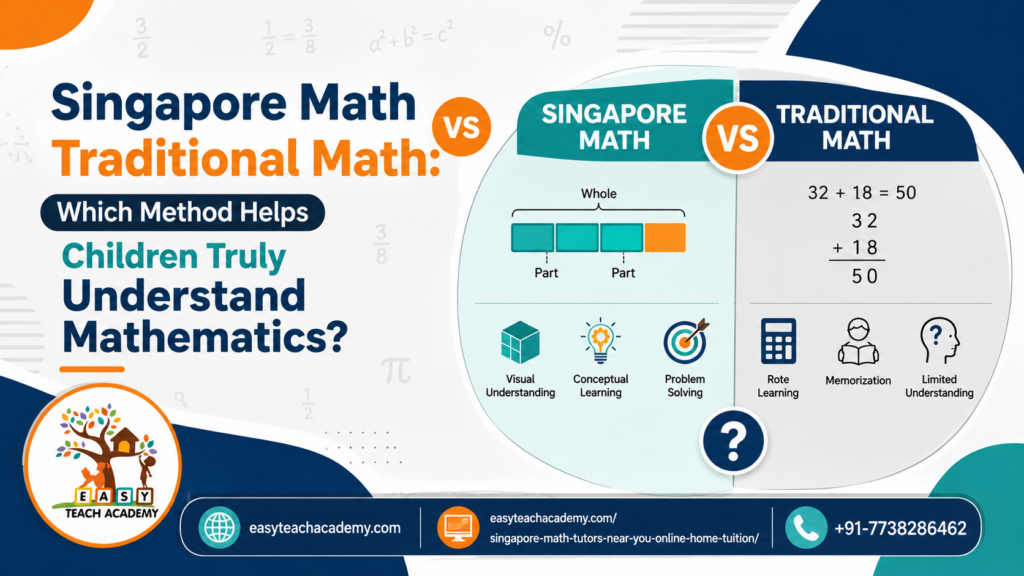
Comparing the Two Approaches
| Traditional Math | Singapore Math |
|---|---|
| Memorises procedures | Understands concepts |
| Repetition-based practice | Problem-solving based learning |
| One standard method | Multiple solution strategies |
| Focus on answers | Focus on reasoning |
| Teacher explains | Students explore and discuss |
| Formula first | Concept first |
| Individual topics | Connected mathematical ideas |
Neither approach is entirely right or wrong.
However, many parents appreciate Singapore Math because it encourages deeper understanding alongside skill development.
Which Children Benefit Most?
Different children learn in different ways.
Singapore Math is often a good choice for children who:
- Enjoy asking questions.
- Like solving puzzles.
- Learn well through pictures.
- Need stronger conceptual understanding.
- Want greater mathematical challenges.
- Prefer understanding rather than memorising.
Traditional approaches may suit children who enjoy structured practice and repetition, while many families choose Singapore Math to strengthen reasoning and problem-solving alongside school learning.
Why Parents Around the World Are Exploring Singapore Math
Families across the world are increasingly interested in concept-based mathematics.
Parents living in Singapore, Perth, Adelaide, Seattle, Chicago, Vancouver, and London are choosing Singapore Math Tutoring because they want children to become confident problem-solvers rather than simply successful test-takers.
Many parents also explore resources such as Singapore Math Workbooks, Math in Focus Singapore Math, or introductory Singapore Math Online Free materials before deciding to enrol in a structured programme with a qualified teacher.
From Kindergarten to Advanced Learning
One advantage of the Singapore Math approach is that it supports children through different stages of learning.
Many families begin with Singapore Math Kindergarten, where children build strong number sense through hands-on activities and visual learning.
As students grow older, they continue developing reasoning skills that can support school mathematics, enrichment programmes, and advanced challenges such as Math Camp Singapore or other mathematics enrichment opportunities.
Some families in Singapore may also be familiar with schools in areas such as RMSS Bishan, where strong academic foundations and disciplined learning environments are valued.
Preparing for Future Opportunities
Strong mathematical thinking supports success throughout education.
Many respected schools, including Raffles Institution, Hwa Chong Institution, and Raffles Girls’ School, are recognised for high academic standards.
Likewise, universities such as National University of Singapore, Nanyang Technological University, Monash University, Princeton University, University of British Columbia, and Imperial College London value students who can think analytically and solve problems effectively.
While admission depends on many factors, developing strong mathematical reasoning during childhood provides an excellent foundation for future academic success.
1. Teaching Style
Traditional Math
Lessons often begin with:
- A rule
- A formula
- A worked example
Students then practise similar questions until they become familiar with the method.
Singapore Math
Lessons usually begin with an idea.
Children first explore the concept using:
- Real objects
- Pictures
- Visual models
- Guided discussions
Only after understanding the concept do they move to mathematical symbols and equations.
This helps children understand why a method works before using it independently.
2. Learning Objectives
Traditional mathematics often focuses on:
- Accuracy
- Speed
- Practice
- Correct answers
Singapore Math aims to develop:
- Conceptual understanding
- Logical reasoning
- Problem-solving
- Mathematical communication
- Independent thinking
Instead of simply finishing exercises, children learn to explain their thinking.
3. Classroom Experience
Traditional Classroom
Students often:
- Listen to explanations.
- Copy examples.
- Complete worksheets.
- Practise similar questions.
Singapore Math Classroom
Students are encouraged to:
- Discuss ideas.
- Ask questions.
- Compare strategies.
- Solve practical problems.
- Explain solutions.
Learning becomes more interactive and engaging.
4. Word Problems
Word problems often cause difficulty because children may know how to calculate but struggle to decide which operation to use.
Traditional Approach
Students are usually taught to identify keywords.
Examples:
- Total
- Difference
- Altogether
- Left
Singapore Math Approach
Children learn to:
- Read carefully.
- Understand the situation.
- Organise information visually.
- Decide which mathematical strategy fits the problem.
This approach develops stronger reasoning rather than relying only on keywords.
5. Visual Learning
One of the biggest differences is the use of visual models.
Singapore Math regularly uses:
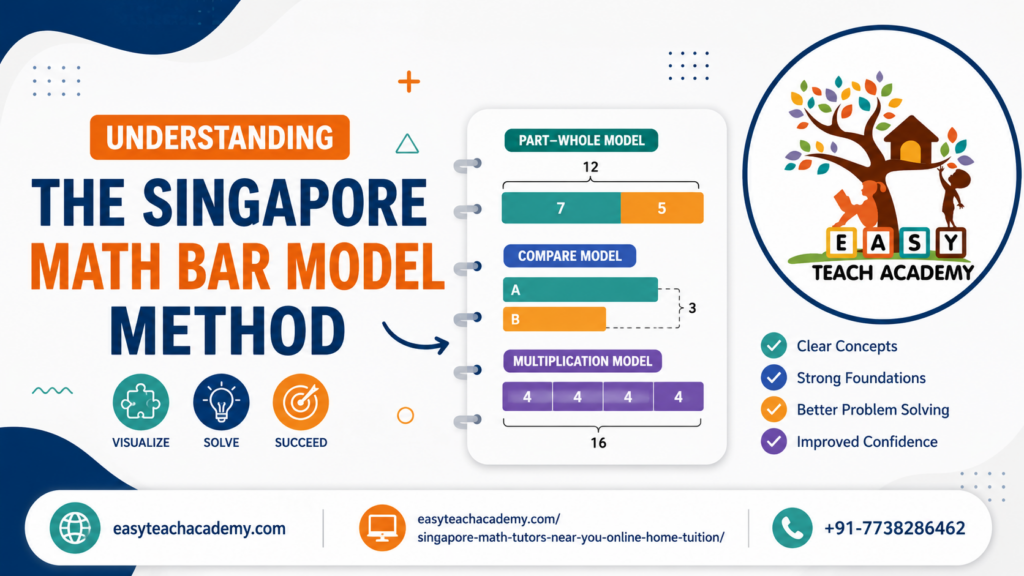
- Bar models
- Number bonds
- Number lines
- Place value charts
- Arrays
- Part-whole diagrams
These tools help children see mathematical relationships clearly.
Traditional programmes may use visuals, but Singapore Math places much greater emphasis on them throughout the learning journey.
6. Homework
Traditional Homework
Homework often includes:
- Repetitive practice
- Similar question types
- Procedure-based exercises
The purpose is to reinforce recently learned methods.
Singapore Math Homework
Homework typically encourages children to:
- Apply concepts.
- Solve unfamiliar questions.
- Explain answers.
- Compare different methods.
- Think critically.
This helps children transfer their understanding to new situations.
7. Assessments
Traditional assessments often focus on:
- Correct answers.
- Calculation speed.
- Following procedures accurately.
Singapore Math assessments frequently include questions that require students to:
- Explain reasoning.
- Solve multi-step problems.
- Apply concepts in unfamiliar contexts.
- Demonstrate understanding rather than recall.
8. Independent Thinking
Perhaps the greatest difference between the two approaches is how children are encouraged to think.
Traditional mathematics often teaches:
“Follow these steps.”
Singapore Math encourages children to ask:
- Why does this work?
- Is there another solution?
- Which method is more efficient?
- Can I explain my reasoning?
These habits help children become independent mathematical thinkers.
Comparison Table
| Feature | Traditional Math | Singapore Math |
|---|---|---|
| Main focus | Procedures | Concepts |
| Learning style | Practice first | Understanding first |
| Teaching method | Teacher-led | Interactive exploration |
| Visual learning | Limited | Extensive |
| Problem-solving | After learning rules | Throughout learning |
| Word problems | Often separate topic | Integrated into lessons |
| Student role | Follow methods | Explore ideas |
| Long-term goal | Accurate calculations | Deep mathematical understanding |
Common Misconceptions
“Singapore Math Is Only for Top Students”
Not true.
Children with different learning abilities can benefit from concept-based teaching when lessons are adapted to their needs.
“Traditional Math Doesn’t Teach Understanding”
Many schools include conceptual learning.
However, Singapore Math places a stronger and more consistent emphasis on building understanding before introducing abstract procedures.
“Online Learning Cannot Teach Singapore Math Effectively”
With live instruction, interactive discussion, visual teaching tools, and regular feedback, Singapore Math Tutoring can be highly effective in an online environment.
Many international families choose online learning because it provides access to experienced teachers regardless of where they live.
Why Parents Worldwide Are Making the Switch
Families living in Singapore, Perth, Adelaide, Seattle, Chicago, Vancouver, and London are increasingly choosing Singapore Mathematics because it supports long-term understanding alongside school learning.
Parents often begin with a Singapore Math Workbook or explore Singapore Math Online Free resources before enrolling in structured Singapore Math Tutoring. Others compare programmes such as Mathnasium Singapore and Math in Focus Singapore Math to find the learning approach that best matches their child’s needs.
Some families also consider enrichment opportunities such as Math Camp Singapore to further develop mathematical thinking beyond the regular curriculum.
“Will learning Singapore Math really benefit my child in the future?”
The answer is about much more than getting higher marks in school.
Singapore Math helps children develop skills that support success throughout their education and beyond.
Building Skills That Last Beyond Primary School
Mathematics is not only about numbers.
It is about learning how to think clearly and solve problems logically.
Children who study Singapore Mathematics often develop important lifelong skills such as:
- Logical reasoning
- Critical thinking
- Pattern recognition
- Analytical decision-making
- Independent learning
- Clear mathematical communication
- Creative problem-solving
These abilities are valuable in almost every subject and profession.
Strong Foundations Lead to Future Success
One of the biggest advantages of Singapore Math is that every new topic builds on previous understanding.
Instead of memorising isolated formulas, children learn how mathematical ideas connect.
For example:
- Number sense supports addition and subtraction.
- Addition leads naturally to multiplication.
- Multiplication helps children understand fractions.
- Fractions prepare students for decimals and percentages.
- Percentages become the foundation for algebra and higher mathematics.
This structured progression helps children feel prepared instead of overwhelmed as they move through school.
Supporting Different Learning Pathways
Every child has different goals.
Some children need help catching up.
Others need additional challenges beyond the school curriculum.
Singapore Math supports many different learning pathways, including:
School Support
Helping children better understand classroom mathematics.
Singapore Math Kindergarten
Building strong number sense before primary school begins.
Singapore Math Tutoring
Providing personalised guidance that matches each child’s learning pace.
Singapore Math Homeschool
Supporting families who choose home education with a structured curriculum.
Mathematics Enrichment
Helping curious learners explore mathematics more deeply through extension activities and advanced reasoning.
Preparing for International Education
Many families choose Singapore Math because it complements different international curricula.
Children studying in Singapore, Perth, Adelaide, Seattle, Chicago, Vancouver, and London often use Singapore Math alongside their local school curriculum to strengthen conceptual understanding and problem-solving skills.
Because the focus is on understanding rather than memorisation, students can apply these skills across different education systems.
Opportunities Beyond the Classroom
Strong mathematical thinking also supports participation in enrichment and extension programmes.
Many families explore opportunities such as:
- Math Camp Singapore
- School mathematics clubs
- Regional mathematics competitions
- Advanced enrichment programmes
Some parents also compare different learning resources, including Singapore Math Workbooks, Math in Focus Singapore Math, and programmes such as Mathnasium Singapore, before selecting the approach that best matches their child’s needs.
These resources can complement regular learning, but personalised guidance from an experienced teacher often helps children make more consistent progress.
Building Foundations for Higher Education
Strong mathematical reasoning benefits students throughout secondary school and university.
Many respected educational institutions value analytical thinking, problem-solving, and quantitative reasoning.
Parents often hope their children will one day study at universities such as:
- National University of Singapore
- Nanyang Technological University
- Monash University
- Princeton University
- Yale University
- University of British Columbia
- Imperial College London
Admission to these institutions depends on many factors, but strong mathematical understanding developed during childhood provides a valuable academic foundation.
About Me – Niral Devnath
Hello, I’m Niral Devnath, founder of Easy Teach Academy.
For more than 15 years, I have been teaching mathematics to children through live online classes.
During this time, I have worked with students from:
- Singapore
- Australia
- United States
- United Kingdom
- Norway
- India
- Other international communities
Over the years, I have taught children with different learning styles, abilities, and academic goals.
Some students needed help rebuilding their confidence.
Others wanted enrichment beyond the school curriculum.
Many simply wanted mathematics explained in a way that finally made sense.
My teaching philosophy is simple:
- Teach concepts before shortcuts.
- Encourage children to ask questions.
- Build logical thinking step by step.
- Make mathematics interesting and enjoyable.
- Help every child reach their full potential.
I believe every child can improve in mathematics when they receive patient guidance, structured lessons, and individual attention.
Why Parents Choose Easy Teach Academy
At Easy Teach Academy, we combine the strengths of Singapore Mathematics with personalised online teaching.
Our Singapore Math Tutoring programme helps children:
- Build strong conceptual understanding.
- Develop logical reasoning.
- Improve analytical thinking.
- Solve challenging problems independently.
- Gain confidence in mathematics.
Parents choose our classes because we provide:
- Live interactive online lessons.
- Small class sizes.
- Individual attention.
- Structured learning plans.
- Regular assessments.
- Progress reports for parents.
- Flexible class schedules for international students.
Whether you are searching for Singapore Math Tutoring, Singapore Math Kindergarten, or a trusted teacher to support your child’s learning, our goal is to provide personalised instruction that helps every student succeed.
Learn More About Our Singapore Math Programme
If you’re looking for a structured, engaging, and concept-based approach to mathematics, we’d be delighted to help your child begin that journey.
Singapore Math Programme
Visit Easy Teach Academy
Frequently Asked Questions, Parent Checklist, and Final Thoughts
After comparing Singapore Math with traditional mathematics, one thing becomes clear:
Both approaches aim to help children learn mathematics, but they take different paths.
Traditional mathematics often emphasises practising procedures and mastering standard methods.
Singapore Math places greater emphasis on understanding concepts, developing logical reasoning, and applying mathematical ideas to new situations.
The best choice depends on your child’s learning needs, goals, and the type of mathematical foundation you want them to build.
Before making your decision, let’s answer some common questions parents ask.
Frequently Asked Questions
Is Singapore Math Better Than Traditional Math?
There is no single method that is best for every child.
However, many parents choose Singapore Math because it focuses on conceptual understanding, visual learning, and problem-solving.
Children who enjoy understanding why mathematics works often benefit from this approach.
Can Singapore Math Be Used Alongside School Mathematics?
Yes.
Many families use Singapore Math as additional support alongside their child’s school curriculum.
The concepts learned through Singapore Math often help students understand classroom lessons more deeply.
Is Singapore Math Suitable for Beginners?
Absolutely.
Many children begin with Singapore Math Kindergarten, where they develop:
- Number sense
- Counting skills
- Pattern recognition
- Simple problem-solving
- Mathematical confidence
These early foundations help prepare children for primary school mathematics.
Will Singapore Math Help with Word Problems?
Yes.
Word problems are a major focus of Singapore Math.
Children learn how to:
- Understand the question.
- Identify important information.
- Use visual models.
- Choose suitable strategies.
- Explain their reasoning.
This approach helps children solve unfamiliar problems with greater confidence.
Can My Child Learn Singapore Math Online?
Yes.
Live online classes allow students to interact with experienced teachers, ask questions, receive personalised guidance, and learn from home.
Many international families now choose Singapore Math Tutoring through online classes because it combines flexibility with individual support.
Common Myths About Singapore Math
Myth 1: Singapore Math Is Only for High-Achieving Students
This is one of the biggest misconceptions.
Singapore Math can support:
- Children who need stronger foundations.
- Average learners.
- Advanced students.
- Gifted learners.
Lessons can be adapted to match each child’s learning pace.
Myth 2: Singapore Math Is Too Difficult
Singapore Math introduces concepts gradually.
Children first understand ideas using visual models and practical examples before working with abstract symbols.
This structured progression often makes learning feel more manageable.
Myth 3: A Singapore Math Workbook Is Enough
A Singapore Math Workbook provides useful practice, but many children benefit from guidance when learning new concepts.
An experienced teacher can:
- Explain difficult ideas.
- Correct misunderstandings.
- Encourage mathematical discussion.
- Adapt lessons to the child’s needs.
The combination of quality resources and effective teaching usually produces the best results.
Myth 4: Free Resources Can Replace Structured Learning
Many parents begin by exploring Singapore Math Online Free materials.
These resources can introduce concepts, but they often do not provide:
- Personal feedback.
- Lesson sequencing.
- Individual support.
- Progress monitoring.
A structured programme helps children build knowledge step by step.
Parent Decision Checklist
Before choosing a mathematics programme, ask yourself:
Teaching Quality
✔ Does the teacher explain concepts clearly?
✔ Does my child understand why methods work?
✔ Are visual learning strategies included?
Learning Experience
✔ Is my child encouraged to ask questions?
✔ Does the programme develop problem-solving skills?
✔ Is learning engaging and interactive?
Student Support
✔ Are lessons personalised?
✔ Will I receive regular progress updates?
✔ Are assessments used to guide improvement?
Long-Term Development
✔ Does the programme prepare my child for future learning?
✔ Will my child become a more independent thinker?
✔ Does it encourage confidence as well as academic progress?
If you answered “yes” to most of these questions, Singapore Math may be an excellent choice for your child.
Why Parents Around the World Continue Choosing Singapore Math
Families in Singapore, Perth, Adelaide, Seattle, Chicago, Vancouver, and London increasingly choose Singapore Mathematics because it develops understanding alongside calculation skills.
Parents also explore programmes such as Math in Focus Singapore Math, Mathnasium Singapore, Singapore Math Kindergarten, and Math Camp Singapore while deciding which learning environment best suits their child. Some families are also familiar with schools in areas such as RMSS Bishan, where strong academic foundations are highly valued.
Many parents hope their children will one day study at respected institutions such as National University of Singapore, Nanyang Technological University, Monash University, Princeton University, Yale University, University of British Columbia, and Imperial College London. While admission depends on many factors, strong mathematical reasoning provides an excellent foundation for future academic success.
About Me – Niral Devnath
Hello, I’m Niral Devnath, founder of Easy Teach Academy.
For over 15 years, I have helped children from Singapore, Australia, the United States, the United Kingdom, Norway, India, and many other countries build strong mathematical foundations through live online teaching.
Throughout my teaching journey, I have worked with students who:
- Needed extra support.
- Wanted enrichment beyond school.
- Were preparing for competitive mathematics.
- Simply wanted to enjoy learning maths again.
My teaching philosophy is based on four simple principles:
- Build understanding before memorisation.
- Encourage logical and independent thinking.
- Adapt lessons to every child’s learning style.
- Create a positive environment where children enjoy mathematics.
Watching students become confident learners is the most rewarding part of my work.
Why Families Choose Easy Teach Academy
At Easy Teach Academy, we believe mathematics should help children think, reason, and solve problems—not simply memorise formulas.
Our Singapore Math Tutoring programme offers:
- Live interactive online classes.
- Personalised learning plans.
- Small class sizes.
- Concept-based teaching.
- Regular assessments.
- Progress reports for parents.
- Flexible schedules for international students.
Whether your child is just beginning with Singapore Math Kindergarten, needs additional support through Singapore Math Tutoring, or is looking for enrichment beyond school, we provide structured lessons designed to help every student succeed.
Begin Your Child’s Singapore Math Journey
If you are looking for an experienced teacher who focuses on understanding, problem-solving, and long-term success, we would be delighted to help.
Explore Our Singapore Math Programme
Visit Easy Teach Academy
We proudly teach students from Singapore, Australia, United States, Canada, United Kingdom, India, and many other countries through live online Singapore Math classes.
Final Thoughts
The difference between Singapore Math and traditional mathematics is not simply the textbook.
It is the learning experience.
Singapore Math encourages children to understand concepts, recognise patterns, communicate their thinking, and solve unfamiliar problems with confidence.
When children understand mathematics instead of memorising it, they are better prepared for future learning, school challenges, and everyday problem-solving.
With the right guidance, consistent practice, and a supportive teacher, mathematics can become one of your child’s greatest strengths.
If you’re ready to give your child a deeper understanding of mathematics and a lifelong love of learning, Easy Teach Academy is here to support every step of that journey.