
The Secret Behind Singapore’s Maths Success
For decades, parents, educators, and researchers have admired one remarkable achievement: children in Singapore consistently demonstrate outstanding mathematical ability. Whether it is classroom performance or international assessments, Singapore has earned a reputation for producing students who think logically, solve complex problems confidently, and understand mathematics at a deep level.
Naturally, this success raises an important question:
What is the secret behind Singapore’s maths success?
Many people assume the answer is longer study hours, difficult homework, or stricter schools. While commitment certainly matters, these are not the main reasons children succeed.
The real secret lies in the way mathematics is taught.
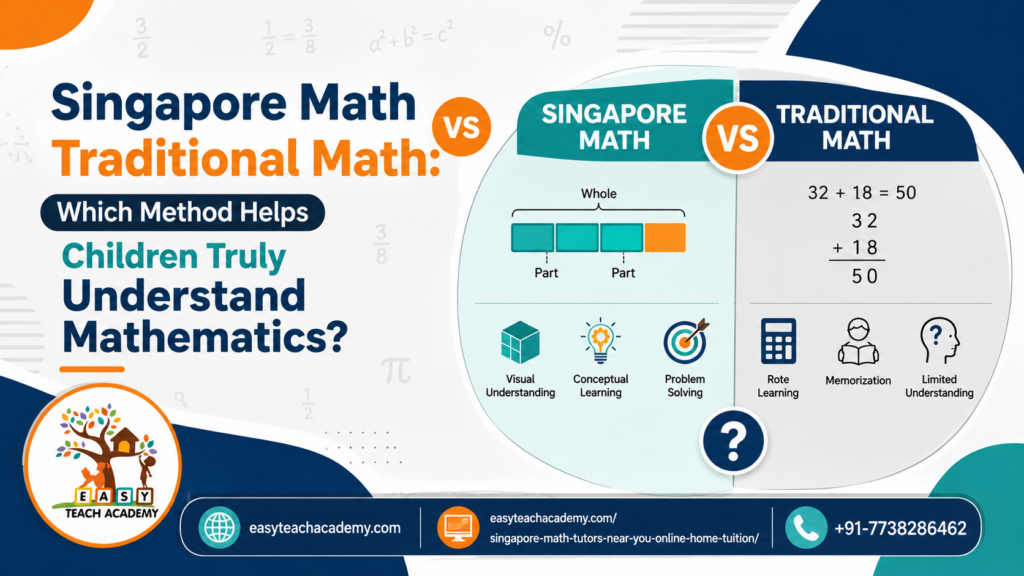
The Singapore Math approach focuses on understanding concepts before memorising procedures. Instead of asking children to remember dozens of formulas, it teaches them how numbers work, how mathematical ideas connect, and how to apply those ideas to solve real-life problems.
This educational philosophy has inspired schools across the world. Today, families in Australia, the United States, the United Kingdom, Canada, New Zealand, India, and many other countries actively search for experienced Singapore Math tutors and Online Singapore Math Classes because they want their children to benefit from this internationally respected method.
In this guide, you’ll discover why Singapore Math has become one of the world’s most successful mathematics programmes, how it develops confident learners, and how parents can help their children experience the same success.
Why Parents Are Choosing Singapore Math
Parents want more than high test scores. They want their children to become confident learners who enjoy solving problems rather than fearing them.
This is exactly what the Singapore Math curriculum aims to achieve.
Unlike approaches that rely heavily on memorisation, Singapore Math encourages children to understand ideas from the very beginning. Lessons are carefully sequenced so that each new topic builds naturally on previous knowledge.
Children learn not only what to do but also why it works.
As a result, they become more confident when tackling unfamiliar questions because they understand the underlying concepts instead of depending on memorised rules.
This confidence often extends beyond mathematics. Children become more willing to ask questions, think independently, and approach challenges with curiosity.
The Real Secret Is Conceptual Understanding
One of the defining characteristics of Singapore Math is its emphasis on conceptual understanding.
Imagine two children learning fractions.
The first memorises that multiplying fractions involves multiplying the numerators and denominators.
The second uses visual models to understand what fractions represent, how they relate to one another, and why multiplication changes the size of the quantities.
Months later, which child is more likely to solve an unfamiliar fraction problem successfully?
The second child.
That difference illustrates the philosophy behind the Singapore Math method.
Understanding creates flexibility.
Memorisation often creates dependency.
When children truly understand mathematical ideas, they can apply them in different situations instead of becoming confused whenever a question looks unfamiliar.
Mathematics Is a Language of Thinking
Many people view mathematics as a collection of numbers, formulas, and calculations.
The Singapore Math curriculum views mathematics differently.
It teaches mathematics as a way of thinking.
Students learn to:
- Analyse information carefully.
- Identify relationships between numbers.
- Explain their reasoning.
- Compare different solving strategies.
- Recognise patterns.
- Draw conclusions logically.
These skills are valuable far beyond the mathematics classroom.
They help children become stronger learners in science, technology, engineering, and many everyday situations that require careful decision-making.
Why Singapore Students Rarely Fear Word Problems
One of the biggest challenges for many children is solving word problems.
Traditional teaching sometimes introduces word problems only after students have memorised calculation methods.
The Singapore Math method takes a different path.
Children are encouraged to understand the story behind the numbers.
Instead of asking, “Which formula should I use?” they learn to ask:
- What information is important?
- What is the question asking?
- How are the numbers connected?
- Can I represent the problem visually?
- Does my answer make sense?
These questions transform word problems from confusing exercises into logical thinking activities.
This explains why Singapore Math problem solving has become one of the most respected educational approaches worldwide.
Learning Becomes Enjoyable
Children are naturally curious.
Unfortunately, repetitive drills and excessive memorisation can reduce that curiosity over time.
The Singapore Math curriculum keeps children engaged by encouraging exploration.
Students investigate different methods, discuss ideas with classmates, and discover patterns independently.
Teachers guide rather than simply provide answers.
When children experience the satisfaction of solving problems through their own reasoning, mathematics becomes rewarding instead of stressful.
Enjoyment plays an important role in long-term success because motivated learners are more likely to practise consistently and develop confidence.
Strong Foundations Lead to Long-Term Success
Building a strong mathematical foundation is similar to constructing a house.
A solid foundation supports everything built above it.
Weak foundations eventually create difficulties.
The Singapore Math approach ensures that children fully understand one concept before progressing to the next.
For example:
- Number recognition comes before addition.
- Addition is mastered before subtraction.
- Multiplication develops from repeated addition.
- Division grows from understanding equal sharing.
- Fractions are introduced visually before symbolic calculations.
- Algebra develops naturally from arithmetic patterns.
Because learning progresses in logical steps, children experience fewer gaps in understanding and greater confidence as topics become more advanced.
A Global Movement in Mathematics Education
The influence of Singapore Math now extends far beyond Singapore.
Schools, educational organisations, and parents across the world have embraced its teaching principles because they consistently produce confident, capable learners.
Families choose Singapore Math because it develops:
- Strong number sense.
- Logical reasoning.
- Critical thinking.
- Mathematical communication.
- Independent learning.
- Problem-solving confidence.
- Long-term academic success.
For parents, the goal is not simply better marks on the next test—it is helping children build skills they can use throughout their education and future careers.
The Secret Behind Singapore’s Maths Success: How the Singapore Math Method Helps Every Child Think Like a Problem Solver
In Part 1, we explored why Singapore Math has become one of the world’s most respected approaches to mathematics education. The real strength of the programme is not that children solve questions faster—it is that they understand mathematics more deeply.
Now, let’s explore the classroom methods that make this possible and why millions of parents trust the Singapore Math curriculum to help their children become confident learners.
The CPA Approach: The Foundation of Singapore Math
One of the biggest reasons behind the success of Singapore Math is the CPA Approach.
CPA stands for:
- Concrete
- Pictorial
- Abstract
Instead of asking children to memorise numbers immediately, teachers guide them through these three carefully planned stages. This progression helps students understand mathematical ideas before working with symbols and equations.
The result is a stronger foundation, fewer misconceptions, and greater confidence.
Stage 1: Concrete Learning – Understanding Through Real Objects
Children learn best when they can see, touch, and manipulate objects.
That is why every important mathematical idea begins with real materials.
Teachers may use:
- Counting cubes
- Coins
- Buttons
- Beads
- Blocks
- Measuring cups
- Fraction circles
- Place value discs
Imagine teaching the idea of subtraction.
Rather than writing:
15 − 7 = ?
Children first remove seven counters from a group of fifteen. They physically experience what subtraction means.
This hands-on learning creates understanding that is much stronger than simply memorising a procedure.
Young learners especially benefit because mathematics becomes something they can experience rather than something they must remember.
Stage 2: Pictorial Learning – Turning Ideas into Visual Thinking
After children understand a concept with physical objects, they move to drawings and visual representations.
Pictures become a bridge between real objects and mathematical symbols.
Teachers introduce:
- Number bonds
- Ten frames
- Arrays
- Place value charts
- Part-whole diagrams
- Singapore Math Bar Models
Instead of relying on memory, students learn to “see” mathematics.
Visual thinking allows children to organise information, recognise relationships, and solve increasingly complex questions.
Parents are often surprised by how much easier difficult topics become once children learn to represent them visually.
Stage 3: Abstract Learning – Using Mathematical Symbols with Confidence
Only after children understand concepts through concrete experiences and visual models do they begin solving problems using numbers and symbols alone.
For example, after working with counters and diagrams, a student confidently solves:
248 + 376 = ?
The numbers now have meaning because they represent ideas the child already understands.
This final stage develops fluency without sacrificing understanding.
Children no longer rely on guesswork because they know exactly why each mathematical operation works.
Why the CPA Approach Produces Better Learners
The Singapore Math method teaches children to build knowledge gradually.
Instead of rushing through topics, every lesson strengthens earlier learning.
This creates several long-term benefits:
- Better conceptual understanding.
- Stronger memory retention.
- Greater confidence.
- Improved problem-solving ability.
- Reduced mathematics anxiety.
- Increased independence.
Rather than asking children to memorise hundreds of isolated facts, the curriculum helps them build an interconnected understanding of mathematics.
The Singapore Math Bar Model: A Powerful Visual Strategy
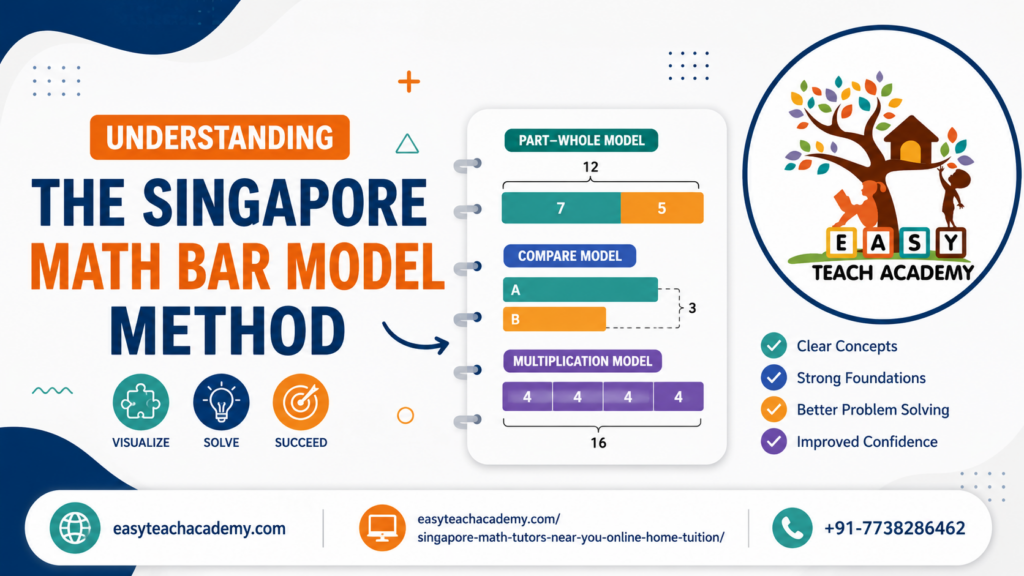
Perhaps the most recognised feature of Singapore Math is the Singapore Math Bar Model.
Parents often wonder why children spend time drawing rectangles instead of immediately calculating answers.
The reason is simple.
The bar model transforms complicated word problems into clear visual representations.
Instead of guessing which mathematical operation to use, students first draw relationships between quantities.
Once the relationships become visible, selecting the correct strategy becomes much easier.
Example: Solving an Addition Problem
Consider this question:
Emma has 35 storybooks.
Her grandmother gives her 18 more.
How many books does Emma have now?
Instead of immediately writing an equation, children draw two connected bars.
The picture helps them understand that both quantities should be combined.
This simple visual step reduces careless mistakes and builds confidence.
Example: Understanding Comparison Problems
Ryan has 64 marbles.
Lucas has 39 marbles.
How many more marbles does Ryan have?
Many children become confused by comparison questions.
The Singapore Math Bar Model clearly shows one quantity as longer than the other.
Students immediately recognise that they need to compare the difference instead of adding both numbers together.
Example: Multiplication Through Equal Groups
Suppose six baskets each contain eight apples.
Instead of memorising multiplication facts alone, children draw six equal bars.
They see multiplication as repeated equal groups rather than a mysterious calculation.
This deeper understanding becomes extremely valuable when students later study fractions, ratios, percentages, and algebra.
Developing Strong Number Sense
One of the hidden strengths of the Singapore Math curriculum is the emphasis on number sense.
Number sense means understanding how numbers behave and relate to one another.
Children learn to recognise patterns naturally.
For example, they quickly realise:
- 49 is one less than 50.
- 99 is almost 100.
- 75 can be broken into 50 + 25.
- 24 × 5 can become 12 × 10.
These flexible strategies make mental calculations easier and improve overall mathematical confidence.
Mental Mathematics Becomes Natural
Instead of depending immediately on written calculations, children develop efficient mental strategies.
Some common techniques include:
- Making tens.
- Doubling and halving.
- Compensation.
- Partitioning numbers.
- Using friendly numbers.
- Estimation.
These strategies improve calculation speed while strengthening understanding.
Students become comfortable thinking mathematically instead of relying on calculators for every question.
Teachers Encourage Thinking, Not Guessing
One major difference in Singapore Math classrooms is the type of questions teachers ask.
Instead of saying:
“What is the answer?”
Teachers often ask:
- Why did you choose that method?
- Can you explain your thinking?
- Is there another way to solve it?
- Which strategy is more efficient?
- How do you know your answer is correct?
These discussions help students develop reasoning skills and mathematical communication.
Children learn that mathematics is about understanding, not simply arriving at the correct answer.
Common Myths About Singapore Math
As Singapore Math becomes more popular worldwide, several misconceptions continue to circulate.
Myth 1: It Is Only for Gifted Children
This is incorrect.
The programme is designed for learners of different abilities. Strong conceptual teaching benefits both struggling learners and high-achieving students.
Myth 2: It Is Too Difficult
Parents often think the curriculum is harder because it encourages deeper thinking.
In reality, children usually find mathematics easier because concepts are introduced gradually and logically.
Myth 3: It Focuses Only on Exam Results
Although students often perform well in assessments, the primary goal of Singapore Math is understanding.
Children learn skills they can apply throughout their education rather than preparing only for a single examination.
Learning That Extends Beyond the Classroom
One reason parents appreciate Singapore Math is that children begin using mathematical thinking in everyday life.
They naturally estimate shopping costs, calculate time, compare prices, measure ingredients while cooking, and solve practical problems with greater confidence.
Mathematics becomes a useful life skill rather than just another school subject.
Why More Parents Are Choosing Online Singapore Math Classes
Families today value flexibility without compromising educational quality.
Online Singapore Math Classes allow children to learn from experienced teachers regardless of location.
Parents appreciate:
- Live interactive lessons.
- Small class sizes.
- Personalised attention.
- Structured learning plans.
- Regular progress updates.
- Flexible scheduling.
- Access to experienced Singapore Math tutors.
For many families, online learning has made high-quality mathematics education more accessible than ever before.
Why Parents Around the World Trust Singapore Math for Their Children’s Success
Mathematics Is About Confidence, Not Just Correct Answers
Many parents believe that becoming good at mathematics simply means getting the correct answer quickly. While accuracy is important, it is only one part of becoming a successful learner. A child who understands mathematical ideas will continue to grow, even when the questions become more challenging.
This is where Singapore Math stands apart. The goal is not to create children who can memorise formulas for an exam. Instead, the Singapore Math curriculum helps students become confident thinkers who know how to analyse problems, choose suitable strategies, and explain their reasoning.
Confidence is built through understanding. When children understand why a method works, they are far less likely to panic when they encounter a new type of question.
Over time, this confidence changes their attitude towards mathematics. Instead of saying, “Math is too difficult,” they begin saying, “Let me think about how to solve this.”
That shift in mindset is one of the greatest strengths of Singapore Math.
Why Some Children Struggle with Mathematics
Many children are capable of achieving excellent results but lose confidence because they miss one or two important concepts early in their learning journey.
For example, if a child does not fully understand place value, later topics such as addition with regrouping, subtraction, multiplication, and decimals become much more difficult.
Similarly, weak number sense often leads to confusion when solving fractions, percentages, ratios, and algebra.
The Singapore Math method addresses these issues by ensuring that children develop strong foundations before moving forward.
Instead of rushing through the syllabus, teachers identify learning gaps and strengthen them before introducing more advanced ideas.
This structured progression reduces frustration and helps children experience consistent success.
Common Mistakes Parents Make While Helping at Home
Parents naturally want to support their children’s education, but some common habits may unintentionally make mathematics more confusing.
Teaching Shortcuts Too Early
Many adults teach tricks because they seem faster.
However, shortcuts only become useful after children understand the underlying concepts.
The Singapore Math curriculum introduces efficient strategies at the appropriate stage of learning, ensuring that speed never replaces understanding.
Focusing Only on Correct Answers
Children benefit more when parents discuss their thinking instead of simply checking answers.
Useful questions include:
- Why did you choose this method?
- Can you explain your answer?
- Is there another way to solve the problem?
- Does your answer seem reasonable?
These conversations encourage mathematical reasoning and independent thinking.
Comparing Children with Others
Every child learns at a different pace.
Comparisons often reduce confidence and increase anxiety.
A better approach is to celebrate individual progress and encourage steady improvement.
The aim is continuous growth, not competition.
How Parents Can Build Mathematical Confidence Every Day
Helping children improve in mathematics does not require hours of extra homework.
Simple daily activities can strengthen important skills naturally.
Make Mathematics Part of Everyday Life
Children learn mathematics in practical situations such as:
- Shopping
- Cooking
- Measuring ingredients
- Reading clocks
- Planning journeys
- Managing pocket money
These experiences help children understand that mathematics is useful beyond the classroom.
Encourage Curiosity
Instead of immediately providing answers, encourage children to think independently.
Ask questions like:
- What do you notice?
- Can you draw a picture?
- What information is important?
- How could you check your answer?
These habits develop stronger problem-solving skills over time.
Celebrate Effort
Children become more confident when effort is recognised alongside achievement.
Persistence, curiosity, and careful thinking are just as valuable as obtaining the correct answer.
A positive learning environment encourages children to keep trying, even when they face challenging questions.
Why Online Singapore Math Classes Are Becoming Increasingly Popular
Families today have more educational choices than ever before.
Parents are no longer limited to finding tutors in their local neighbourhood.
Through Online Singapore Math Classes, children can learn from experienced teachers regardless of where they live.
Online lessons provide several advantages:
- Interactive live teaching
- Flexible class schedules
- Individual attention
- Personalised learning plans
- Digital resources
- Regular progress reports
- Comfortable learning from home
For busy families, online learning offers convenience without compromising educational quality.
Meet Your Teacher: Niral Devnath
Choosing the right teacher is just as important as choosing the right curriculum.
A great teacher does more than explain mathematical concepts. They inspire confidence, encourage curiosity, and help children enjoy learning.
Niral Devnath, the founder of Easy Teach Academy, has more than 15 years of teaching experience helping children strengthen their mathematical skills through structured, engaging, and concept-based learning.
Over the years, he has worked with students from Singapore, Australia, the United States, the United Kingdom, Norway, and several other countries, helping them improve their understanding of mathematics and develop greater confidence in solving problems.
His teaching philosophy is based on a simple belief:
Every child can succeed in mathematics when concepts are taught clearly, patiently, and systematically.
Rather than encouraging memorisation, lessons focus on helping students understand why mathematics works.
Students are guided to think independently, communicate their reasoning, and solve unfamiliar problems with confidence.
Why Families Choose Easy Teach Academy
At Easy Teach Academy, every lesson is designed to help children develop strong mathematical foundations through the proven Singapore Math approach.
Parents appreciate our focus on:
- Conceptual understanding
- Step-by-step learning
- Small class sizes
- Individual attention
- Interactive online lessons
- Regular assessments
- Continuous feedback
- Positive learning experiences
Whether a child needs additional support or advanced enrichment, lessons are adapted to match individual learning needs.
Our goal is not simply to improve examination scores but to help children become confident learners who enjoy mathematics.
Learn more about our Singapore Math Tutors and live online classes here:
Preparing Children for the Future with Singapore Math
The world your child will grow up in is changing faster than ever before. Advances in artificial intelligence, robotics, automation, data science, and digital technology are transforming how people work and solve problems. While computers can calculate answers in seconds, they cannot replace human creativity, logical reasoning, or critical thinking.
This is one of the biggest reasons why Singapore Math has become a preferred choice for parents around the world. It teaches children much more than arithmetic. It helps them become confident thinkers who can analyse information, evaluate different strategies, and solve unfamiliar problems independently.
The skills developed through the Singapore Math curriculum prepare children not only for school examinations but also for future careers where problem-solving and analytical thinking will be essential.
Why Singapore Math Is an Investment in Your Child’s Future
Education is one of the most valuable investments parents can make. A strong mathematical foundation opens doors to many academic and professional opportunities.
Children who develop logical thinking from an early age often find it easier to succeed in subjects such as:
- Science
- Technology
- Engineering
- Computer Programming
- Artificial Intelligence
- Data Analytics
- Economics
- Finance
- Architecture
- Business
Even students who choose careers outside these fields benefit from improved reasoning, organisation, and decision-making skills.
The Singapore Math method nurtures these lifelong abilities by encouraging children to understand concepts deeply instead of memorising isolated procedures.
How Singapore Math Builds Skills Beyond Mathematics
One of the greatest strengths of Singapore Math is that its benefits extend far beyond the mathematics classroom.
Children gradually develop important life skills, including:
Critical Thinking
Students learn to examine problems carefully before deciding on a solution.
Logical Reasoning
They understand how ideas connect rather than relying on memorised rules.
Communication Skills
Children explain their thinking clearly and confidently.
Perseverance
Challenging questions teach students to stay patient and continue exploring different approaches.
Independent Learning
Students become less dependent on constant guidance and more confident in solving problems on their own.
These qualities support success throughout school and later in professional life.
Why Parents Choose Easy Teach Academy
Finding the right teacher can make a significant difference in a child’s learning journey.
At Easy Teach Academy, we believe mathematics should inspire curiosity, confidence, and a love of learning.
Our Online Singapore Math Classes are designed to provide children with a structured, supportive, and engaging learning experience.
We focus on:
- Building conceptual understanding.
- Strengthening problem-solving skills.
- Developing strong number sense.
- Improving mathematical confidence.
- Encouraging independent thinking.
- Providing personalised guidance.
- Tracking student progress regularly.
Every lesson is interactive and carefully planned to meet each student’s learning needs.
Whether your child requires extra support or wishes to move ahead of the school curriculum, our goal is to help them achieve lasting success through the proven Singapore Math approach.
Why Learn with Niral Devnath?
Parents often ask what makes a teacher truly effective.
Experience matters, but so does the ability to connect with children and explain concepts in a simple, engaging way.
I am Niral Devnath, founder of Easy Teach Academy, and for more than 15 years, I have been helping children build confidence in mathematics through concept-based teaching.
Over the years, I have worked with students from Singapore, Australia, the United States, the United Kingdom, Norway, and other countries. Teaching children from different educational systems has given me valuable insight into how to adapt lessons to individual learning styles while maintaining the core principles of the Singapore Math curriculum.
My teaching philosophy is built on four simple principles:
- Every child has the ability to succeed in mathematics.
- Understanding is always more important than memorisation.
- Confidence grows through consistent guidance and practice.
- Learning should be enjoyable, interactive, and meaningful.
My lessons encourage students to ask questions, think independently, and discover solutions instead of simply copying methods. This helps children become confident learners who can apply mathematical thinking in many different situations.
Success Begins with the Right Learning Environment
Children learn best when they feel encouraged, supported, and comfortable making mistakes.
At Easy Teach Academy, every lesson aims to create a positive environment where students are free to explore ideas, ask questions, and build confidence at their own pace.
Parents regularly tell us that their children become more enthusiastic about mathematics after experiencing structured Singapore Math tuition that focuses on understanding instead of pressure.
Small improvements each week often lead to remarkable long-term progress.
Frequently Asked Questions
What makes Singapore Math different from other maths programmes?
The Singapore Math method focuses on conceptual understanding, visual learning, logical reasoning, and structured problem-solving rather than memorising procedures. Children learn why mathematical ideas work before applying them to increasingly challenging problems.
Is Singapore Math suitable for all children?
Yes. The Singapore Math curriculum can support children with different learning styles and ability levels. Lessons can be adapted for students who need additional support as well as those seeking advanced enrichment.
Can my child learn Singapore Math online?
Absolutely. Live Online Singapore Math Classes provide interactive instruction, personalised guidance, regular feedback, and flexible scheduling, allowing students to learn effectively from home.
At what age should children start Singapore Math?
Many children begin developing the skills used in Singapore Math during their primary school years. Starting early helps build strong number sense and confidence before more advanced topics are introduced.
Will Singapore Math help improve school performance?
A strong understanding of mathematical concepts often helps students perform better across many national and international curricula. The emphasis on reasoning and problem-solving can support success in classroom learning and assessments.
How can I support my child’s learning at home?
Create opportunities for your child to apply mathematics in everyday situations, encourage them to explain their thinking, and praise persistence as well as correct answers. These habits complement the Singapore Math approach and strengthen long-term understanding.
Final Thoughts
The secret behind Singapore’s success in mathematics is not hidden in complicated formulas or endless practice. It lies in a carefully designed teaching philosophy that values understanding, curiosity, and logical thinking.
The Singapore Math curriculum demonstrates that children achieve more when they truly understand concepts instead of simply memorising procedures. By developing strong number sense, visual reasoning, and problem-solving skills, students gain the confidence to tackle increasingly complex challenges.
Whether your child is currently struggling with mathematics, performing well and seeking enrichment, or simply looking for a stronger foundation, Singapore Math offers a structured pathway to lasting success.
Give Your Child the Confidence to Excel in Mathematics
Every child deserves the opportunity to enjoy learning mathematics and develop the confidence to solve problems independently.
At Easy Teach Academy, we are committed to helping students build these skills through engaging, interactive, and personalised Online Singapore Math Classes.
If you would like your child to experience the proven benefits of the Singapore Math approach, we would be delighted to support their learning journey.
Why Choose Easy Teach Academy?
✔ Experienced teacher with 15+ years of teaching experience.
✔ Live online classes with personalised attention.
✔ Step-by-step teaching based on the Singapore Math curriculum.
✔ Strong focus on conceptual understanding and problem-solving.
✔ Regular progress assessments and parent feedback.
✔ Flexible class schedules for students from different countries.
Book a Free Consultation or Learn More
Visit our Singapore Math page to explore our programmes and see how we can help your child develop strong mathematical skills:

The explanation of the Singapore Math approach is very clear and easy to understand. I especially liked the section on conceptual learning instead of memorization.